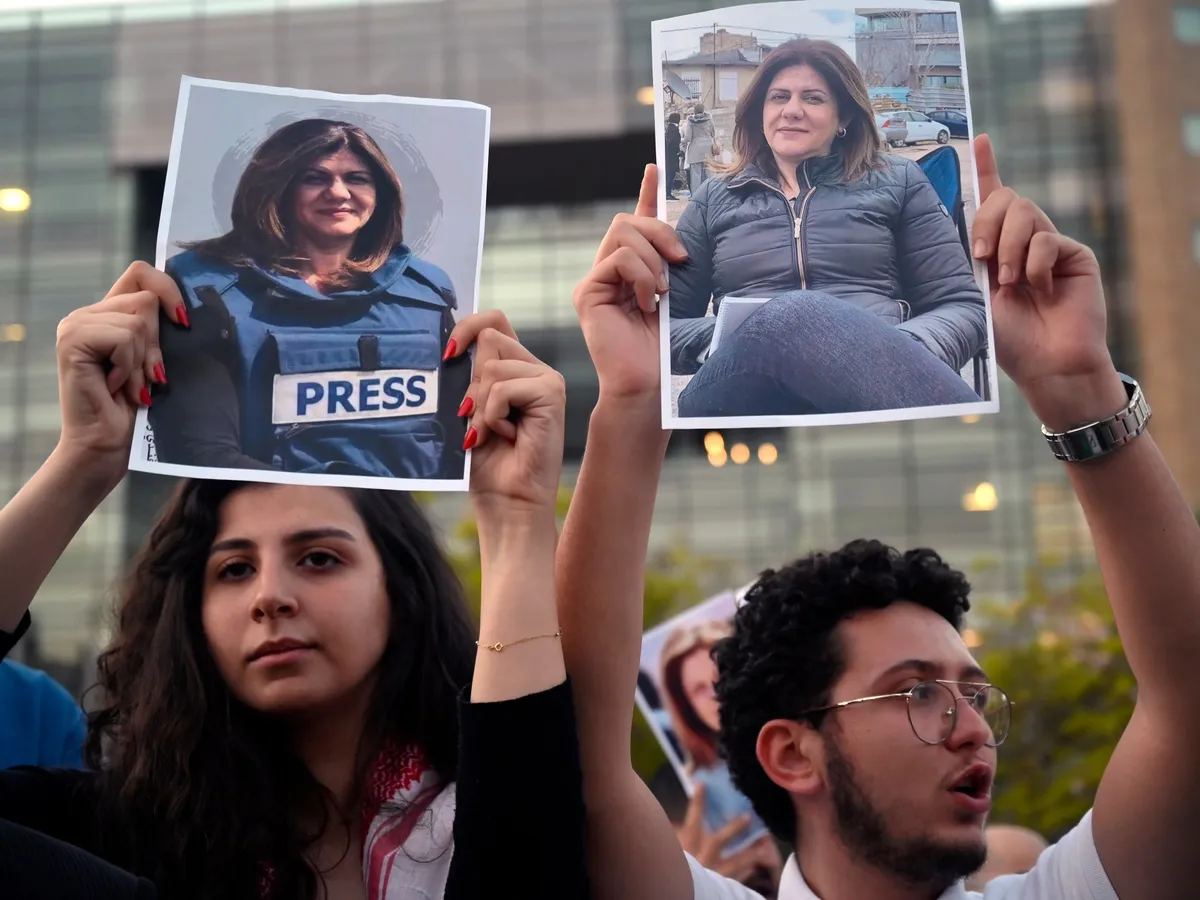
ESSAYShireen’s killing was meant to scare Palestinians into silence. Instead, it has inspired many young Palestinians to speak up.Lebanese and Palestinian activists carry posters of journalist Shireen Abu Akleh during a protest against her killing in Jenin, in front of the headquarters of the UN's ESCWA in Beirut, Lebanon, on May 12, 2022 [Wael Hamzeh/EPA]Published On 11 May 2026I can’t remember a time in my childhood when I didn’t hear Shireen Abu Akleh’s voice. She was one of the few constants in our ever-shifting landscape, an icon that anchored the Palestinian cause firmly in the Arab conscience.She started reporting on the most important events in Palestine even before I was born. She documented the second Intifada and the battle for Jenin in 2002. In 2005, she became the first Arab journalist to gain access to the Ashqelon prison to interview Palestinian prisoners held there for years.I still vividly recall listening to Shireen during the 2014 war on Gaza. I was just 12 years old, but I was watching the news regularly. I was waiting for Shireen in front of the TV at the top of every hour, eager to hear what she would say. Was a ceasefire coming? Did Israel face pressure to stop bombing us?Even though her voice carried the anguish of what was going on in Gaza, her presence on screen projected hope and resilience.Shireen was loved and respected by all Palestinians, regardless of their faith or political affiliation. Her courage, moral clarity, and commitment to making the voices of the Palestinian people heard were awe-inspiring.And so, when on May 11, 2022, news of her killing arrived, it was a devastating shock for us. We soon saw the footage: Shireen lying on the ground, journalist Shatha Hanaysha by her side, and someone behind the camera desperately shouting for an ambulance. Israeli fire hampered rescue efforts, leaving Shireen bleeding on the ground as colleagues were unable to pull her to safety.The assassination in broad daylight of one of Palestine’s top journalists was not just a shocking crime. It was a harbinger of what was to come.A year and a half later, Israel began a campaign of systematic targeting of Palestinian journalists in Gaza. As of today, at least 260 media workers have been killed. Israel is now recognised as the “biggest killer of journalists”.But the assassinations of Shireen and other journalists – like Anas al-Sharif, Fadi al-Wahidi and Mariam Abu Daqqa – have not had the silencing effect Israel had hoped for. The deaths of these heroes did not scare young people into inaction; instead, they motivated them to pick up the camera, the microphone and the pen and continue their work.I am one of them. Shireen’s assassination changed something deep within me.At that time, I was a student of English literature, deeply immersed in the power of language and storytelling. However, Shireen’s killing made me shift my focus from literary fiction to the real world.I realised that while literature preserves our culture, journalism defends our present truth. I didn’t just want to write; I wanted to report, to bear witness. I wanted to be like Shireen.So I started enrolling in journalism classes within my faculty, trying to develop new skills. The genocide, which made journalism a deadly profession in Gaza, paradoxically launched my journalistic career.As a resident of Gaza City, I became a firsthand witness to the horrors that rained down on the north. I survived numerous Israeli attacks and was forced to flee with my family multiple times.I started journaling about the experience of genocide. I often thought of Shireen, wondering what she would have said in the face of the atrocities we faced that seemed beyond human comprehension. I knew she watched us from above and wept. The world seemed deaf and blind to the mass death of Palestinians.But then I remembered her words: “I chose journalism to be close to the people. It might not be easy to change reality, but at least I was able to bring that voice to the world.” This was her hidden message to young people like me: to be a journalist means to speak up even when the rest of the world does not want to hear.And so I started writing about the situation in northern Gaza, where I stayed through several sieges and a famine.Due to the internet blackout, I could not connect to the rest of the world for the longest time. Finally, after the temporary truce in January 2025 was announced, some connectivity was restored. I was able to publish my first piece, titled “Surviving war in north Gaza”, documenting the harrowing, untold details of life and death I had witnessed.I felt pride and satisfaction that I had finally broken the siege of silence. But for my family, this achievement brought a deep-seated fear. They were afraid that I too could become a target.Nevertheless, I kept on writing even when Israel was killing journalists every week, even when the world did not move to stop it.Today, we are supposed to have a “ceasefire”, but the murders of journalists have not ceased. Just last month, Israel killed Mohammed Wishah, who worked as a correspondent for Al Jazeera Mubasher.Yet, there are still so many of us, young people, who insist on writing, documenting, and screaming through our words in the face of horror and injustice. We have picked up the torch from Shireen, and we carry it forward.Palestine will not be silenced.
SRCAl Jazeera
LANGEN
LEANCenter
WORDS904
ENT12
MON · 2026-05-11 · 10:30 GMTBRIEF NSR-2026-0511-75299
NSR-2026-0511-75299Opinion·EN·Human Interest
Picking up the torch from Shireen Abu Akleh
Shireen Abu Akleh, a prominent Palestinian journalist, was killed on May 11, 2022, while reporting in Jenin. Her death, which occurred amidst Israeli fire that reportedly hampered rescue efforts, was a significant loss for the Palestinian cause.
Nour Abo AishaAl JazeeraFiled 2026-05-11 · 10:30 GMTLean · CenterRead · 4 min
Al JazeeraFIG 01
Reading time
4min
Word count
904words
Sources cited
0cited
Entities identified
12entities
Quality score
100%
§ 01
Briefing Summary
AI-generatedNEWSAR · AI
Shireen Abu Akleh, a prominent Palestinian journalist, was killed on May 11, 2022, while reporting in Jenin. Her death, which occurred amidst Israeli fire that reportedly hampered rescue efforts, was a significant loss for the Palestinian cause. Despite the intention to silence Palestinian voices, her killing and the subsequent deaths of numerous other journalists in Gaza have instead inspired many young Palestinians to speak up. The article highlights Abu Akleh's long career documenting key events and her respected status among Palestinians. Her assassination is presented as a precursor to a broader pattern of targeting Palestinian journalists, with Israel now recognized as a major perpetrator of journalist killings.
Confidence 0.90Claims 5Entities 12
§ 02
Article analysis
Model · rule-basedFraming
Human Interest
Social Justice
Tone
Mixed Tone
AI-assessed
CalmNeutralAlarmist
Factuality
0.30 / 1.00
Opinion-Heavy
LowHigh
Sources cited
0
No named sources
FewMany
§ 03
Key claims
5 extracted01
The author shifted focus from literary fiction to journalism after Shireen Abu Akleh's assassination.
factualauthor
Confidence
1.00
02
Shireen Abu Akleh documented significant events in Palestine, including the second Intifada and the battle for Jenin in 2002.
factual
Confidence
0.90
03
Shireen Abu Akleh's killing was intended to silence Palestinians but instead inspired young Palestinians to speak up.
factual
Confidence
0.80
04
As of the article's publication, at least 260 media workers have been killed in Gaza.
statistic
Confidence
0.70
05
Israel is recognized as the 'biggest killer of journalists'.
factual
Confidence
0.60
§ 04
Full report
4 min read · 904 words§ 05
Entities
12 identifiedKey playerOppositionContextPositiveNeutralNegative
People4
Organizations2
§ 06
Keywords & salience
8 termsshireen abu akleh
1.00
palestinian journalists
0.90
killing of journalists
0.80
gaza
0.70
palestinian cause
0.60
jenin
0.60
resilience
0.50
activism
0.40
§ 07
Topic connections
Interactive graph No topic relationship data available yet. This graph will appear once topic relationships have been computed.