NEWSAR
Multi-perspective news intelligence
SRCAssociated Press (AP)
LANGEN
LEANCenter
WORDS1 211
ENT10
MON · 2026-05-11 · 22:23 GMTBRIEF NSR-2026-0512-75448
News/Supreme Court halts order for Alabama to use US House map wi…
NSR-2026-0512-75448News Report·EN·Political Strategy

Supreme Court halts order for Alabama to use US House map with 2 largely Black districts

The U.S. Supreme Court has halted a lower court order requiring Alabama to use a congressional map with two majority-Black districts.
Associated Press (AP)Filed 2026-05-11 · 22:23 GMTLean · CenterRead · 5 min
Supreme Court halts order for Alabama to use US House map with 2 largely Black districts
Associated Press (AP)FIG 01
Reading time
5min
Word count
1 211words
Sources cited
1cited
Entities identified
10entities
Quality score
100%
§ 01

Briefing Summary

AI-generated
NEWSAR · AI

The U.S. Supreme Court has halted a lower court order requiring Alabama to use a congressional map with two majority-Black districts. This decision allows Alabama to potentially revert to a map approved by its Republican legislature, which features only one such district. The Supreme Court cited its recent ruling striking down a similar map in Louisiana as unconstitutional racial gerrymandering. This move could enable Republicans to gain an additional House seat. Alabama officials had already prepared for this possibility by enacting a law to void primary results and hold new elections under revised boundaries. Justice Sotomayor dissented, arguing the Louisiana case did not fully resolve the Alabama case's grounds for a Voting Rights Act violation.

Confidence 0.90Sources 1Claims 5Entities 10
§ 02

Article analysis

Model · rule-based
Framing
Political Strategy
Legal & Judicial
Tone
Measured
AI-assessed
CalmNeutralAlarmist
Factuality
0.90 / 1.00
Factual
LowHigh
Sources cited
1
Limited
FewMany
§ 03

Key claims

5 extracted
01

Alabama enacted a law allowing it to void primary results and hold a new primary under revised district boundaries.

factual
Confidence
1.00
02

Justice Sonia Sotomayor dissented, stating a lower court could still find Alabama intentionally discriminated against Black voters under the 14th Amendment.

quoteJustice Sonia Sotomayor
Confidence
1.00
03

Alabama officials pointed to a Louisiana case striking down a majority-Black district as reason for the Supreme Court to end the judicial order.

factualAlabama officials
Confidence
1.00
04

The U.S. Supreme Court halted an order for Alabama to use a House map with two largely Black districts.

factual
Confidence
1.00
05

The decision could allow Republicans to gain an additional U.S. House seat.

prediction
Confidence
0.80
§ 04

Full report

5 min read · 1 211 words
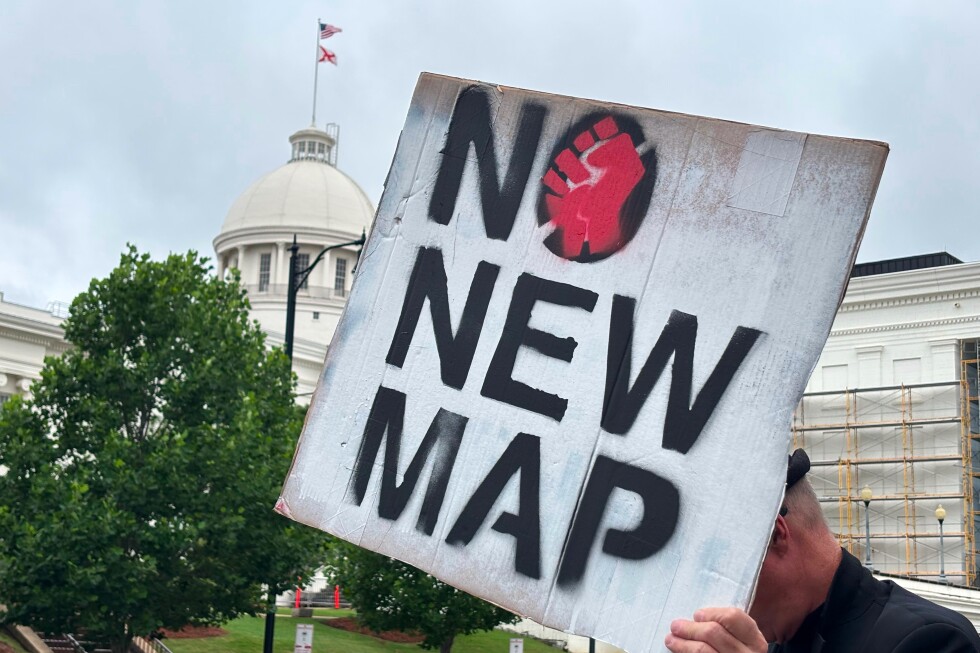
A demonstrator holds up a sign outside the Alabama Statehouse in Montgomery, Ala., on Thursday, May, 7 2026. (AP Photo/Kim Chandler) 2026-05-11T22:01:53Z WASHINGTON (AP) — The U.S. Supreme Court on Monday set the stage for Alabama to get rid of one of two largely Black congressional districts before this year’s midterm elections, creating an opening for Republicans to gain an additional U.S. House seat in a partisan battle for control of the closely divided chamber. The decision follows a Supreme Court ruling in April that struck down a majority-Black U.S. House district in Louisiana as an unconstitutional racial gerrymander, significantly weakening a provision of the federal Voting Rights Act. Alabama officials had pointed to the Louisiana case as reason for the Supreme Court to end a judicial order to use a court-imposed House map until after the 2030 census. The high court overturned that order and directed a lower court to reconsider the case in light of the Louisiana decision. That could free the state to instead use a map approved in 2023 by the Republican-led legislature that includes only one district where Black residents comprise a majority. freestar.queue.push(function () { window.fsAdCount = window.fsAdCount + 1 || 0; let customChannel = '/dynamic_' + fsAdCount; let adList = document.querySelectorAll(".fs-feed-ad") let thisAd = adList[fsAdCount]; let randId = Math.random().toString(36).slice(2); thisAd.id = randId; let thisPlacement = fsAdCount == 0 ? "apnews_story_feed" : "apnews_story_feed_dynamic"; freestar.newAdSlots({ placementName: thisPlacement, slotId: randId }, customChannel); }); Anticipating a court reversal, Alabama officials recently enacted a law allowing it to void the results of a May 19 primary for some congressional districts and instead hold a new primary under the revised district boundaries. It’s up to Republican Gov. Kay Ivey to set a date for a special primary election, though it must occur by August. In a dissent to Monday’s brief ruling, Justice Sonia Sotomayor said the Louisiana case had reversed only one of the grounds upon which the Alabama case had been decided. Although the Voting Rights Act violation is gone, Sotomayor said a lower court could still find that Alabama had intentionally discriminated against Black voters in violation of the 14th Amendment. /* Desktop-first: fully collapse by default */ #ap-readmore-embed { display: none; margin: 0; padding: 0; height: 0; min-height: 0; overflow: hidden; text-align: center; position: relative; z-index: 2; } /* Only show on mobile */ @media (max-width: 767px) { #ap-readmore-embed { display: block; margin: 28px 0; height: auto; overflow: visible; } } #ap-readmore-embed .ap-readmore-btn { appearance: none; -webkit-appearance: none; border: 0; background: #000; color: #fff; cursor: pointer; display: inline-flex; align-items: center; justify-content: center; gap: 10px; padding: 14px 22px; border-radius: 999px; font-family: inherit, "AP Sans", -apple-system, BlinkMacSystemFont, "Helvetica Neue", Arial, sans-serif; font-weight: 700; font-size: 16px; letter-spacing: 0.2px; line-height: 1; box-shadow: 0 10px 18px rgba(0,0,0,0.12); transition: transform 120ms ease, box-shadow 120ms ease, opacity 120ms ease; touch-action: manipulation; -webkit-tap-highlight-color: transparent; position: relative; z-index: 3; } #ap-readmore-embed .ap-readmore-btn:hover { transform: translateY(-1px); box-shadow: 0 14px 22px rgba(0,0,0,0.16); } #ap-readmore-embed .ap-readmore-btn:active { transform: translateY(0); box-shadow: 0 10px 18px rgba(0,0,0,0.12); opacity: 0.95; } #ap-readmore-embed .ap-readmore-btn:focus-visible { outline: 3px solid rgba(228, 0, 43, 0.35); outline-offset: 3px; } #ap-readmore-embed .ap-readmore-icon { width: 10px; height: 10px; border-right: 2px solid currentColor; border-bottom: 2px solid currentColor; transform: rotate(45deg); margin-top: -2px; } #ap-readmore-embed .ap-readmore-fade { display: none; height: 48px; margin-top: -48px; pointer-events: none; background: linear-gradient(to bottom, rgba(255,255,255,0), rgba(255,255,255,1)); } Read More (function () { var APRM_EMBED_ID = "ap-readmore-embed"; var APRM_MOBILE_MQ = "(max-width: 767px)"; function APRM_onReady(fn) { if (document.readyState === "loading") { document.addEventListener("DOMContentLoaded", fn); } else { fn(); } } APRM_onReady(function () { var APRM_embedEl = document.getElementById(APRM_EMBED_ID); if (!APRM_embedEl) return; // 🚨 DESKTOP: remove entire module wrapper and bail early if (!window.matchMedia(APRM_MOBILE_MQ).matches) { var APRM_rootModule = APRM_embedEl.closest(".HTMLModuleEnhancement") || APRM_embedEl.closest(".HtmlModule"); if (APRM_rootModule && APRM_rootModule.parentNode) { APRM_rootModule.parentNode.removeChild(APRM_rootModule); } else if (APRM_embedEl.parentNode) { APRM_embedEl.parentNode.removeChild(APRM_embedEl); } return; // stop the rest of the script from running } }); })(); (function () { var EMBED_ID = "ap-readmore-embed"; var BTN_ID = "apReadMoreBtn"; var FADE_ID = "apReadMoreFade"; var STOP_SELECTOR = ".Page-below"; var SIGN_IN_GATE_SELECTOR = ".sign-in-gate-content"; var HIDDEN_ATTR = "data-ap-readmore-hidden"; var MOBILE_MQ = "(max-width: 767px)"; function ready(fn) { if (document.readyState === "loading") { document.addEventListener("DOMContentLoaded", fn); } else { fn(); } } function isElementNode(n) { return n && n.nodeType === 1; } function cancelEvent(e) { if (!e) return; if (typeof e.preventDefault === "function") e.preventDefault(); if (typeof e.stopPropagation === "function") e.stopPropagation(); if (typeof e.stopImmediatePropagation === "function") e.stopImmediatePropagation(); e.cancelBubble = true; e.returnValue = false; } function collapseDesktopEmbed(embed) { if (!embed) return true; if (!window.matchMedia(MOBILE_MQ).matches) { var maybeWrappers = [ embed.parentElement, embed.closest(".html-embed"), embed.closest("[data-type='htmlembed']"), embed.closest("[class*='embed']"), embed.closest("[class*='Embed']") ].filter(Boolean); embed.style.display = "none"; embed.style.margin = "0"; embed.style.padding = "0"; embed.style.height = "0"; embed.style.minHeight = "0"; embed.style.overflow = "hidden"; maybeWrappers.forEach(function (el) { el.style.margin = "0"; el.style.padding = "0"; el.style.height = "0"; el.style.minHeight = "0"; el.style.overflow = "hidden"; }); if (embed.parentNode) { embed.parentNode.removeChild(embed); } return true; } return false; } ready(function () { var embed = document.getElementById(EMBED_ID); var btn = document.getElementById(BTN_ID); var fade = document.getElementById(FADE_ID); if (!embed || !btn) return; if (collapseDesktopEmbed(embed)) return; var signInGate = document.querySelector(SIGN_IN_GATE_SELECTOR); if (signInGate) { embed.innerHTML = ""; return; } // — Analytics: impression when embed enters viewport — if ("IntersectionObserver" in window) { var io = new IntersectionObserver(function (entries, observer) { if (entries[0].isIntersecting) { window.dataLayer = window.dataLayer || []; window.dataLayer.push({ event: "ap_readmore_impression" }); observer.disconnect(); } }, { threshold: 0 }); io.observe(btn); } var stopEl = document.querySelector(STOP_SELECTOR); if (!stopEl) return; var rootCandidates = [ embed.closest(".Page"), embed.closest("article"), embed.closest("main"), document.body ].filter(Boolean); var root = rootCandidates.find(function (c) { return c.contains(stopEl); }) || document.body; var all = root.getElementsByTagName("*"); var hidden = []; for (var i = 0; i Alabama is one of several states trying to change their congressional district boundaries before the November elections as part of a nationwide redistricting battle being won, so far, by Republicans. freestar.queue.push(function () { window.fsAdCount = window.fsAdCount + 1 || 0; let customChannel = '/dynamic_' + fsAdCount; let adList = document.querySelectorAll(".fs-feed-ad") let thisAd = adList[fsAdCount]; let randId = Math.random().toString(36).slice(2); thisAd.id = randId; let thisPlacement = fsAdCount == 0 ? "apnews_story_feed" : "apnews_story_feed_dynamic"; freestar.newAdSlots({ placementName: thisPlacement, slotId: randId }, customChannel); }); Voting districts typically are redrawn once a decade, immediately after a census, to account for population changes. But President Donald Trump urged Texas Republicans last year to redraw congressional districts to their advantage in a bid to hold onto a narrow House majority in the midterm elections. Democrats in California countered with their own redistricting. And numerous Republican-led states have followed. The high court’s Louisiana ruling provided fuel for Republicans to intensify their redistricting efforts. So far, Republicans think they could win as many as 14 additional seats in the November elections from new districts enacted in Texas, Missouri, North Carolina, Ohio, Florida and Tennessee. Democrats think they could win up to six additional seats from new districts in California and Utah. But Democrats suffered a major setback when the Virginia Supreme Cour t overturned a voter-approved redistricting amendment that could have yielded four more seats for the party. ___ Lieb reported from Jefferson City, Missouri. DAVID A. LIEB Lieb covers issues and trends in state governments across the U.S. He’s reported about government and politics for The Associated Press for 30 years. twitter mailto MARK SHERMAN Sherman has covered the Supreme Court for The Associated Press since 2006. His journalism career spans five decades. He is based in Washington, D.C., and previously lived in New York, Paris and Atlanta. twitter mailto
§ 05

Entities

10 identified
§ 06

Keywords & salience

10 terms
voting rights act
1.00
supreme court
0.90
racial gerrymander
0.90
black voters
0.80
congressional districts
0.80
alabama
0.70
u.s. house map
0.70
14th amendment
0.60
partisan battle
0.50
midterm elections
0.40
§ 07

Topic connections

Interactive graph
Network visualization showing 26 related topics
View Full Graph
Person Organization Location Event|Click node to navigate|Edge numbers = shared articles