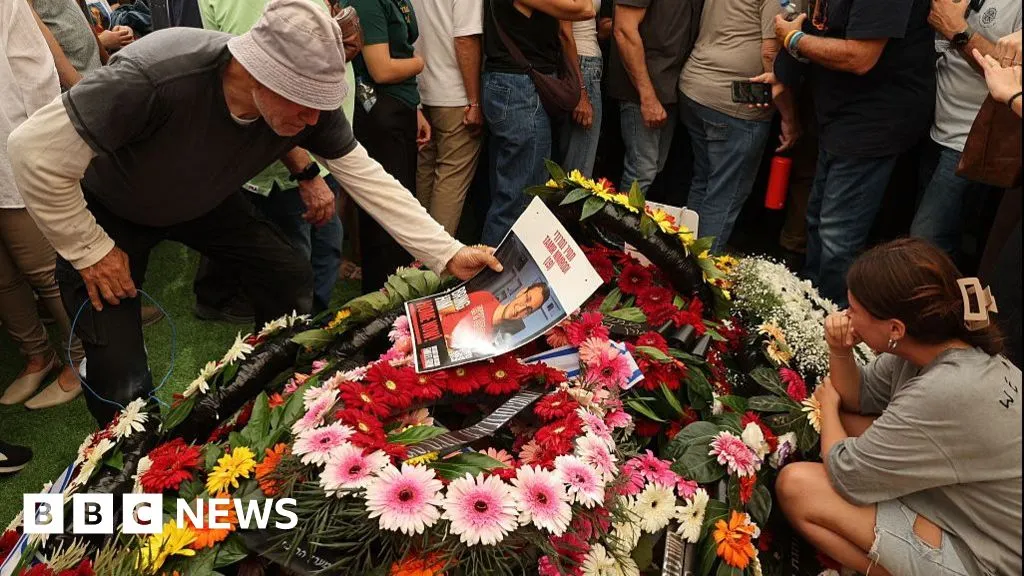
The events triggered the deadliest ever war in Gaza, with 72,740 people killed to date - the majority children, women and the elderly, according to the Hamas-run Health Ministry.Although Israel's parliament passed the Death Penalty for Terrorists Law in March, aimed at Palestinians convicted of terrorism offences, it does not apply retroactively. This meant that separate legislation was required to deal with those alleged to have carried out the assault.Israeli politicians supporting the law say it will allow for a trial of historic significance, comparing it to that of the Nazi war criminal Adolf Eichmann. Eichmann - an architect of the Jewish Holocaust - was hanged in 1962, becoming the only person previously sentenced to death by an Israeli civil court.The new law creates a special legal framework for prosecuting those accused of direct involvement in the attacks, including members of the Nukhba special forces unit of the Al-Qassam Brigades, the military wing of Hamas, who were captured in Israel.They are expected to face charges ranging from terrorism and murder to sexual violence and also genocide - which will carry the death penalty. They will be tried before a special military court in Jerusalem with different rules from regular criminal trials.Key moments of hearings including the opening, verdict, and sentencing are due to be filmed and broadcast on a dedicated website.Victims of the 7 October assault and bereaved families joined parliamentary committee discussions about the new legislation.Carmit Palty Katzir said she took part to safeguard the rights of those who were worst affected. Her brother, Elad Katzir was taken hostage from their childhood home in Kibbutz Nir Oz and killed in captivity. Her father, Rami was killed and her late mother, Hana, was taken hostage and later released."It's important to understand that in so many ways this event hasn't ended," Palty Katzir told Israeli army radio. "So many of the families have been left with completely open-ended questions about the murders. A bulk of information simply doesn't get to us."Palty Katzir said she hoped for answers from the trial of suspects but demanded that sensitive details should be revealed to victims before they were made public.Israel's Prison Service currently holds 1,283 people as so-called unlawful combatants, without formal charges being brought. The vast majority are from Gaza. A small number of Gazans are also believed to be held by the Israeli military, and reportedly 300 to 400 Gazans are held as criminal defendants, suspected of involvement in the 7 October attacks.Proponents of the new law say the military court will adjust some normal rules of evidence and procedure so that it can handle a legal process of huge size and import. They argue that this will not significantly affect the fairness of the trial.However, human rights groups dispute that - saying existing procedures are designed to protect defendants' rights. They expect some hearings to be held without the defendants being physically present."Government coalition members have made it clear that they expect mass executions to result from this court that they've established," says Sari Bashi, executive director of the Public Committee Against Torture in Israel."We know that Palestinians being held on suspicion of participating in the crimes of October 7 have been tortured, systematically and in a widespread way. My concern is that they are going to be convicted and even executed based on confessions extracted under torture.""The people who are responsible for attacking civilians in southern Israel should be held accountable, but not like this," Bashi goes on. "They deserve due process, and the death penalty should never be on the table."The Israeli government denies accusations of widespread torture asserting that it complies with standards of international law.At Sunday's news conference the Justice Minister Yariv Levin told journalists that "work of an enormous and unprecedented scale" had been carried out under his direction to set up the special legal framework.He said an investigation team "watched thousands of hours of videos, reviewed a huge body of evidence and at the same time interrogated the terrorists who carried out the massacre and were captured." Ultimately, video and audio documentation is expected to be preserved in the State Archives.Many Gazans are still seeking information about relatives who are known or believed to have crossed the border into Israel during the October 2023 attacks or who were detained afterwards.A few dozen protested against the new death penalty law outside the headquarters of the International Committee of the Red Cross in Gaza City on Monday."Look, this law is cruel, it's a law that tries to take away the hope that you're living on," Hisham al-Wahad, the brother of missing journalist Haitham al-Wahad, told the BBC. "We as families of prisoners and families of the missing are calling on states and public opinion - international, Arab and Islamic - to take action to stop such a law and such a matter."The al-Wahad family say that Haitham, a cameraman, was last seen with colleagues covering events near Israel's Erez crossing into Gaza at Beit Hanoun - after it had been overrun by Hamas gunmen on 7 October.
SRCBBC News - World
LANGEN
LEANCenter
WORDS840
ENT12
TUE · 2026-05-12 · 04:11 GMTBRIEF NSR-2026-0512-75493
NSR-2026-0512-75493News Report·EN·Legal & Judicial
Israel passes law to allow death penalty and public trials for those linked to 7 October
Israel's parliament has passed a new law enabling public trials and the death penalty for individuals directly involved in the October 7th attacks. This legislation creates a special legal framework for prosecuting captured members of Hamas's Nukhba forces, who face charges including terrorism, murder, sexual violence, and genocide.
BBC News - WorldFiled 2026-05-12 · 04:11 GMTLean · CenterRead · 4 min
BBC News - WorldFIG 01
Reading time
4min
Word count
840words
Sources cited
3cited
Entities identified
12entities
Quality score
100%
§ 01
Briefing Summary
AI-generatedNEWSAR · AI
Israel's parliament has passed a new law enabling public trials and the death penalty for individuals directly involved in the October 7th attacks. This legislation creates a special legal framework for prosecuting captured members of Hamas's Nukhba forces, who face charges including terrorism, murder, sexual violence, and genocide. Hearings, including the verdict and sentencing, are expected to be filmed and broadcast online. Supporters compare the trials to that of Nazi war criminal Adolf Eichmann, the only person previously sentenced to death by an Israeli civil court. The law aims to provide a significant trial for those accused of orchestrating the attacks, with victims' families involved in discussions to safeguard their rights and seek answers.
Confidence 0.90Sources 3Claims 5Entities 12
§ 02
Article analysis
Model · rule-basedFraming
Legal & Judicial
Conflict
Tone
Mixed Tone
AI-assessed
CalmNeutralAlarmist
Factuality
0.70 / 1.00
Factual
LowHigh
Sources cited
3
Well sourced
FewMany
§ 03
Key claims
5 extracted01
Israel's Prison Service currently holds 1,283 people as so-called unlawful combatants, without formal charges being brought.
factual
Confidence
1.00
02
Victims of the 7 October assault and bereaved families joined parliamentary committee discussions about the new legislation.
factual
Confidence
1.00
03
Key moments of hearings including the opening, verdict, and sentencing are due to be filmed and broadcast on a dedicated website.
factual
Confidence
1.00
04
The new law creates a special legal framework for prosecuting those accused of direct involvement in the 7 October attacks.
factual
Confidence
1.00
05
Israel's parliament passed the Death Penalty for Terrorists Law in March, aimed at Palestinians convicted of terrorism offences.
factual
Confidence
1.00
§ 04
Full report
4 min read · 840 words§ 05
Entities
12 identifiedKey playerOppositionContextPositiveNeutralNegative
People5
Organizations3
§ 06
Keywords & salience
10 terms7 october attacks
1.00
death penalty
1.00
terrorism offences
0.90
public trials
0.80
gaza war
0.70
hamas
0.60
adolf eichmann trial
0.50
al-qassam brigades
0.50
hostage
0.40
genocide charges
0.40
§ 07
Topic connections
Interactive graph Network visualization showing 51 related topics
View Full Graph Person Organization Location Event|Click node to navigate|Edge numbers = shared articles