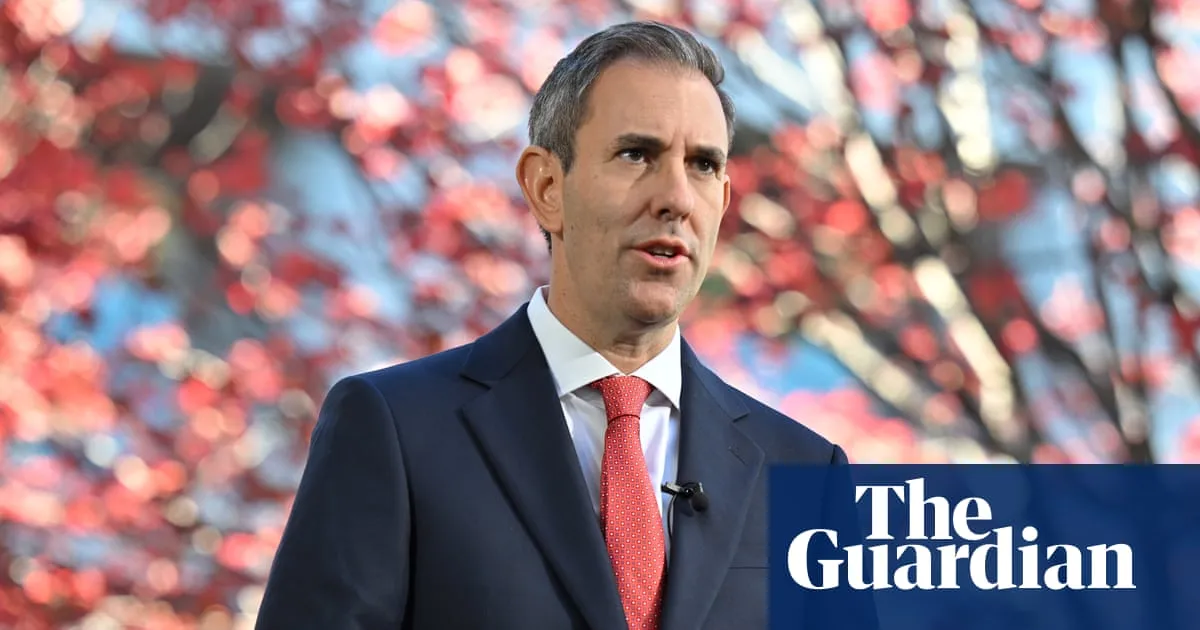
‘Tonight we choose the hard road to reform, not the path of least resistance,’ treasurer Jim Chalmers has said in announcing Australia’s 2026 federal budget. Photograph: Mick Tsikas/AAP View image in fullscreen ‘Tonight we choose the hard road to reform, not the path of least resistance,’ treasurer Jim Chalmers has said in announcing Australia’s 2026 federal budget. Photograph: Mick Tsikas/AAP Budget 2026 Australia: Jim Chalmers goes for broke in federal budget facing twin threats of housing pain and Iran war disaster Labor’s ambitious and politically risky tax reform aims to help first home buyers and foster intergenerational fairness Federal budget 2026 LIVE updates: Australia government budget announcement and speech – latest news Explore all of our 2026 Australia federal budget coverage Get our breaking news email, free app or daily news podcast Jim Chalmers has announced the most ambitious and politically risky tax changes since the Howard era as part of a federal budget that defies the looming economic threat of the Iran war to push Australia along the “hard road to reform”. Arguing that the Australian public is ready for difficult choices aimed at reviving intergenerational fairness and the collapsing dream of home ownership, the government will scale back tax breaks for landlords by abolishing negative gearing for new investors and replacing the 50% capital gains tax discount with the inflation-linked approach that existed before 1999. Treasury modelling suggests that the property tax changes will help an extra 75,000 Australians “achieve the dream of home ownership” over the coming decade. “I think the time is right for these kinds of reforms and for this level of ambition,” the treasurer said. “Around the Australian community there is an appetite for a government which is prepared to take on some difficult things. It has become increasingly clear to us, for example, that the housing challenge is primarily about supply but it is not exclusively about supply.” The budget also includes the previously announced deep cuts to the National Disability Insurance Scheme, with the “difficult but necessary reform” slated to save $36.2bn over the four-year forward estimates. The property tax changes that cost Labor two federal elections are now likely to receive an easy passage through parliament, as Anthony Albanese flexes his party’s huge majority in the lower house and a friendly Senate. The budget also includes tax relief for more than 13 million workers in the form of an automatic $250 “working Australians tax offset” but the relief will be delayed until 2027-28. This sits alongside a $1,000 instant tax deduction that will deliver an average $205 benefit for 6.2 million people in 2026-27. The budget includes $2.6bn for the previously announced 26-cent temporary cut to the fuel excise. But Labor held back from announcing any major new cost-of-living support measures, in a major break from what has been the centrepiece for budgets at the federal and state level since the Covid pandemic began. Instead, the government preferred to keep its powder dry as the Treasury modelled a worst-case scenario where a doubling in oil prices to US$200 a barrel would drive inflation above 7%, unemployment above 5% and send the economy backwards in the September quarter. “A lesser government would have used the developments overseas as an excuse to do less, and what we’ve tried to do is accelerate the reform and not just absorb the shock,” Chalmers said. “In an era where people feel like the system no longer works for them, this budget doesn’t just acknowledge that – it acts on it. “Tonight we choose the hard road to reform, not the path of least resistance. By responding to the pressure Australians confront today, and fulfilling our obligations and responsibilities to the generations to come.” Assisted by major upgrades to tax revenues from higher commodity prices and inflation, the budget shows cumulative improvements to the bottom line of $44.9bn over five years compared with the December fiscal update. But the finances remain firmly in the red, with an estimated deficit of $28.3bn in 2025-26, growing to $34.4bn in 2028-29. The “structural savings” such as the NDIS reforms allow the budget to project a return to surplus in a decade’s time. Explore more on these topics Australian budget 2026 Australian economy Labor party Jim Chalmers Australian politics Tax Cost-of-living crisis news Share Reuse this content
SRCThe Guardian - World News
LANGEN
LEANCenter-Left
WORDS716
ENT9
TUE · 2026-05-12 · 09:35 GMTBRIEF NSR-2026-0512-75567
NSR-2026-0512-75567News Report·EN·Political Strategy
Budget 2026 Australia: Jim Chalmers announces capital gains tax and negative gearing reform for housing
In Australia's 2026 federal budget, Treasurer Jim Chalmers has introduced significant and politically risky tax reforms aimed at addressing housing affordability and intergenerational fairness. The government will abolish negative gearing for new property investors and replace the 50% capital gains tax discount with an inflation-linked approach.
Patrick Commins Economics editorThe Guardian - World NewsFiled 2026-05-12 · 09:35 GMTLean · Center-LeftRead · 3 min
The Guardian - World NewsFIG 01
Reading time
3min
Word count
716words
Sources cited
1cited
Entities identified
9entities
Quality score
100%
§ 01
Briefing Summary
AI-generatedNEWSAR · AI
In Australia's 2026 federal budget, Treasurer Jim Chalmers has introduced significant and politically risky tax reforms aimed at addressing housing affordability and intergenerational fairness. The government will abolish negative gearing for new property investors and replace the 50% capital gains tax discount with an inflation-linked approach. These changes, projected to help 75,000 more Australians own homes within a decade, are presented as necessary to tackle the housing crisis beyond just supply issues. The budget also includes previously announced cuts to the National Disability Insurance Scheme, expected to save $36.2 billion. The reforms are anticipated to pass Parliament easily due to the government's strong majority.
Confidence 0.90Sources 1Claims 5Entities 9
§ 02
Article analysis
Model · rule-basedFraming
Political Strategy
Social Justice
Tone
Mixed Tone
AI-assessed
CalmNeutralAlarmist
Factuality
0.70 / 1.00
Factual
LowHigh
Sources cited
1
Limited
FewMany
§ 03
Key claims
5 extracted01
The government is choosing the 'hard road to reform' rather than the 'path of least resistance'.
quoteJim Chalmers
Confidence
1.00
02
Deep cuts to the National Disability Insurance Scheme are included, projected to save $36.2bn over four years.
factual
Confidence
1.00
03
The budget includes a $250 'working Australians tax offset' delayed until 2027-28 and a $1,000 instant tax deduction for 6.2 million people.
factual
Confidence
1.00
04
Treasurer Jim Chalmers announced significant tax reforms including changes to negative gearing and capital gains tax in the 2026 federal budget.
factualJim Chalmers
Confidence
1.00
05
The reforms aim to help an extra 75,000 Australians achieve home ownership over the next decade.
statisticTreasury modelling
Confidence
0.90
§ 04
Full report
3 min read · 716 words§ 05
Entities
9 identifiedKey playerOppositionContextPositiveNeutralNegative
Organizations2
§ 06
Keywords & salience
10 termsnegative gearing
1.00
capital gains tax
1.00
housing affordability
0.90
federal budget 2026
0.90
tax reform
0.80
intergenerational fairness
0.70
jim chalmers
0.60
property tax
0.50
home ownership
0.50
national disability insurance scheme
0.40
§ 07
Topic connections
Interactive graph Network visualization showing 29 related topics
View Full Graph Person Organization Location Event|Click node to navigate|Edge numbers = shared articles