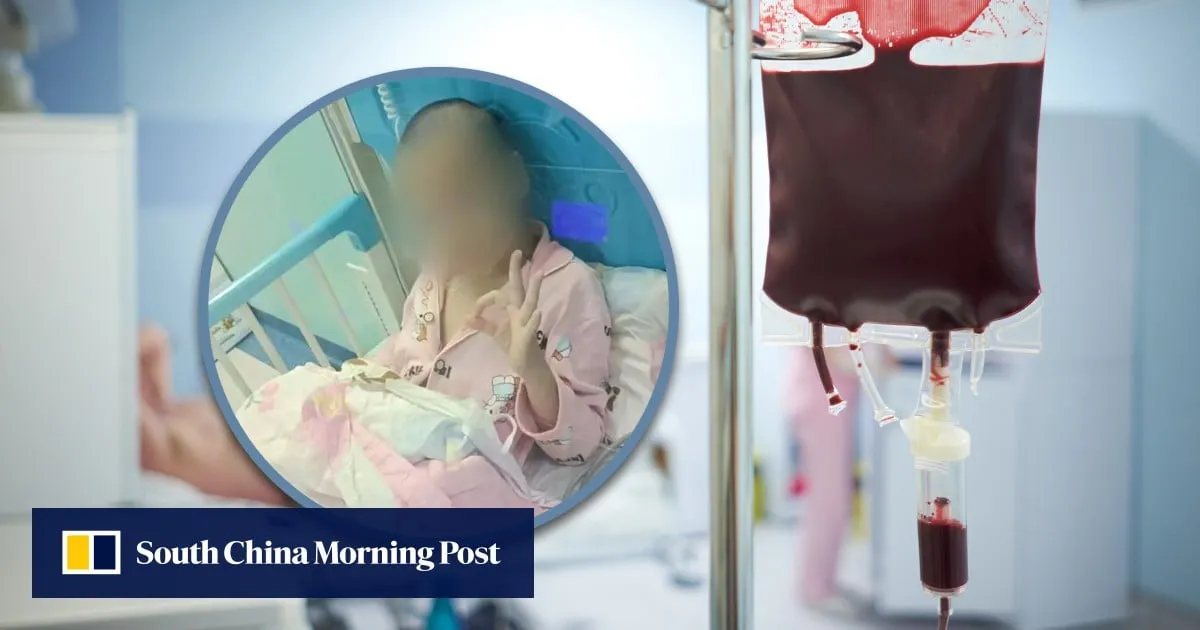
A 15-year-old Chinese girl who has been suffering from a severe blood disorder most of her life is slowly recovering after receiving a transplant from her newborn brother.Xiaoyan from southern China’s Guangdong province is now only 140cm tall, and weighs just 25kg.She was diagnosed with thalassemia, an inherited blood disorder, at three months old.Her father, a construction worker, and her jobless mother did not arrange standard treatment for her except for regular blood transfusions.It was only when Xiaoyan’s spleen became so enlarged and needed to be removed in 2018, that she received media attention and began receiving proper treatment.Teenager Xiaoyan lies in her hospital bed surrounded by machines. Photo: QQ.comThey advised them to find a match from a stem cell registry, or give birth to another child and use their cord blood.Cord blood is an important source of hematopoietic stem cells.It is collected from the umbilical cord and placenta after birth, and is considered especially helpful in treating related people’s blood disease, including the baby’s future disease.In China, an increasing number of parents are considering keeping or donating the newborns’ cord blood as a “life backup”.China currently has seven official umbilical cord blood banks.According to official statistics in November 2025, the seven banks kept nearly 2.5 million units of cord blood, 45,000 of which had been used in treatments.Brave Xiaoyan gives a sign with her right hand to say that she is fine as she sits up in bed Photo: QQ.comIt cost about 20,000 yuan (US$3,000) to preserve it for 20 years. Some parents consider it a financial burden and would rather donate the cord blood for free.Further ReadingIn Xiaoyan’s case, she had a one-year-old brother then, but her parents did not save his cord blood.Xiaoyan’s family was in a poor condition. Her father, the family’s only breadwinner, was injured at work and her grandparents both had chronic conditions.Considerate Xiaoyan even texted her mother that she did not want the transplant because “our family has little money”.Not being able to afford non-family blood cell donation, which costs way more than using her sibling’s cord blood, her parents decided to have another child.In 2021, Xiaoyan’s youngest brother was born. His blood half matched hers, which the doctor said was enough.She had to go through therapies to remove excess iron in her body so that the transplant could go ahead.In 2025, Xiaoyan’s body was ready for surgery. After receiving financial donation from kind-hearted strangers, Xiaoyan received a free transplant in April 2026.The doctors say she is recovering well. Her hematopoietic function is gradually being rebuilt.“I know umbilical cord blood is useful, but ordinary families cannot afford saving it,” one online observer said.Doctors, above, carry out preparation procedures before a stem cell operation. Photo: Shutterstock“I could not afford it, so I donated my child’s cord blood instead,” said another.Although there are ethical debates about giving birth to another child to treat their siblings in other countries, in China it is a well-accepted method. Chinese media outlets also published similar cases to promote the method.For example, in 2016, a Guangdong couple were reported to have given birth to three sons to save their daughter with thalassemia.However, experts says that a newborn sibling’s cord blood does not guarantee a successful transplant.Their blood might not match that of their sibling, or if the parents have genetic problems, their new child might also have congenital disorders.
SRCSouth China Morning Post
LANGEN
LEANCenter-Right
WORDS559
ENT5
TUE · 2026-05-12 · 10:00 GMTBRIEF NSR-2026-0512-75609
NSR-2026-0512-75609News Report·EN·Human Interest
China parents conceive baby to collect umbilical cord blood to save daughter with severe disorder
A 15-year-old Chinese girl, Xiaoyan, suffering from thalassemia, has undergone a successful transplant using umbilical cord blood from her newborn brother. Diagnosed at three months old, her family's financial struggles meant standard treatments were limited to transfusions.
Fran LuSouth China Morning PostFiled 2026-05-12 · 10:00 GMTLean · Center-RightRead · 3 min
South China Morning PostFIG 01
Reading time
3min
Word count
559words
Sources cited
0cited
Entities identified
5entities
Quality score
100%
§ 01
Briefing Summary
AI-generatedNEWSAR · AI
A 15-year-old Chinese girl, Xiaoyan, suffering from thalassemia, has undergone a successful transplant using umbilical cord blood from her newborn brother. Diagnosed at three months old, her family's financial struggles meant standard treatments were limited to transfusions. Media attention in 2018 led to better care, and doctors recommended a stem cell transplant. Unable to afford external donors, Xiaoyan's parents conceived another child in 2021, whose cord blood was a sufficient match. The transplant, performed in 2025, has led to Xiaoyan's slow recovery, highlighting the growing trend of using cord blood as a "life backup" in China, despite preservation costs.
Confidence 0.90Claims 5Entities 5
§ 02
Article analysis
Model · rule-basedFraming
Human Interest
Public Health
Tone
Mixed Tone
AI-assessed
CalmNeutralAlarmist
Factuality
0.80 / 1.00
Factual
LowHigh
Sources cited
0
No named sources
FewMany
§ 03
Key claims
5 extracted01
The girl is recovering well after receiving a free transplant funded by donations.
factual
Confidence
1.00
02
The family could not afford non-family blood cell donation, leading them to have another child for cord blood.
factual
Confidence
1.00
03
A 15-year-old Chinese girl with thalassemia received a stem cell transplant from her newborn brother.
factual
Confidence
1.00
04
Preserving cord blood for 20 years costs about 20,000 yuan (US$3,000) in China.
factual
Confidence
0.90
05
China has seven official umbilical cord blood banks with nearly 2.5 million units stored as of November 2025.
statisticofficial statistics
Confidence
0.90
§ 04
Full report
3 min read · 559 words§ 05
Entities
5 identifiedKey playerOppositionContextPositiveNeutralNegative
Organizations1
§ 06
Keywords & salience
8 termsumbilical cord blood
1.00
thalassemia
0.90
stem cell transplant
0.80
hematopoietic stem cells
0.70
blood disorder
0.60
cord blood banking
0.50
medical treatment
0.40
family planning
0.40
§ 07
Topic connections
Interactive graph Network visualization showing 51 related topics
View Full Graph Person Organization Location Event|Click node to navigate|Edge numbers = shared articles