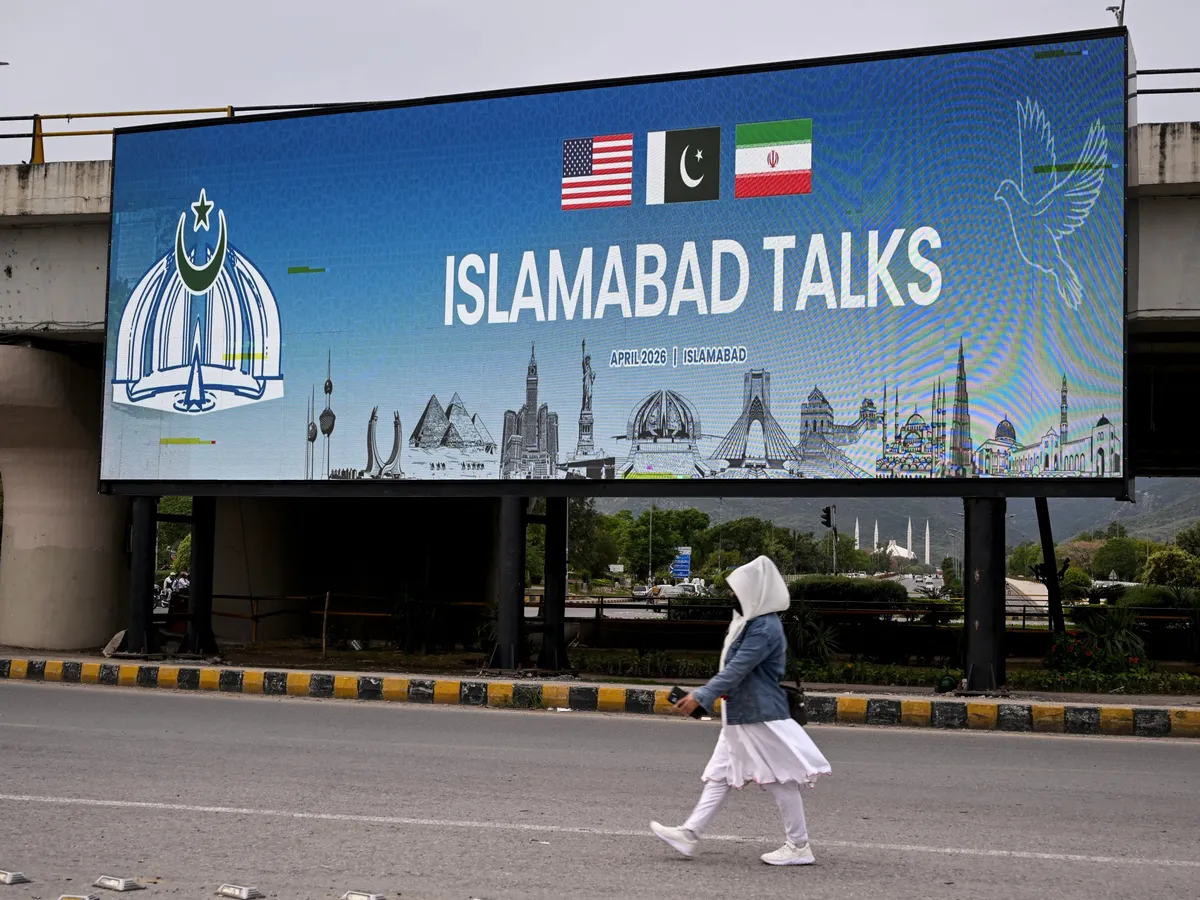
Pakistan rejects allegations of aiding Iran militarily while Trump says truce on ‘life support’.A digital screen promotes the Iran-talks" class="entity-link entity-event" data-entity-id="119740" data-entity-type="event">US-Iran talks that took place in Islamabad on April 11, 2026 [AFP]Published On 12 May 2026Islamabad, Pakistan – Pakistan has rejected allegations that it had sheltered Iranian military aircraft from potential United States strikes as the fragile ceasefire it helped broker between Washington and Tehran appears increasingly at risk.The Ministry of Foreign Affairs statement on Tuesday came hours after US President Donald Trump said the month-old truce was on “massive life support” as he dismissed Iran’s latest peace proposal as “a piece of garbage” that he had not even finished reading.Recommended Stories list of 4 itemslist 1 of 4‘Stupid’: Trump rejects Iran response to US peace proposallist 2 of 4Iran says its demands were seeking peace, while the US’s are ‘unreasonable’list 3 of 4‘Unacceptable’: What’s Iran’s peace proposal that Trump has rejected?list 4 of 4Iran denies proposal sent to US contains ‘excessive demands’end of listTrump’s remarks followed a report by CBS News on Monday saying Iran had moved several military aircraft, including an RC-130 reconnaissance plane, to Pakistan-air-force-base-nur-khan" class="entity-link entity-location" data-entity-id="125861" data-entity-type="location">Pakistan Air Force Base Nur Khan near Rawalpindi after the April 8 ceasefire, potentially shielding them from US attacks.Pakistan’s Foreign Ministry on Tuesday called the report “misleading and sensationalised”, saying the aircraft had arrived as part of diplomatic logistics linked to talks in Islamabad between senior US and Iranian officials on April 11. Pakistan said both Iranian and US aircraft used the base.“The Iranian aircraft currently parked in Pakistan arrived during the ceasefire period and bear no linkage whatsoever to any military contingency or preservation arrangement,” the ministry said.The Foreign Ministry also pointed out that any significant foreign military presence at the base would be impossible to hide.“Assertions suggesting otherwise are speculative, misleading, and entirely detached from the factual context,” it said, adding that Pakistan had “consistently acted as an impartial, constructive and responsible facilitator” throughout the process.Washington uneaseThe denials, however, have done little to calm concerns in Washington.Hopes for a peace deal between the US and Iran and the continuation of their ceasefire have dimmed considerably since US President Donald Trump said the truce was ‘on life support’ and called Iran’s list of demands ‘garbage’ [Kent Nishimura/AFP]A CNN report published hours after the CBS story said some Trump administration officials believed Pakistan has been sharing “a more positive version of the Iranian position with the US than what reflects reality” while questioning whether Islamabad was “aggressively conveying Trump’s displeasure”.A Pakistani official told Al Jazeera that Islamabad has been as direct with both parties as any neutral arbiter could be because mediation requires impartiality to succeed rather than pushing agendas.“Objective is to resolve the complex, historical, highly consequential conflict rather than earning brownie points or headline diplomacy,” the official said, speaking on condition of anonymity because the official was not authorised to speak to the media.US Senator Lindsey Graham, a Trump ally and member of his Republican Party, called for “a complete reevaluation” of Pakistan’s mediator role, saying on X that he “would not be shocked” if the CBS report proved accurate.Analysts, however, said the controversy was unlikely to significantly damage Islamabad’s position.“Pakistan has done more than many had expected. Delivering a ceasefire in an environment marred by sheer distrust was no mean feat,” Syed Ali Zia Jaffery, deputy director at the Centre for Security, Strategy and Policy Research at the University of Lahore, told Al Jazeera.He said the fact that both Tehran and Washington continued to rely on Pakistan suggested the allegations would have limited impact.“As long as both capitals believe that Islamabad remains a dependable facilitator and mediator, such reportage won’t have any impact. This is a multiparty war, which leaves a lot of room for spoilers to obfuscate things,” Jaffery said.Talks at an impasseThe immediate trigger for the latest tensions was Washington’s rejection of an Iranian peace proposal delivered through Pakistan on Sunday.Iranian state media said Tehran’s terms included US war reparations, full Iranian sovereignty over the Strait of Hormuz, an end to sanctions and the release of its frozen assets while insisting nuclear negotiations be deferred to a later stage.Trump, posting on his Truth Social platform, described the proposal as “TOTALLY UNACCEPTABLE”.“I would say the ceasefire is on massive life support,” he said later in the Oval Office, describing the situation as one “where the doctor walks in and says, ‘Sir, your loved one has approximately a 1 percent chance of living.’“Iranian Ministry of Foreign Affairs spokesman Esmaeil Baghaei rejected that characterisation, calling the proposal “reasonable and generous” and saying Tehran had demanded “only Iran’s legitimate rights”.Parliament Speaker Mohammad Bagher Ghalibaf, Iran’s lead negotiator, struck a more defiant tone.“Our armed forces are prepared to deliver a lesson-giving response to any aggression,” he wrote on social media on Monday. “There is no alternative but to accept the rights of the Iranian people as laid out in the 14-point proposal.”The core disagreements remain unchanged.Washington wants Iran to explicitly abandon its nuclear programme and surrender its stockpile of uranium enriched to 60 percent, near weapons-grade levels.Tehran insisted nuclear negotiations can only follow the lifting of sanctions and the end of the US naval blockade imposed on its ports on April 13.Since the Islamabad talks ended without an agreement between the US and Iran on April 12, Pakistan has largely acted as an intermediary, carrying proposals between the two sides, which have not met directly since.On May 4, Pakistani Deputy Prime Minister and Foreign Minister Ishaq Dar spoke with Iranian Foreign Minister Abbas Araghchi about Islamabad’s mediation efforts.The same day, 22 crew members on board the Iranian container ship MV Touska, which had been captured by US forces, were evacuated to Pakistan before being transferred to Iran in what Islamabad described as a confidence-building measure coordinated with both sides.Iranian Foreign Minister Abbas Araghchi talks with Pakistani Foreign Minister Mohammad Ishaq Dar and Field Marshal Asim Munir in Islamabad, Pakistan, on April 25, 2026 [Handout/Pakistan’s Ministry of Information via Reuters]Qatar has also backed the mediation effort. US Secretary of State Marco Rubio met Qatari Prime Minister Sheikh Mohammed bin Abdulrahman bin Jassim Al Thani in Miami, Florida, on Saturday with Doha pledging support for “mediation efforts led by Pakistan”.Jaffery said the ceasefire had been “practically violated” once the US imposed its naval blockade although both sides have since sought to avoid a return to full-scale war.“I do not think that kinetic engagement is imminent. What is likely to intensify is harassment and interdiction along the Strait of Hormuz,” he said.Muhanad Seloom, a nonresident senior fellow at the Middle East Council on Global Affairs, agreed.What is likely in the next few days, he said, “is narrow kinetic action, likely against IRGC [Islamic Revolutionary Guard Corps] assets harassing Hormuz traffic, calibrated so Iran can absorb it without striking US bases in the Gulf”.Seloom pointed to recent comments from US Energy Secretary Chris Wright on going “back to the military method to open the strait”. That, the analyst told Al Jazeera, revealed that the US was looking at “a Hormuz operation, not regime confrontation”.
SRCAl Jazeera
LANGEN
OutletState media · Qatar
WORDS1,175
ENT10
TUE · 2026-05-12 · 12:17 GMTBRIEF NSR-2026-0512-75621
NSR-2026-0512-75621News Report·EN·Diplomatic
Pakistan scrambles to salvage US-Iran diplomacy as ceasefire faces collapse
Pakistan has rejected allegations of sheltering Iranian military aircraft from potential U.S. strikes, stating the planes arrived as part of diplomatic logistics for U.S.-Iran talks held in Islamabad on April 11, 2026.
Abid HussainAl JazeeraFiled 2026-05-12 · 12:17 GMTOutlet · State media · QatarRead · 5 min
Al JazeeraFIG 01
Reading time
5min
Word count
1,175words
Sources cited
4cited
Entities identified
10entities
NEWSAR · AI
Pakistan has rejected allegations of sheltering Iranian military aircraft from potential U.S. strikes, stating the planes arrived as part of diplomatic logistics for U.S.-Iran talks held in Islamabad on April 11, 2026. This denial comes as U.S. President Donald Trump described the month-old ceasefire brokered by Pakistan as being on "life support" and dismissed Iran's latest peace proposal. Trump's remarks followed a report claiming Iran moved military aircraft to a Pakistani air base after the ceasefire. Pakistan's Foreign Ministry called the report misleading, emphasizing its role as an impartial facilitator and stating that any significant military presence would be impossible to conceal. The situation highlights Pakistan's efforts to mediate U.S.-Iran diplomacy amidst growing tensions and a fragile truce.
Confidence 0.90Sources 4Claims 5Entities 10
Framing
Diplomatic
National Security
Tone
Mixed Tone
AI-assessed
CalmNeutralAlarmist
Factuality
0.70 / 1.00
Factual
LowHigh
Sources cited
4
Well sourced
FewMany
01
Pakistan's Foreign Ministry called the CBS report 'misleading and sensationalised'.
quotePakistan Ministry of Foreign Affairs
Confidence
1.00
02
US President Donald Trump stated the month-old truce between the US and Iran is on 'massive life support'.
quoteDonald Trump
Confidence
1.00
03
Pakistan rejects allegations of sheltering Iranian military aircraft from potential US strikes.
factualPakistan Ministry of Foreign Affairs
Confidence
1.00
04
A CBS News report alleged Iran moved military aircraft to Pakistan Air Force Base Nur Khan after the ceasefire.
factualCBS News
Confidence
0.90
05
Some Trump administration officials believe Pakistan is sharing a more positive version of Iran's position with the US than reality.
factualCNN report citing Trump administration officials
Confidence
0.80
§ 04
Full report
5 min read · 1,175 wordsKey playerOppositionContextPositiveNeutralNegative
People1
Locations6
us-iran diplomacy
1.00
ceasefire collapse
0.90
pakistan allegations
0.80
trump peace proposal
0.70
military aircraft
0.60
islamabad talks
0.50
diplomatic logistics
0.50
us-iran relations
0.40
§ 07
Connections
Who appears together in the newsIn this articleWider coverageLine weight = articles in common
Laying out network…
Strongest ties articles in common
- 15,009
- 12,269
- 7,769
- 1,279
- 1,231
- 810
Recurring context not named in this article
- LIsraellinks 8
- OIslamic Revolutionary Guard Corpslinks 8
- LStrait of Hormuzlinks 8
- PJD Vancelinks 8
- LOmanlinks 8
- LQatarlinks 8
- LChinalinks 7
- LRussialinks 7