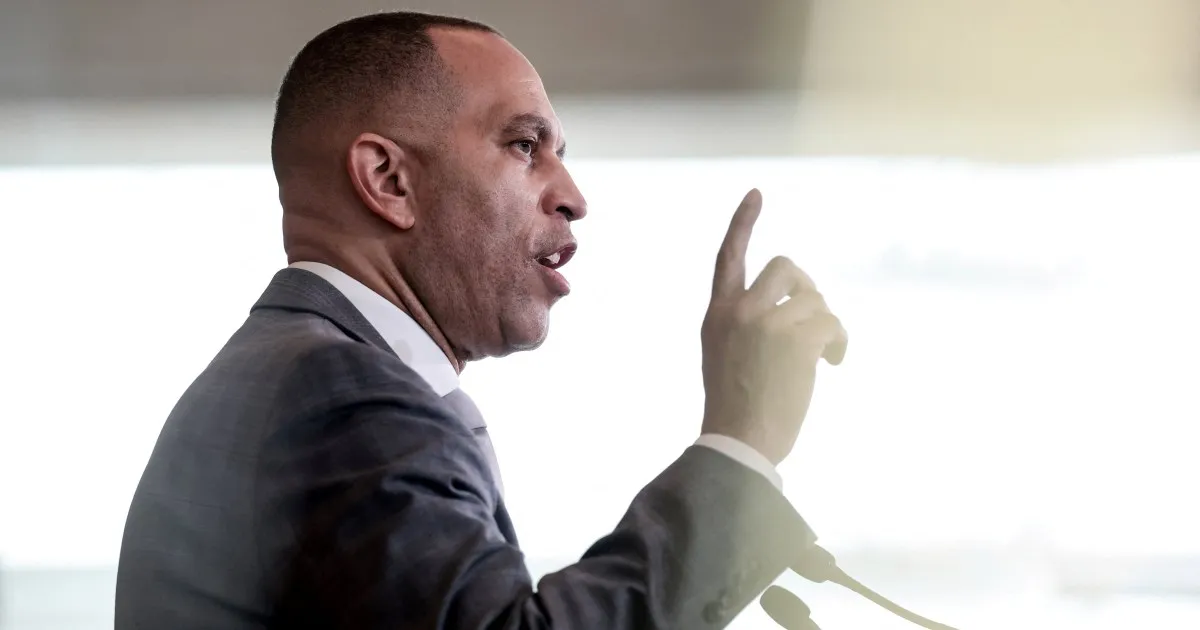
US representative Jen Kiggans appears to endorse racist statements about top House Democrat Hakeem Jeffries.US House Minority Leader Hakeem Jeffries (D-NY) delivers remarks at the United States Holocaust Memorial Museum’s National Commemoration of the Days of Remembrance at the US Capitol in Washington, DC, US, April 14, 2026. [Evelyn Hockstein/Reuters]Published On 12 May 2026The office of Hakeem Jeffries, the top-ranking Democrat in the United States House of Representatives, has released a fiery statement condemning a fellow lawmaker who endorsed a racist comment about him.Tuesday’s statement came a day after US Representative Jen Kiggans appeared on a conservative radio talk show, where she discussed the ongoing battle over redistricting in the state.Recommended Stories list of 3 itemslist 1 of 3Democrats up in Virginia, but US voters may pay price for redistricting warlist 2 of 3World reacts to shooting at White House correspondents’ dinnerlist 3 of 3Trump calls for ‘incitement’ charges against top Democrat Hakeem Jeffriesend of listDuring the show, host Rich Herrera criticised Jeffries, who is from New York, for his support of an effort to redraw Virginia’s congressional map.Herrera said Jeffries should either relocate to Virginia and run for public office, or “get your cotton-picking hands off of Virginia”.“That’s right. Ditto,” Kiggans, a Republican, responded. “Yes. Yes to that.”The term “cotton picking” is typically seen to have racist roots in the US, where enslaved Black people were used as labour on southern cotton plantations until the mid-19th century.Kiggans later denied approving of Herrera’s statement. She argued that she was instead agreeing with the broad sentiment about Democrats’ efforts in state redistricting.“The radio host should not have used that language and I do not — and did not — condone it,” she said.“It was obvious to anyone listening that I was agreeing Hakeem Jefferies should stay out of Virginia.”Still, a Jeffries spokesperson, Christie Stephenson, vehemently condemned Kiggans on Tuesday.“Extremists who endorse disgusting, vile and racist language are pathetic,” Stephenson said.“Jen Kiggans has no interest in our nation’s progress toward a multiracial democracy and apparently craves a return to the days of Jim Crow racial oppression in the South.”Top Democrats, including US Minority Whip Katherine Clark and California Governor Gavin Newsom, have called on Kiggans to resign.The Congressional Black Caucus (CBC) also posted a clip of the radio exchange on the social media platform X, writing: “Did she agree with him? Yes. Is this racist? Yes. Should she resign? Yes to that, too.”The radio interview comes after US President Donald Trump, in February, posted a racist video depicting former President Barack Obama and his wife, former First Lady Michelle Obama, as primates.Tim Scott, the only Black Republican senator in the US, condemned the video as the “most racist thing I’ve ever seen”. The video was later removed, with the White House blaming a staffer for posting it to Trump’s account.The latest incident comes amid a nationwide battle over redistricting, before the November’s critical midterm elections.Normally, states redraw their electoral maps once a decade to reflect the latest census results. But last year, the Trump administration called on the Texas legislature to pass a new congressional map to give the Republican Party a boost at the polls.Since then, several states have sought to redraw their maps to benefit one party or the other.In Virginia, voters approved a redrawn map in April that would have increased the number of Democrat-leaning districts. However, the state’s Supreme Court has since invalidated the map. Democrats have appealed to the US Supreme Court to intervene.Partisan gerrymandering — or the manipulation of electoral maps for political aims — is not illegal under US law. But critics have denounced the practice as undemocratic.Discrimination based on race, however, is outlawed in the US, and laws like the Voting Rights Act of 1973 have been used to ensure fair representation at the ballot box.But a US Supreme Court decision in late April has weakened how that law may be enforced. The high court struck down a key provision in the Voting Rights Act, making it easier to break up predominantly Black congressional districts, except in cases where there are explicitly racist motivations.Civil rights groups have charged that such motivations would be near impossible to prove. They also argue the ruling could be used to dilute the voting power of Black Americans, who have historically skewed Democratic.Republican lawmakers in Tennessee, Florida, Alabama and South Carolina have pursued efforts to redraw their maps in light of the ruling.
SRCAl Jazeera
LANGEN
LEANCenter
WORDS734
ENT12
TUE · 2026-05-12 · 18:23 GMTBRIEF NSR-2026-0512-75705
NSR-2026-0512-75705News Report·EN·Social Justice
‘Cotton picking’: US lawmaker condemned for racist comment about Jeffries
US Representative Jen Kiggans is facing condemnation for her apparent endorsement of a racist comment made about House Minority Leader Hakeem Jeffries. During a conservative radio interview on May 11, 2026, Kiggans responded "Ditto" and "Yes.
Al Jazeera StaffAl JazeeraFiled 2026-05-12 · 18:23 GMTLean · CenterRead · 3 min
Al JazeeraFIG 01
Reading time
3min
Word count
734words
Sources cited
5cited
Entities identified
12entities
Quality score
100%
§ 01
Briefing Summary
AI-generatedNEWSAR · AI
US Representative Jen Kiggans is facing condemnation for her apparent endorsement of a racist comment made about House Minority Leader Hakeem Jeffries. During a conservative radio interview on May 11, 2026, Kiggans responded "Ditto" and "Yes. Yes to that" when the host used the phrase "cotton-picking hands" in reference to Jeffries' involvement in Virginia redistricting. The term "cotton picking" is widely considered to have racist origins. Kiggans later claimed she was agreeing with the sentiment that Jeffries should not interfere in Virginia's redistricting, not condoning the language. Jeffries' office and other prominent Democrats have strongly criticized Kiggans, with some calling for her resignation.
Confidence 0.90Sources 5Claims 5Entities 12
§ 02
Article analysis
Model · rule-basedFraming
Social Justice
Political Strategy
Tone
Mixed Tone
AI-assessed
CalmNeutralAlarmist
Factuality
0.70 / 1.00
Factual
LowHigh
Sources cited
5
Well sourced
FewMany
§ 03
Key claims
5 extracted01
A spokesperson for Hakeem Jeffries called Kiggans' endorsement of the language 'disgusting, vile and racist'.
quoteChristie Stephenson (Hakeem Jeffries' spokesperson)
Confidence
1.00
02
Kiggans later denied approving of the language, stating she was agreeing that Jeffries should stay out of Virginia.
quoteJen Kiggans
Confidence
1.00
03
Kiggans responded to Herrera's comment with 'That's right. Ditto. Yes. Yes to that.'
quoteJen Kiggans
Confidence
1.00
04
During a radio show, host Rich Herrera said Jeffries should 'get your cotton-picking hands off of Virginia'.
quoteRich Herrera
Confidence
1.00
05
US Representative Jen Kiggans appeared to endorse a racist comment about House Minority Leader Hakeem Jeffries.
factualArticle
Confidence
0.90
§ 04
Full report
3 min read · 734 words§ 05
Entities
12 identifiedKey playerOppositionContextPositiveNeutralNegative
People6
Organizations3
§ 06
Keywords & salience
9 termshakeem jeffries
1.00
jen kiggans
1.00
racist comment
1.00
cotton picking
0.90
redistricting
0.70
us house of representatives
0.60
political discourse
0.50
racial oppression
0.50
congressional black caucus
0.40
§ 07
Topic connections
Interactive graph Network visualization showing 19 related topics
View Full Graph Person Organization Location Event|Click node to navigate|Edge numbers = shared articles