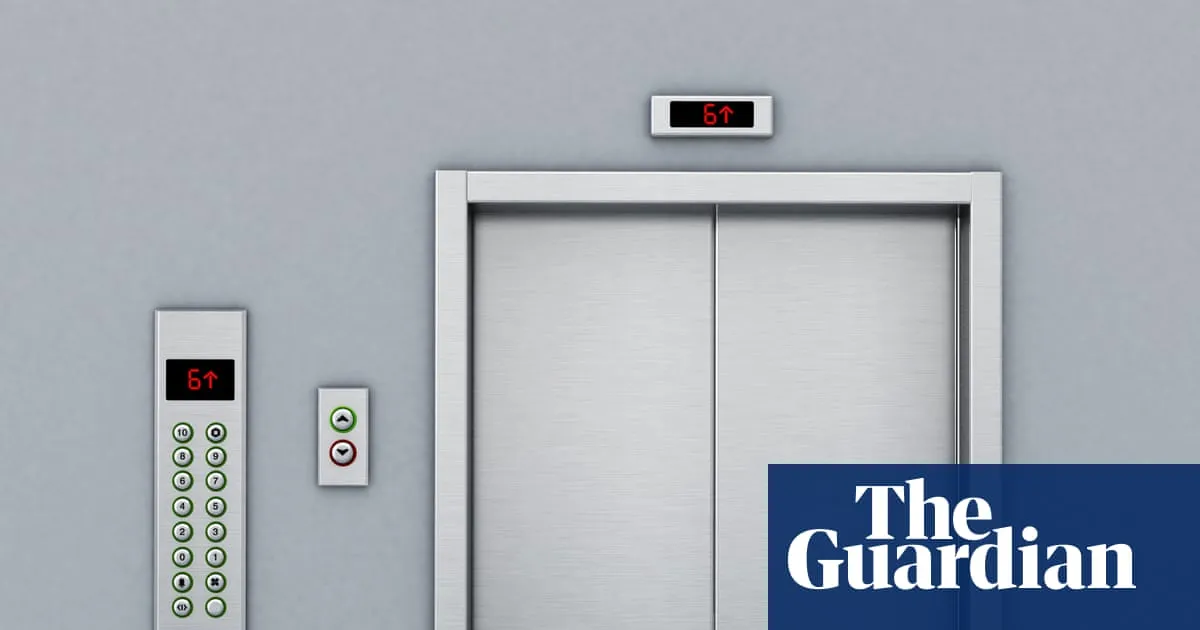
Lifts are no longer big enough to fit the UK’s larger citizens, according to researchers.A study of maximum capacity in elevators in the UK and mainland Europe found lifts have not kept up with increasing obesity levels, raising concerns about safety and equity.The research, presented at the European Congress on Obesity in Istanbul, Turkey, used photos of weight limits for 112 lifts manufactured between 1972 and 2024 in the UK, France, Germany, Italy, Spain, Austria and Finland.Prof Nick Finer, the president and chair of the International Prader-Willi Syndrome Organisation and lead author of the study, compared the average maximum weight allowance (total weight allowance divided by maximum passenger limits) with the average adult weight in the year the lift was manufactured.The research found that despite adults’ continued growing weight, total lift limits have not increased since about 2004. In the mid-1970s, the average British man weighed 75kg and a woman 65kg, but that has swelled to 86kg and 73kg respectively.Maximum allowances rose from about 62kg a person in 1972 to 75kg in 2002, broadly in line with average body weight increases during this time. But most lift manufacturers assumed average weight remained at 75kg, 4kg lighter than the average adult.“What seems to have happened is there was a shift to manufacturers calculating the amount of room you take up on the floor [rather than weight],” said Finer. “But they assume the shape of a person is an oval rather than a circle. They have completely failed to recognise that if obesity is increasing then so is the amount of room you take up.”Most lift manufacturers have assumed average weight has remained at 75kg. Photograph: Dmitriy Moroz/AlamyLifts that are too small caused potential safety issues, with designs based on “flawed calculations”, Finer said. “The ability to transport people up floors in a speedy time is impacted if you can only get half the number of people in the lift that you designed them for.”Lifts could cut out, for example, if the passengers exceeded the total weight limits. “But perhaps even more important than that is the stigma that [people with obesity] may experience on entering lifts – a form of everyday weight discrimination.”Finer added that “we need sadly, to super-size many of the things in life” to be suitable and safe for people living with obesity, as otherwise they would be excluded from society. “If we don’t recognise growing trends in obesity and body size then we’re really making it hard for those people to function in our society.”Responding to the study’s findings, Jane DeVille-Almond, the president of the British Obesity Society, said: “We need to accept that society is unlikely to revert to sizes from 50 years ago, and start developing facilities for the 21st century.”Louise Payne, a registered nutritionist, said: “It’s clear public spaces aren’t always designed with larger bodies in mind. This is not simply an issue of comfort, it’s about dignity, accessibility, and inclusion.“Nobody should feel embarrassed, unsafe, or excluded when using public transport or accessing everyday services.”
SRCThe Guardian - World News
LANGEN
LEANCenter-Left
WORDS501
ENT12
TUE · 2026-05-12 · 22:01 GMTBRIEF NSR-2026-0513-75755
NSR-2026-0513-75755News Report·EN·Public Health
Capacity of lifts not kept up with UK obesity levels, study shows
A recent study presented at the European Congress on Obesity found that UK lift capacities have not kept pace with rising obesity levels. Researchers analyzed weight limits of 112 lifts manufactured between 1972 and 2024 across several European countries.
Anna Bawden Health and social affairs correspondentThe Guardian - World NewsFiled 2026-05-12 · 22:01 GMTLean · Center-LeftRead · 3 min
The Guardian - World NewsFIG 01
Reading time
3min
Word count
501words
Sources cited
3cited
Entities identified
12entities
Quality score
100%
§ 01
Briefing Summary
AI-generatedNEWSAR · AI
A recent study presented at the European Congress on Obesity found that UK lift capacities have not kept pace with rising obesity levels. Researchers analyzed weight limits of 112 lifts manufactured between 1972 and 2024 across several European countries. The study revealed that while individual lift weight allowances increased until around 2004, they have since stagnated, failing to account for the continued growth in average adult body weight. This discrepancy, with manufacturers now prioritizing floor space over weight, raises concerns about potential safety issues and everyday discrimination for individuals with obesity. The lead author suggests that many aspects of life may need to be adapted to accommodate larger body sizes for inclusivity and safety.
Confidence 0.90Sources 3Claims 5Entities 12
§ 02
Article analysis
Model · rule-basedFraming
Public Health
Social Justice
Tone
Measured
AI-assessed
CalmNeutralAlarmist
Factuality
0.80 / 1.00
Factual
LowHigh
Sources cited
3
Well sourced
FewMany
§ 03
Key claims
5 extracted01
Public spaces are not always designed with larger bodies in mind, impacting dignity and access.
factualJane DeVille-Almond and Louise Payne
Confidence
1.00
02
Lifts that are too small can cause safety issues and lead to stigma and everyday weight discrimination for people with obesity.
factualProf Nick Finer
Confidence
1.00
03
Lift manufacturers shifted from calculating weight to floor space, failing to account for increased obesity.
factualProf Nick Finer
Confidence
1.00
04
Total lift weight limits have not increased since about 2004, despite continued growth in adult body weight.
factualProf Nick Finer
Confidence
1.00
05
Lifts in the UK and mainland Europe have not kept up with increasing obesity levels, according to a study.
factualresearchers
Confidence
1.00
§ 04
Full report
3 min read · 501 words§ 05
Entities
12 identifiedKey playerOppositionContextPositiveNeutralNegative
Locations9
§ 06
Keywords & salience
9 termslift capacity
1.00
obesity levels
1.00
weight limits
0.90
safety concerns
0.80
body size
0.70
average adult weight
0.60
weight discrimination
0.50
lift manufacturers
0.40
european congress on obesity
0.40
§ 07
Topic connections
Interactive graph No topic relationship data available yet. This graph will appear once topic relationships have been computed.