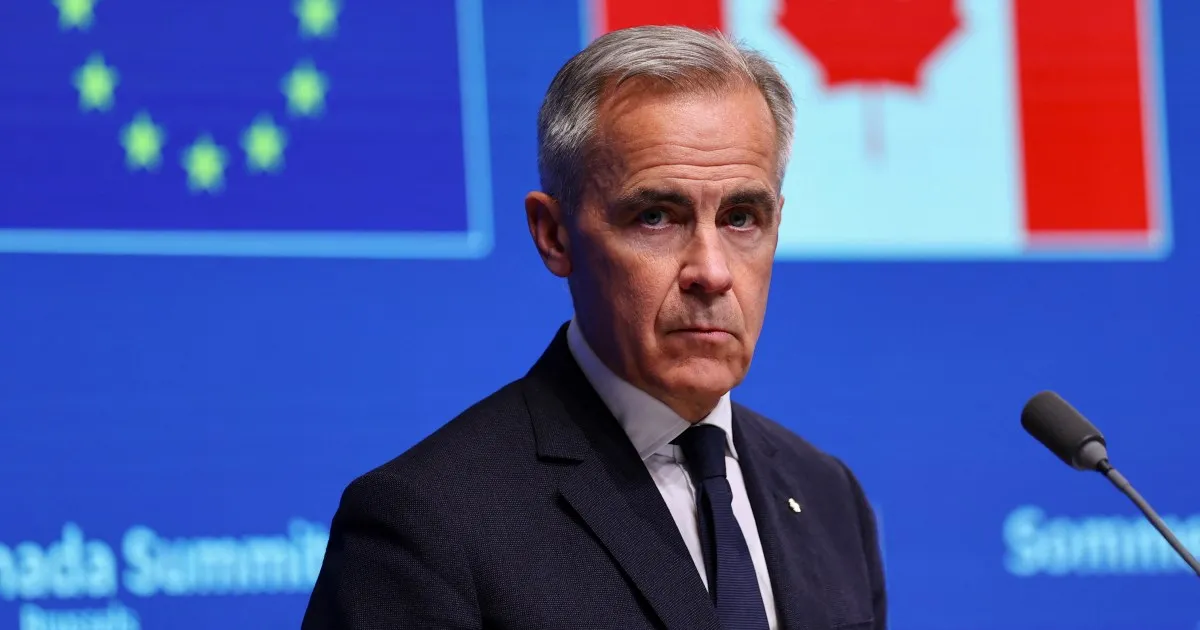
EDITOR'S ANALYSISCanadian leader’s visit comes after nearly a decade of strained ties between Ottawa and Beijing.Canadian Prime Minister Mark Carney has said the country wants to double its non-United States trade in the next decade and the trip to China is part of that effort [File: Gonzalo Fuentes/Reuters]Published On 15 Jan 2026Canadian Prime Minister Mark Carney has arrived in China for a visit that comes at a pivotal moment in relations between the two countries.Carney, the first Canadian leader to visit China since 2017, is set to meet with Chinese President Xi Jinping and Chinese Premier Li Qiang.Recommended Stories list of 4 itemslist 1 of 4Ukraine’s former Prime Minister Yulia Tymoshenko accused of bribery: Reportlist 2 of 4Child rights org says Google undermines parental control of child accountslist 3 of 4Why is the US Fed chair criminal probe causing global alarm?list 4 of 4French government survives no-confidence votesend of listRelations between Canada and China plunged into a deep freeze after Canadian authorities arrested a key official of Chinese telecommunications firm Huawei as she was transitioning through the Vancouver international airport in December 2018.China retaliated against the arrest of Meng Wanzhou, which was carried out at the request of authorities in the United States, by detaining two Canadians.Relations have continued to face challenges.In 2024, Ottawa, following a line set by Washington, slapped Chinese electric vehicles with 100 percent tariffs, prompting Beijing to impose tariffs on certain Canadian agricultural goods, including canola.Ottawa has also accused China of political interference.Against that backdrop, Carney’s visit “marks a recalibration and change in tone and signals Canada’s desire to improve relations”, said Vina Nadjibulla, vice president of research and strategy at the Canada" class="entity-link entity-organization" data-entity-id="11736" data-entity-type="organization">Asia Pacific Foundation of Canada.“This is probably Prime Minister Carney’s second-most challenging trip after his first visit to the White House,” Nadjibulla told Al Jazeera.Carney is keen to diversify the Canadian economy and reduce its dependence on the US, the destination for nearly 80 percent of Canadian exports.While Canada has historically been among the US’s closest allies, the relationship has gone south since Donald Trump’s return to the White House.Trump has slapped Canada with a 35 percent across-the-board tariff and separate duties on steel, aluminium and lumber, while repeatedly threatening to make the country the 51st US state.Carney has travelled extensively, including to the European Union and the Gulf – he heads to Qatar after Beijing – to find new markets and investors for the economy. The Canadian leader has said he wants to double Canada’s non-US trade in the next decade.In a first step towards a thaw with China, Carney met Xi in South Korea during the Asia-Pacific Economic Cooperation Summit in October.“The Prime Minister is being pragmatic, and his trip will focus on specific economic deals – selling Canadian energy and agriculture products,” Nadjibulla said, adding that she did not expect to see the full lifting of tariffs between the sides.The trip, as a review of the trade agreement between the US, Mexico and Canada, is under way. The USMCA has allowed Canadian and Mexican goods that are covered under the agreement to enter the US tariff-free.In Canada’s case, that means about 86 percent of US imports from Canada and Mexico are compliant, making the effective tariff rate on Canadian goods about 6 percent, Tony Stillo, director of Canada Economics at Oxford Economics, said in a note on Wednesday.While Canada clearly would benefit from USMCA continuing, Trump, as recently as Tuesday, said the trade agreement was “irrelevant” to the US.But if an agreement to extend or modify the USMCA is not reached, it will enter a period of mandatory annual reviews until 2036, after which it would expire, resulting in a “prolonged period of trade policy uncertainty”, Stillo said.“If the North American trade agreement eventually disintegrates, the three parties could return to bilateral trade agreements to maintain market access to one another, but this would impose costs on North American trade and investments.”‘Political and narrative win’While Carney is keenly aware of the stakes, the visit holds significance for China, too.Beijing is not only on the lookout for new export markets and the removal of trade restrictions, such as the electric vehicle tariff, but a “political and narrative win” as well, Nadjibulla said.China has often criticised Canada for following the US too closely and will portray Carney’s visit, and any policy changes that may follow, as Ottawa “trying to correct mistakes of the past,” she said.Beijing’s ultimate hope would be compliance from Canada on sensitive issues like Taiwan and the South China Sea.Earlier this week, two Canadian MPs from Carney’s Liberal Party wrapped up a visit to self-governing Taiwan, which Beijing claims as its territory, ahead of schedule on the advice of the government.The lawmakers cited the need to avoid “confusion” in Canada’s foreign policy ahead of Carney’s visit.Nadjibulla said it was a “worrying” development, adding that Canada would face a “very difficult balancing act” with China.
SRCAl Jazeera
LANGEN
LEANCenter
WORDS814
ENT12
THU · 2026-01-15 · 02:08 GMTBRIEF NSR-2026-0115-7595
NSR-2026-0115-7595News Report·EN·Diplomatic
Canada’s Mark Carney seeks reset on pivotal trip to China
In January 2026, Canadian Prime Minister Mark Carney visited China, marking the first visit by a Canadian leader since 2017. The trip aims to reset strained relations between the two countries, which deteriorated following the 2018 arrest of a Huawei executive in Canada and subsequent Chinese retaliation.
Megha BahreeAl JazeeraFiled 2026-01-15 · 02:08 GMTLean · CenterRead · 4 min
Al JazeeraFIG 01
Reading time
4min
Word count
814words
Sources cited
1cited
Entities identified
12entities
Quality score
100%
§ 01
Briefing Summary
AI-generatedNEWSAR · AI
In January 2026, Canadian Prime Minister Mark Carney visited China, marking the first visit by a Canadian leader since 2017. The trip aims to reset strained relations between the two countries, which deteriorated following the 2018 arrest of a Huawei executive in Canada and subsequent Chinese retaliation. Carney is scheduled to meet with President Xi Jinping and Premier Li Qiang. The visit comes as Canada seeks to diversify its trade relationships and reduce its economic reliance on the United States, especially given recent tariff disputes with the US. China had also imposed tariffs on Canadian goods in response to Canada's tariffs on Chinese electric vehicles.
Confidence 0.90Sources 1Claims 5Entities 12
§ 02
Article analysis
Model · rule-basedFraming
Diplomatic
Economic Impact
Tone
Measured
AI-assessed
CalmNeutralAlarmist
Factuality
0.80 / 1.00
Factual
LowHigh
Sources cited
1
Limited
FewMany
§ 03
Key claims
5 extracted01
Relations between Canada and China plunged after Canada arrested a Huawei official in 2018.
factual
Confidence
1.00
02
Canada wants to double its non-United States trade in the next decade.
factualMark Carney
Confidence
1.00
03
Carney is the first Canadian leader to visit China since 2017.
factual
Confidence
1.00
04
Canadian Prime Minister Mark Carney has arrived in China for a visit.
factual
Confidence
1.00
05
Carney's visit marks a recalibration and signals Canada's desire to improve relations.
quoteVina Nadjibulla
Confidence
0.90
§ 04
Full report
4 min read · 814 words§ 05
Entities
12 identifiedKey playerOppositionContextPositiveNeutralNegative
People6
Organizations2
§ 06
Keywords & salience
8 termscanada-china relations
1.00
mark carney
0.90
trade diversification
0.70
tariffs
0.60
us-canada relations
0.60
meng wanzhou
0.50
political interference
0.50
huawei
0.40
§ 07
Topic connections
Interactive graph Network visualization showing 51 related topics
View Full Graph Person Organization Location Event|Click node to navigate|Edge numbers = shared articles