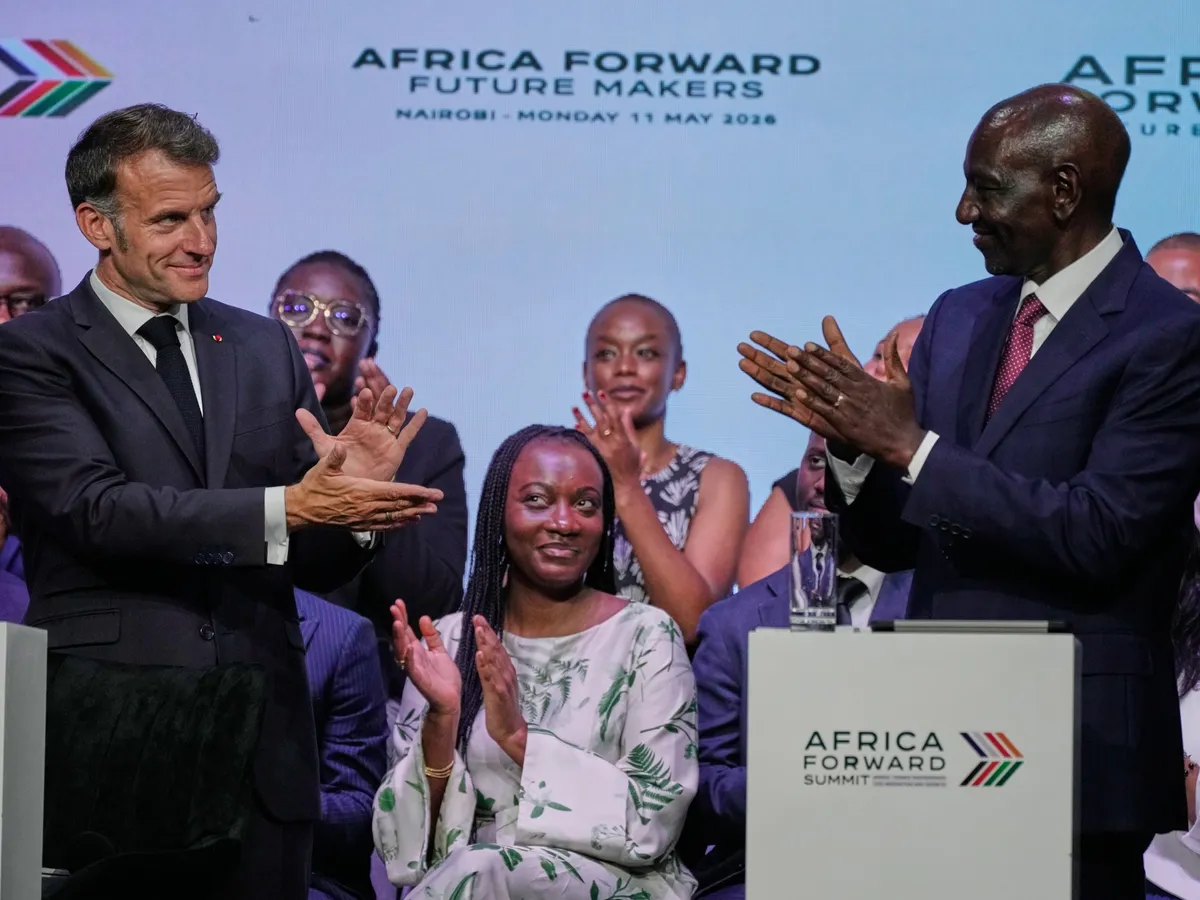
EXPLAINERFrance is facing deepening resentment in former African colonies where it once had political influence.France's President Emmanuel Macron, left, and Kenya's President William Ruto, right, participate in the youth session 'Africa Forward, Creation in Motion' during the Africa-forward-summit" class="entity-link entity-event" data-entity-id="125476" data-entity-type="event">Africa Forward Summit at the University of Nairobi, Kenya, Monday, May 11, 2026 [Brian Inganga/AP]Published On 13 May 2026France’s President Emmanuel Macron has hosted a high-level meeting of heads of state and business leaders alongside his Kenyan counterpart, William Ruto, as Paris continues to pivot to other parts of the continent due to its strained relations with French-speaking West African countries.The conference, which was held on Monday and Tuesday in Kenya’s capital, Nairobi, was France’s first Africa summit in an English-speaking country.Recommended Stories list of 4 itemslist 1 of 4Macron tours East Africa amid push to redefine France’s role in Africalist 2 of 4Kenya hosts France’s Macron: Why the relationship matters to bothlist 3 of 4France’s Macron announces $27bn investment in Africa at Kenya summitlist 4 of 4Burkina Faso dissolves more than 100 NGOs and civil society groupsend of listDue to colonialism, French influence on the continent has been strongest in central and West African Francophone countries, which include those in the arid Sahel region separating the Sahara from the coastal south.However, as insecurity has continued to rack Sahelian countries from Mali to Niger over the last decade, anti-French sentiment has grown due to failed French military interventions and beliefs that Paris was interfering in the affairs of its former colonies.France’s influence has shrunk dramatically across Africa" class="entity-link entity-location" data-entity-id="2447" data-entity-type="location">West Africa in recent years, with some countries turning to alliances with Russia.Now, France says it wants to “overhaul” its engagement with African countries by pivoting to Anglophone countries where it lacks a colonial legacy. The summit in Nairobi was once such an attempt.Was it a success? Here’s what happened at the summit:France’s President Emmanuel Macron attends the Africa-forward-summit" class="entity-link entity-event" data-entity-id="125476" data-entity-type="event">Africa Forward Summit at the Kenyatta International Convention Centre in Nairobi, Kenya, Tuesday, May 12, 2026 [Brian Ingang/AP]What happened at the summit?Macron announced on Tuesday that France would invest 23 billion euros ($27bn) in African countries, particularly in energy, artificial intelligence, and culture.Kenya’s President Ruto, for his part, reiterated several times that the new partnership must respect the sovereignty of African countries.It “must not be built on dependency but on sovereign equality, not on aid or charity but on mutually beneficial investment, and not on extraction or exploitation but on win-win engagements”, Ruto said.However, France’s new investments were overshadowed by online backlash that trailed some of Macron’s actions at the summit.He interrupted an ongoing panel of young artists on one occasion by stepping on stage to scold the audience for murmuring, saying it showed a “total lack of respect”.Macron also claimed at a news conference during the summit that he was “a true Pan-Africanist”, which critics argue is cultural or political appropriation.Ahead of the summit, the French president had said that Paris wanted “to build partnerships on an equal footing, founded on shared interests and tangible results”.But his controversial statements at the Nairobi summit raised questions among many Africans on social media about how seriously France will take its promises.“It’s too early to tell if this is a successful pivot, as the partnership has only just been established,” Beverly Ochieng, Dakar-based Africa" class="entity-link entity-location" data-entity-id="2447" data-entity-type="location">West Africa analyst at intelligence firm Control Risks, told Al Jazeera.Any success, she added, would depend on how Paris and new partners like Kenya manage the shadows cast by growing anti-France sentiments on the continent.“Alongside this is whether France’s economic and cultural investments – a shift from focusing on military and development aid – are indeed on equal footing, are responsive to contemporary political pressures, and facilitate growth and productivity in Africa,” she said.What’s France’s influence in Francophone Africa?France maintains significant colonial-era influence in defence, currency, and commerce in “Francafrique”, which refers to France’s historical sphere of influence in Africa.French soldiers of the ‘Belleface’ Desert Tactical Group (GTD) work to move an all-terrain armoured vehicle from the mud in the Gourma region during Operation Barkhane in Ndaki, Mali, July 28, 2019 [Benoit Tessier/Reuters]Military presenceParis has long maintained a military presence in the former colonies. Following the wave of independence movements in the 1960s, France granted independence to several countries, but in most cases, did not remove military assets.Despite French troop presence, countries in the West African Sahel have continued to witness waves of instability, stemming from separatist movements as well as religious extremism.In 2012, insecurity in Mali escalated, perpetrated by separatists and armed groups working together. The crisis spread across joint borders into Burkina Faso and Niger.Amid the rising insecurity, and upon a request from Mali, France deployed thousands of troops, including several fighter jets stationed in Chad, a former colony. Over the next decade, attacks declined but continued intermittently.However, when the military in Mali seized power in 2020, France condemned the coup led by current President Assimi Goita, angering the new government. Paris soon began to shift its assets and troops to Niger.In a turn of events, the military also seized power in Burkina Faso and Niger and ordered French troops out.Mali, Burkina Faso, and Niger have since formed the Alliance of Sahel States (AES) and turned to Russian mercenaries for support.Even the more friendly governments of the Ivory Coast, Chad, and Senegal have requested the exit of French troops.France handed over control of its last major military facility in Senegal last July after Senegalese President Bassirou Diomaye Faye, who attended the Kenya summit, said French bases were incompatible with the country’s sovereignty.France-backed currencyDespite reduced military influence, France retains monetary control through the Communaute Financiere Africaine (CFA) franc.The currency was created in 1945. At the time, its acronym stood for “Colonies Francaises d’Afrique” (French Colonies in Africa).There are two versions: the West African CFA franc and the Central African franc. Collectively, about 14 countries with a combined population of around 210 million use it, including the AES states.The CFA has a fixed exchange rate that is tied to France’s own currency, the euro. Since the end of World War II, all CFA countries were required to keep 50 percent of their reserves in the French Treasury, and a French representative was always present on the currency board.Although the CFA has been challenged by critics as a colonial relic, it remains in use to date.In 2019, the West African franc was reformed so that countries no longer needed to keep half of their reserves in France.However, it is still pegged to France’s currency, with supporters arguing its link to the more stable euro has protected those countries from inflation in a turbulent region.A man carries water to a fire while a French-owned Auchan supermarket burns in the background in Dakar, Senegal on March 16, 2023 [Guy Peterson/AFP]French businessesThere are more than 3,000 French ventures in Africa, according to business intelligence firm Kasi Insight.Most are concentrated in North Africa – Morocco, Algeria, and Tunisia, and other Francophone countries. South Africa also holds significant numbers.These businesses range from telecommunication companies like Orange to energy companies like TotalEnergies and Orano, as well as banks like Societe Generale.In the West African Sahel, French investments are facing turbulent times amid tensions with the military governments.In Niger, for example, Orano, which has mined uranium in the country for 50 years, said it lost control of its local subsidiaries after the 2023 coup. Last year, Niamey nationalised the mining company Somair, a subsidiary in which Orano had a 63 percent stake.“Several French-linked companies have either reduced visibility, frozen expansion plans, or faced renegotiation pressure,” Yannick Lefang, founder of Kasi Insight, told Al Jazeera.Sahel governments are now turning to partnerships with Russia, Turkiye, Gulf States, and increasingly, China.However, Lefang said, Sahel governments cannot easily disengage from consumer-facing French companies like the Orange telecoms network because “they are deeply embedded in local economies and employment structures”.Some 44 percent of the nearly 400 million people who speak French are in Africa. Kinshasa, the capital city of the Democratic Republic of the Congo, is known as the largest French-speaking city in the world.Paris is swapping military support and development aid for pure commerce, analysts say.“While headlines often frame this as ‘France leaving Africa’, our data suggests the reality is more a redistribution of influence than a full retreat,” Lefang said.France has notably moved closer to Nigeria and Kenya, with which it does not have a colonial history. The two countries host nearly 300 French companies combined.Nigeria, Africa" class="entity-link entity-location" data-entity-id="2447" data-entity-type="location">West Africa’s largest economy, announced in March that it was collaborating with Paris to purchase military equipment and train its army amid a worsening insecurity crisis.Earlier in 2024, both countries had signed a 300-million-euro ($350m) investment agreement to support critical infrastructure, healthcare, transportation, and renewable energy in Nigeria.Similarly, France has signed a defence pact with Kenya, an important economic hub in East Africa, to boost cooperation in intelligence sharing, maritime security, and peacekeeping.However, Anglophone countries are highly competitive, analysts say.In 2025, President Ruto of Kenya terminated a highway contract with France’s Vinci Highways SAS due to cost concerns. The contract has now been handed to a Chinese company.
SRCAl Jazeera
LANGEN
LEANCenter
WORDS1 505
ENT12
WED · 2026-05-13 · 17:43 GMTBRIEF NSR-2026-0513-76032
NSR-2026-0513-76032Analysis·EN·Political Strategy
Can Macron’s Kenya visit revive French influence in Africa?
French President Emmanuel Macron held a summit in Nairobi, Kenya, on May 11-12, 2026, with Kenyan President William Ruto and other African leaders and business figures. This marked France's first Africa summit in an English-speaking nation, signaling a strategic pivot away from its traditional Francophone West African sphere of influence.
Shola LawalAl JazeeraFiled 2026-05-13 · 17:43 GMTLean · CenterRead · 7 min
Al JazeeraFIG 01
Reading time
7min
Word count
1 505words
Sources cited
2cited
Entities identified
12entities
Quality score
100%
§ 01
Briefing Summary
AI-generatedNEWSAR · AI
French President Emmanuel Macron held a summit in Nairobi, Kenya, on May 11-12, 2026, with Kenyan President William Ruto and other African leaders and business figures. This marked France's first Africa summit in an English-speaking nation, signaling a strategic pivot away from its traditional Francophone West African sphere of influence. The shift is driven by growing anti-French sentiment in former colonies due to perceived interference and failed military interventions, leading some nations to seek alliances with Russia. During the summit, Macron pledged a 23 billion euro ($27 billion) investment in African countries, focusing on energy, artificial intelligence, and culture, aiming to redefine France's engagement with the continent by building new partnerships in Anglophone nations.
Confidence 0.90Sources 2Claims 4Entities 12
§ 02
Article analysis
Model · rule-basedFraming
Political Strategy
Diplomatic
Tone
Measured
AI-assessed
CalmNeutralAlarmist
Factuality
0.60 / 1.00
Mixed
LowHigh
Sources cited
2
Limited
FewMany
§ 03
Key claims
4 extracted01
The new partnership must respect the sovereignty of African countries and be built on sovereign equality, not aid or charity, but on mutually beneficial investment, and not on extraction or exploitation but on win-win engagements.
quoteWilliam Ruto
Confidence
0.95
02
France would invest 23 billion euros ($27bn) in African countries, particularly in energy, artificial intelligence, and culture.
statisticEmmanuel Macron
Confidence
0.95
03
France's influence has shrunk dramatically across West Africa in recent years, with some countries turning to alliances with Russia.
factual
Confidence
0.85
04
France is facing deepening resentment in former African colonies where it once had political influence.
factual
Confidence
0.80
§ 04
Full report
7 min read · 1 505 words§ 05
Entities
12 identifiedKey playerOppositionContextPositiveNeutralNegative
Locations9
§ 06
Keywords & salience
10 termsfrench influence in africa
1.00
macron's visit to kenya
0.90
france-africa relations
0.80
anti-french sentiment
0.70
colonial legacy
0.60
french investment in africa
0.60
west africa
0.50
africa forward summit
0.50
sahel region
0.40
artificial intelligence
0.40
§ 07
Topic connections
Interactive graph No topic relationship data available yet. This graph will appear once topic relationships have been computed.