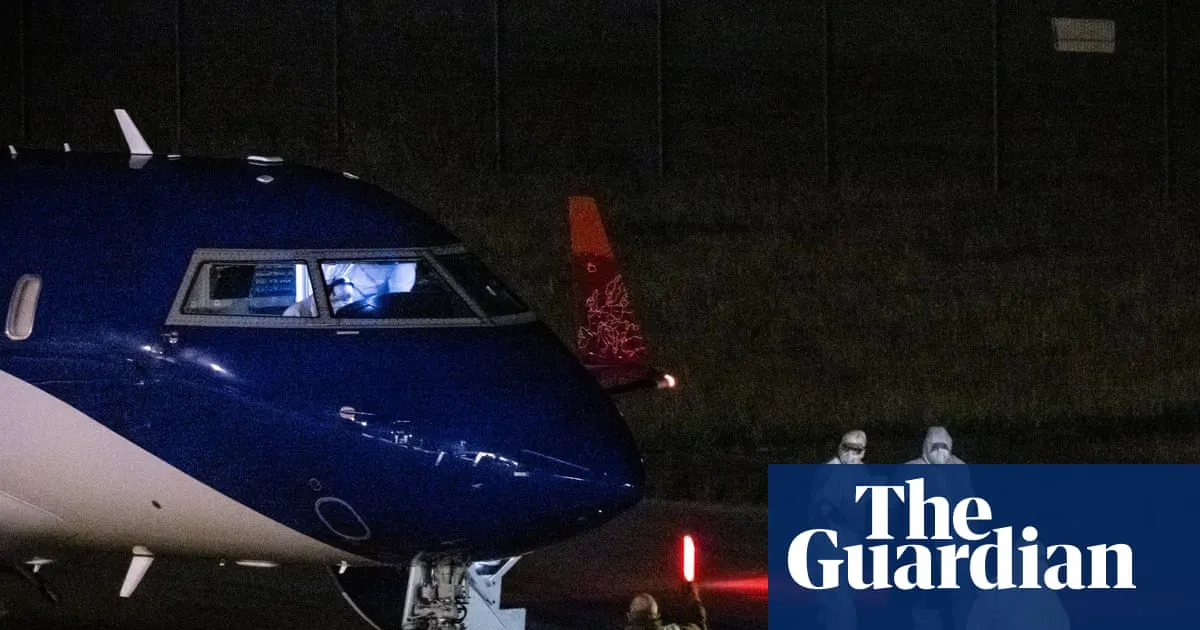
Passengers of the hantavirus-affected MV Hondius, including Australians, arrive on a second evacuation flight from Tenerife at Eindhoven air base, the Netherlands. Six passengers will leave the Netherlands on Thursday, arriving in Perth on Friday. Photograph: Rob Engelaar/EPA View image in fullscreen Passengers of the hantavirus-affected MV Hondius, including Australians, arrive on a second evacuation flight from Tenerife at Eindhoven air base, the Netherlands. Six passengers will leave the Netherlands on Thursday, arriving in Perth on Friday. Photograph: Rob Engelaar/EPA Australians from hantavirus cruise ship to fly out of Netherlands in full PPE after plane and crew secured Health minister Mark Butler says six passengers who have tested negative for hantavirus will land in Australia" class="entity-link entity-location" data-entity-id="706" data-entity-type="location">Western Australia on Friday Follow our Australia news live blog for latest updates Get our breaking news email, free app or daily news podcast Four Australian citizens who were aboard the MV Hondius, the cruise ship at the centre of the hantavirus outbreak, will soon be home after the government secured a suitable aircraft and crew for the journey. The health minister, Mark Butler, said the citizens, along with a permanent resident and a New Zealand citizen, were due to take off from the Netherlands on Thursday evening local time and would land in Perth on Friday afternoon. “Six passengers are still in good health, they have all tested negative for hantavirus and are showing no symptoms as well,” Butler said. “Passengers and crew members will travel this flight for its duration in full PPE. There are very strict conditions about the flight, the landing, and the quarantine arrangements.” The passengers will be subject to a quarantine order, remaining at Australia" class="entity-link entity-location" data-entity-id="706" data-entity-type="location">Western Australia’s Bullsbrook quarantine facility for at least three weeks. The flight crew bringing them home will also be required to quarantine, either in Australia or in another country. The Department of Foreign Affairs and Trade had scrambled to find an aircraft and crew who were able to complete quarantine, after a 48-hour deadline was imposed on their international transfer through the Netherlands by Dutch authorities. The outbreak now includes 11 reported cases, with nine officially confirmed. Three people have died. The MV Hondius, which is registered in the Netherlands, is on its way to Rotterdam, with 25 crew members and two medical staff on board. It is expected to arrive on Monday. After disembarking, the crew will enter quarantine and the ship will undergo what its operator calls a “thorough cleaning and disinfection process”. “The operation to bring all those on board home in the safest possible way was highly complex. It required intensive cooperation with national and international partners,” the Dutch government said in a statement on Tuesday. “The Dutch government thanks all those involved, including the shipping company, and expresses its gratitude and appreciation for the cooperation with Spain.” The Australian government has been working around the clock to bring the group home. “This is a difficult arrangement to make,” Butler told ABC News on Tuesday, adding the travellers were in “good health and relatively good spirits” at the time. “You’ve got to have crew that are willing to isolate at the end of the flight, you’ve got to have a flight that has some refuelling arrangements put in place between the Netherlands and Australia,” Butler said. “And it’s important that we’ve put those quarantine arrangements in place, ready to go when they do land in Australia.” Butler said the hantavirus had been listed under Australia’s Biosecurity Act, which allows the government to make quarantine orders. Hantavirus, a group of viruses found around the world, is generally spread via infected rodents to humans through faeces, urine or saliva. Human-to-human transmission is very uncommon, but can occur through close and prolonged contact, the Australian Centre for Disease Control says. Still, infection can be serious, resulting in critical illness or death. Three people have died from the outbreak, and a French woman is currently being treated after falling critically ill, with life-threatening heart and lung problems. The World Health Organization maintains that the threat to the general public remains low, but officials have urged caution. “At the moment, there is no sign that we are seeing the start of a larger outbreak,” Tedros Adhanom Ghebreyesus, the WHO director general, told reporters on Tuesday. “But of course the situation could change, and given the long incubation period of the virus, it’s possible we might see more cases in the coming weeks.” Butler said this week Australia’s quarantine protocols would be among the most stringent in the world. Explore more on these topics Hantavirus Health (Australia news) Infectious diseases Perth Australia" class="entity-link entity-location" data-entity-id="706" data-entity-type="location">Western Australia Health (Society) news Share Reuse this content
SRCThe Guardian - World News
LANGEN
LEANCenter-Left
WORDS772
ENT11
THU · 2026-05-14 · 04:13 GMTBRIEF NSR-2026-0514-76120
NSR-2026-0514-76120News Report·EN·Public Health
Australians from hantavirus cruise ship to fly out of Netherlands in full PPE after plane and crew secured
Six passengers, including four Australian citizens, who were aboard the hantavirus-affected MV Hondius cruise ship are set to return to Perth, Western Australia, on Friday. They arrived in the Netherlands via an evacuation flight from Tenerife and will depart on a second flight Thursday evening, traveling in full Personal Protective Equipment (PPE).
Nick Visser and Cait KellyThe Guardian - World NewsFiled 2026-05-14 · 04:13 GMTLean · Center-LeftRead · 4 min
The Guardian - World NewsFIG 01
Reading time
4min
Word count
772words
Sources cited
3cited
Entities identified
11entities
Quality score
100%
§ 01
Briefing Summary
AI-generatedNEWSAR · AI
Six passengers, including four Australian citizens, who were aboard the hantavirus-affected MV Hondius cruise ship are set to return to Perth, Western Australia, on Friday. They arrived in the Netherlands via an evacuation flight from Tenerife and will depart on a second flight Thursday evening, traveling in full Personal Protective Equipment (PPE). All six passengers have tested negative for hantavirus and are asymptomatic. Upon arrival in Perth, they will undergo a mandatory three-week quarantine at a dedicated facility. The flight crew will also be subject to quarantine requirements. The outbreak has resulted in 11 reported cases, with three deaths.
Confidence 0.90Sources 3Claims 5Entities 11
§ 02
Article analysis
Model · rule-basedFraming
Public Health
Diplomatic
Tone
Measured
AI-assessed
CalmNeutralAlarmist
Factuality
0.90 / 1.00
Factual
LowHigh
Sources cited
3
Well sourced
FewMany
§ 03
Key claims
5 extracted01
The passengers will undergo a three-week quarantine at Western Australia’s Bullsbrook facility.
factualarticle
Confidence
1.00
02
The MV Hondius outbreak has 11 reported cases, 9 confirmed, and 3 deaths.
statisticarticle
Confidence
1.00
03
Passengers and crew members will travel in full PPE due to strict conditions.
factualMark Butler
Confidence
1.00
04
Four Australian citizens, a permanent resident, and a New Zealand citizen are returning home from the MV Hondius.
factualarticle
Confidence
1.00
05
Six passengers who tested negative for hantavirus will land in Perth on Friday.
factualMark Butler
Confidence
1.00
§ 04
Full report
4 min read · 772 words§ 05
Entities
11 identifiedKey playerOppositionContextPositiveNeutralNegative
Organizations2
§ 06
Keywords & salience
10 termshantavirus
1.00
cruise ship
0.90
evacuation flight
0.80
ppe
0.70
quarantine
0.70
mv hondius
0.60
australia
0.50
netherlands
0.50
perth
0.40
mark butler
0.40
§ 07
Topic connections
Interactive graph Network visualization showing 51 related topics
View Full Graph Person Organization Location Event|Click node to navigate|Edge numbers = shared articles