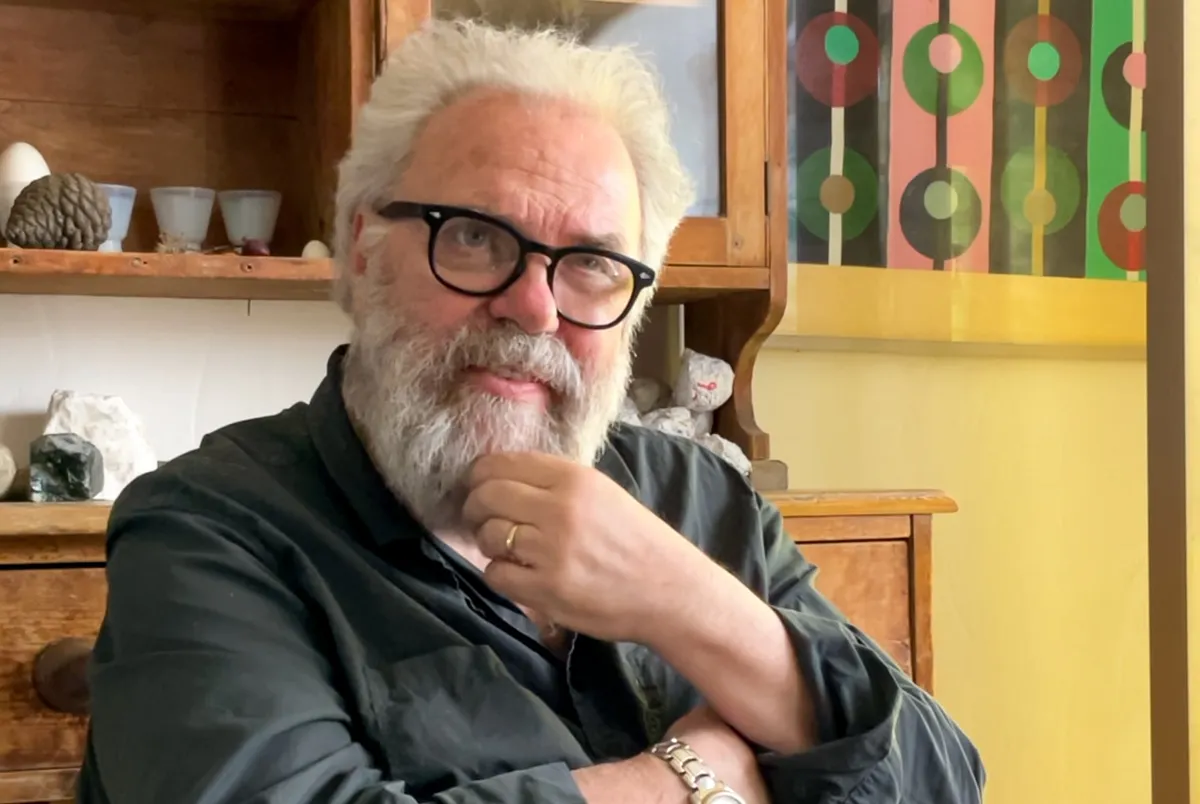
UK artist defends ‘Drawings Against Genocide’ show after cancellationMatthew Collings says his work depicting Israeli violence against Palestinians has been intentionally misinterpreted as anti-Semitic.Matthew Collings says his drawings featuring violence by Israeli state actors against Palestinians are 'artistic metaphors for Zionism' [Laura O'Connor]Published On 14 May 2026Norfolk, United Kingdom – Matthew Collings, an English artist in his 70s, sketches on the papers in front of him at his home in the scenic coastal county of Norfolk.Over the past six years, since moving away from the art commentary and criticism that he focused on for decades, he has made more than 3,000 drawings.Recommended Stories list of 4 itemslist 1 of 4Australia festival faces mass boycott after dropping Palestinian authorlist 2 of 4Juliet Stevenson on Gaza: ‘I’m disappointed by the silence in my industry’list 3 of 4Arundhati Roy ‘shocked’ by jury’s Gaza remarks, quits Berlin film festivallist 4 of 4Gaza at the Venice Biennale: Where language falls short, threads take overend of listSince October 2023, a good third of them have focused on Israel’s genocide against Palestinians.Many were to be displayed in a May iteration of his show, Drawings Against Genocide, at a London gallery this month. However, the show was abruptly cancelled following an intervention by a group called the Israel" class="entity-link entity-organization" data-entity-id="126807" data-entity-type="organization">UK Lawyers for Israel (UKLFI), which claimed the images were anti-Semitic.The exhibit, which debuted under its current title in Margate earlier this year at Joseph Wales Studios, is comprised of 130 drawings that depict violence against Palestinians, with various blood-bathed military, political, and business leaders.“It’s very clear in the title what they’re against, they’re not against Jews,” Collings said of his artworks in an interview with Al Jazeera.“They’re against genocide. The genocide isn’t committed by Jews. It’s committed by Zionists. It’s committed by Israel, which is a state that would not exist were it not for Zionism,” he added, referring to the nationalist, political ideology that called for the creation of a Jewish state. “Nothing in my drawings for genocide is remotely anti-Semitic.”The allegations of anti-Semitism have focused on the portrayals of Jewish people in the drawings and allegations that various images depict blood libel, child sacrifice, and other hateful tropes.But Collings said there are no images of such tropes in the show.“Of 130 drawings, 30 have recognisable public figures who are Jewish, and half of those people are heroes in my eyes,” Collings said.These include images of Moses teaching the commandment “Thou shalt not kill”, and a tea party of Walter Benjamin, Hannah Arendt, Karl Marx, and the American political scientist and activist Norman Finkelstein.“And the half that I criticise, I don’t criticise for being Jewish, I criticise them for supporting genocide,’ Collings explained to Al Jazeera.One drawing depicts the American comedian Jerry Seinfeld, who regularly expresses support for Israel’s army amid the genocide.“It depicts demons and monsters, but they are artistic metaphors for Zionism, brutality, and violence. They’re not Jews covered in scaly skin or demon eyes. They are an abstract concept, which is what art has always done.”At the Margate show, a pro-Israel activist and writer “staged an outrage stunt”, appearing at the gallery and accusing Collings of being anti-Semitic, the artist said. Shortly after the opening, pro-Israel activists contacted Kent Police with claims that the show was anti-Semitic. Kent Police, however, found that no criminal offences had taken place.The writer in question was Sunday Telegraph columnist Zoe Strimpel, who later spoke about her experience on GB News, a right-wing media outlet, saying she wanted the police to “do something”. She said she had met Collings at the show and told him that the Israeli state “is also the Jewish state”.One of Collings’s artworks of the Drawings Against Genocide show includes the words, ‘Thou shalt not kill’ [Courtesy: Matthew Collings]The Telegraph, a British conservative newspaper, later reported that, in a letter to the complainant, Kent Police wrote, “The artwork is critical of the Israeli state and its actions but does not include content that is directly abusive or insulting towards Jewish people as a group. There is also no indication of an intent by the artist to stir up racial or religious hatred, which is a specific requirement within the legislation.”“They did my work for me,” Collings said. “Jewishness does not mean Zionism.”Shortly after reaching their conclusion, however, Kent Police received more than 1,000 nearly identical emails from pro-Israel senders protesting their decision, prompting an investigation of a possible distributed denial-of-service (DDoS) attack.Collings and his partner have, similarly, received hundreds of thousands of emails since various pro-Israel news outlets began covering the case and advocating for the closure of the show.“Everything – every single thing – that they say about the show turned out to be untrue,” Collings says. “There is no anti-Semitic content to the show, as the police said.”In a letter obtained by Al Jazeera, originally sent to the Margate venue and dated March 22, 2026, UKLFI urged the gallery to cancel the exhibit and claimed that “many of the images are likely to breach” public disorder laws, warning that “for your information, a person guilty of an offence” could be fined.Collings says his works are an ‘abstract concept’ [Courtesy: Matthew Collings]UKLFI stated on its website that a similar letter was sent to Delta House in London, which responded by cancelling Drawings Against Genocide.In the statement, UKLFI wrote, “We welcome the decision to cancel this exhibition. Freedom of expression is a fundamental right, but it does not extend to the promotion of material that relies on anti-Semitic tropes, dehumanising imagery, and conspiracy narratives about Jews.”Delta House has not responded to Al Jazeera’s request for comment.Anna Ost, senior legal officer at the European Legal Support Center (ELSC), said she has seen silencing tactics before.“I can’t comment on this particular instance as I haven’t seen the exhibition; however, the fact that the Kent Police found no case to answer points to this being another example of the pattern of legally baseless threats directed at suppressing pro-Palestine expression,” she told Al Jazeera.Despite the attacks, Collings remains undeterred, with upcoming shows being scheduled throughout the UK and in Australia.“Wherever there is a battle lost, several are won,” he said, putting down his sketching pencil.However, the cancellation of his May show created logistical concerns.“Whatever the venue is, the person in charge of it has to be an activist like us. If they’re not, they will be intimidated or somehow persuaded by Israel" class="entity-link entity-organization" data-entity-id="126807" data-entity-type="organization">UK Lawyers for Israel,” he said.One drawing depicts an ‘anti-Zionist tea party’ with guests including Karl Marx [Courtesy of Matthew Collings]In the ELSC’s Britain’s Index of Repression, a database created in collaboration with Forensic Architecture to track the repression of pro-Palestine expression, Israel" class="entity-link entity-organization" data-entity-id="126807" data-entity-type="organization">UK Lawyers for Israel appears 128 times, with 20 of these cases targeting artistic and cultural institutions, Ost said.“Since art and culture have the potential of reaching larger audiences, they would be a strategic target for those actors sustaining Israel’s genocide and settler colonialism, to make sure Palestine is erased, and no one is talking about genocide or challenging complicity in it,” she noted.David Cannon, chair of the Jewish Network for Palestine, told Al Jazeera in a phone call that the suppression of pro-Palestine expression is “systemic”.He cited recent protests against the British Museum after it removed several mentions of “Palestine” in its displays and information panels.The British Museum made these changes after the Israel" class="entity-link entity-organization" data-entity-id="126807" data-entity-type="organization">UK Lawyers for Israel intervened, as reported by the Guardian, mirroring the pattern of Delta House and several of the institutions tracked by the ELSC.
SRCAl Jazeera
LANGEN
LEANCenter
WORDS1 241
ENT11
THU · 2026-05-14 · 08:30 GMTBRIEF NSR-2026-0514-76179
NSR-2026-0514-76179News Report·EN·Human Rights
UK artist defends ‘Drawings Against Genocide’ show after cancellation
UK artist Matthew Collings is defending his exhibition "Drawings Against Genocide" after its cancellation in London. The show, featuring over 130 drawings depicting violence against Palestinians, was scheduled for May but was called off following claims by UK Lawyers for Israel (UKLFI) that the artworks were anti-Semitic.
By Laura O'ConnorAl JazeeraFiled 2026-05-14 · 08:30 GMTLean · CenterRead · 5 min
Al JazeeraFIG 01
Reading time
5min
Word count
1 241words
Sources cited
2cited
Entities identified
11entities
Quality score
100%
§ 01
Briefing Summary
AI-generatedNEWSAR · AI
UK artist Matthew Collings is defending his exhibition "Drawings Against Genocide" after its cancellation in London. The show, featuring over 130 drawings depicting violence against Palestinians, was scheduled for May but was called off following claims by UK Lawyers for Israel (UKLFI) that the artworks were anti-Semitic. Collings asserts his work uses artistic metaphors for Zionism and criticizes Israeli state actions, not Jewish people, stating the title clearly indicates his opposition to genocide. He denies that his drawings contain anti-Semitic tropes, such as blood libel or child sacrifice, which UKLFI alleged were present in his depictions of public figures. The exhibition had previously shown in Margate.
Confidence 0.90Sources 2Claims 5Entities 11
§ 02
Article analysis
Model · rule-basedFraming
Human Rights
Social Justice
Tone
Measured
AI-assessed
CalmNeutralAlarmist
Factuality
0.60 / 1.00
Mixed
LowHigh
Sources cited
2
Limited
FewMany
§ 03
Key claims
5 extracted01
Collings claims that of 130 drawings, 30 feature recognizable public figures, half of whom he considers heroes.
factualMatthew Collings
Confidence
1.00
02
Collings asserts that none of his drawings for the 'Drawings Against Genocide' show are remotely anti-Semitic.
quoteMatthew Collings
Confidence
1.00
03
Collings states his drawings depict Israeli violence against Palestinians and are artistic metaphors for Zionism, not anti-Semitic.
quoteMatthew Collings
Confidence
1.00
04
The cancellation was due to claims by UK Lawyers for Israel (UKLFI) that the artworks were anti-Semitic.
factualarticle
Confidence
1.00
05
UK artist Matthew Collings' exhibition 'Drawings Against Genocide' was cancelled by a London gallery.
factualarticle
Confidence
1.00
§ 04
Full report
5 min read · 1 241 words§ 05
Entities
11 identifiedKey playerOppositionContextPositiveNeutralNegative
Organizations3
Locations5
§ 06
Keywords & salience
10 termsmatthew collings
1.00
drawings against genocide
1.00
israeli violence
0.90
palestinians
0.90
anti-semitism
0.80
zionism
0.70
artistic metaphors
0.60
uk lawyers for israel
0.50
art exhibition
0.40
blood libel
0.40
§ 07
Topic connections
Interactive graph Network visualization showing 51 related topics
View Full Graph Person Organization Location Event|Click node to navigate|Edge numbers = shared articles