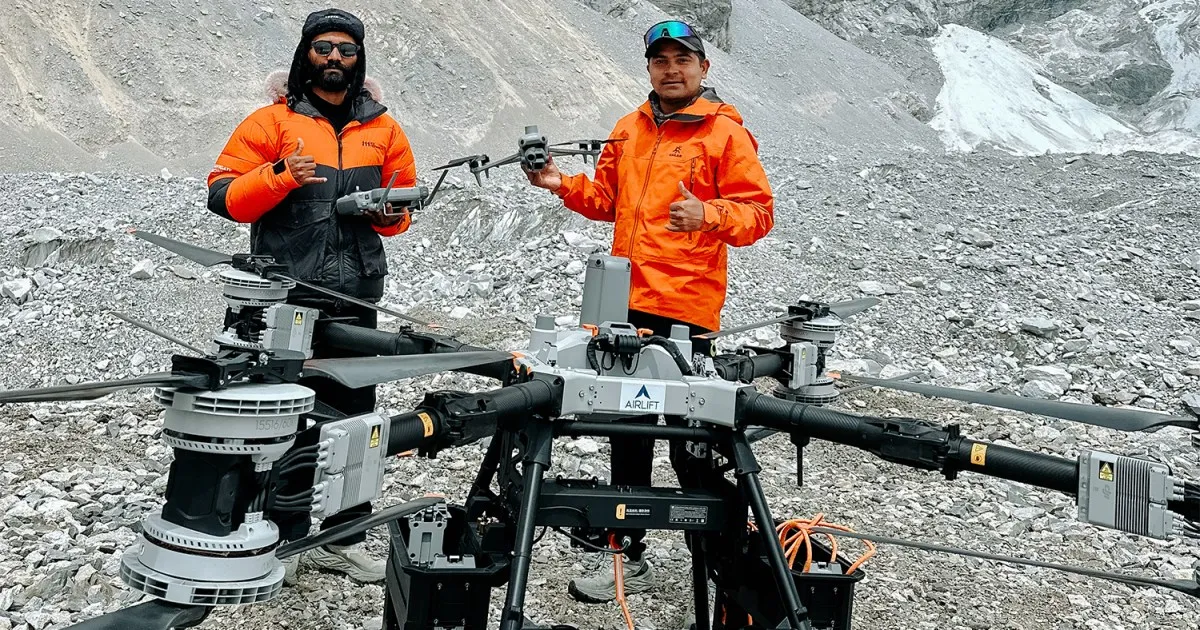
The superpowers are competing for a technological foothold on the world’s highest peak, pushing Nepal towards a geopolitical chessboard.Nepal's AirLift Technology team operating China-made DJI FlyCart 100 drone at the Everest Base Camp [Courtesy of Milan Pandey]Published On 14 May 2026Kathmandu, Nepal – On May 1, a team of officials from the United States – led by President Donald Trump’s special envoy for South and Central Asia, Sergio Gor – took a helicopter to the base camp of Mount Everest.Located at an altitude of 5,364 metres (17,600 feet), the base camp is where Everest climbers acclimatise to the thin air before heading towards the 8,849-metre (29,032ft) summit in Nepal, home to eight of the world’s 10 highest peaks.Recommended Stories list of 4 itemslist 1 of 4Revealed: US grounded Chinese drones despite security warningslist 2 of 4US-China head-to-head: Explained in 11 maps and chartslist 3 of 4Nepal lodges protest against India over long-running border disputelist 4 of 4Photos: Trump in China for talks with Xi Jinpingend of listThe US team had reached the camp to test the capacity of their home-made Alta X Gen 2 drone in carrying supplemental oxygen bottles, ladders, mountain gear and food from the base camp to Camp I on the mountain’s southern ridge at an altitude of 6,130 metres (20,112ft).It is a task the Chinese-made DJI FlyCart 30 drones have already been performing since 2024.For its test, the US team hired Seven Summit Treks, an expedition agency, and local drone pilots were called to the base camp. But as Gor and his team reached the base camp, the US plan hit a snag.Nepal’s Ministry of Home Affairs refused to issue a drone flight permit to the US officials. The ministry’s internal memo, obtained by Al Jazeera, said the permit was refused due to “drone flying procedures” and “security sensitivity”.The Alta X Gen 2 drone never flew near Everest, and the US officials returned to the capital, Kathmandu.Why the US wanted to test its droneThe controversy has trapped Nepal in a tussle between the US and its archrival China, turning the world’s highest peak into a new theatre of the tech war between the world’s most powerful economies.China, Nepal’s immediate neighbour on the other side of the Himalayas, was the first country to establish its technological foothold on Everest, which straddles the border between the two Asian countries.In 2024, China’s DJI FlyCart 30 drone was tested for the first time to ferry logistics for climbers. After a successful test, DJI gave two drones to AirLift Technology, a Nepalese drone company, to carry supplies to Camp I, providing the Sherpas, who traditionally did the job, with considerable respite.This year, DJI provided its latest version of the drone, FlyCart 100, to AirLift, even before its formal launch in the market. Drone operators say FlyCart 100 can carry up to 45kg (99 pounds) to Camp I in less than three minutes, nearly half of its actual carrying capacity at sea level.“It can carry loads and return to the base camp, bringing down garbage, in about eight minutes. Sherpas need to walk six to seven hours to reach Camp I for the same work and take a whole day to get there and return,” Milan Pandey, the director of AirLift Technology, told Al Jazeera.The latest version of DJI FlyCart 100 can carry at least 10 oxygen cylinders to Camp I in a few minutes, compared with three Sherpas who take a whole day to complete the job, and bring back poop bags and other rubbish from the mountain slopes. On normal days, a DJI FlyCart 100 carries more than 900kg of load to Camp I every day, according to drone operators.China’s DJI FlyCart 100 carrying loads to Camp I from Everest Base camp [Courtesy of Milan Pandey]Analysts say the US and China are placing Nepal in a potentially precarious position by using its terrain as a place to test sensitive technology. They say being caught in the middle of the rivalry between the superpowers is a “tricky position” for Nepal.“The fact that Nepalese officials have already flip-flopped their decision based on pressure from Beijing and Washington demonstrates how potentially fraught such a situation can be,” Steven Feldstein, senior fellow at Carnegie Endowment for International Peace, told Al Jazeera. “Given how critical a role drones are playing in the security landscape, this only ratchets up the stakes further.”Tussle before climbing seasonThe denial of permission to the US team came as the annual Everest climbing season began.On Wednesday, a 12-member team of Nepalese climbers reached the summit to clear the route for hundreds of mountaineers expected to make the ascent in the coming weeks. China has restricted commercial Everest expeditions from its side.Among a record 492 climbing permits issued by the Nepalese government this year, the Chinese topped the list with 109, followed by 76 for US nationals.The US, despite being a leading unmanned aerial vehicle (UAV) manufacturer, is a prominent consumer of Chinese drones. However, concerns over security and surveillance by Chinese companies have forced the US to restrict the use of their drones and expand its own market.But the denial of permission to the US team to test its drone had another consequence: the Nepalese authorities cancelled the drone permits of Chinese DJI FlyCart 100 drones as well for a week.“Drones have made it easier, but the controversy hampered our work this year,” Pandey of AirLift Technology told Al Jazeera. “The tussle affected our regular work for more than a week. We couldn’t ferry ladders to the Everest icefall when the drone was needed the most for rope fixing.”Seven Summit had hired AirLift as its drone operator.Over the years, the use of Chinese drones in the Everest expedition has reduced the risk for the Sherpas, who traditionally carry the mountain gear, food and climbing equipment along the treacherous routes to Camp I. Drones save time and minimise risk for Sherpas, five of whom have already lost their lives this year, even before the official Everest season began.But Nepalese security analysts say China, the US and even India try to penetrate an impoverished Nepal in the name of economic aid and technological support.“We easily accept their aid, without verifying what kind of technology they are providing,” said Binoj Basnyat, a retired major-general of the Nepalese army, suspecting these devices could be used for surveillance.“Orders should be as per our need. Permission should be given with due precaution,” he said.‘Trump’s men going to Nepal’Expedition organisers say China’s objections to Nepal allowing US companies could have forced the government to cancel the drone flight permission.“China was aware of Trump’s men going to Nepal. They [Americans] went to the Everest base camp and showcased a new drone. That complicated the issue,” said the owner of an expedition agency, who refused to reveal his identity, fearing it could affect his business in the days to come.As the task of fixing ropes along the way to Everest was made more difficult by a massive hanging icefall, the expedition operators urged the Nepalese government to lift its ban on drone operation near the summit.The ban was lifted on May 9. China’s DJI FlyCart 100 resumed the load ferry, while the US-made Alta X Gen 2 drone remains grounded at the base camp.Pandey said his company is not keen on US drones after a test in Kathmandu showed it can carry only 5kg at high altitudes. Compared with the DJI FlyCart 100, the US drones were also more expensive, he said.But Gor, Trump’s special envoy who had travelled to the Everest base camp, hoped the new UAV technology would enable deliveries on Everest in minutes as opposed to days-long treks earlier.“The US leads in innovation, and we are glad to partner with local Nepali companies to bring cutting-edge technology to Nepal,” the US Embassy in Nepal quoted Gor as saying on May 2.“Nepal’s new government will work to increase the fruitful partnership between our two nations,” he said. In March, Nepal elected a 35-year-old rapper, Balendra Shah, as prime minister after a landmark vote.Gao Liang, associate fellow and vice director of Nepal Study Centre at China’s Sichuan University, said Beijing has no intention of engaging in technological competition with the US in the Everest region.“There is already a domestic consensus in Nepal that the United States’s geopolitical strategic interests in Nepal are primarily to use the country to advance America’s strategic goals against China,” he said. “Therefore, the so-called geopolitical complications largely originate from the US side, while China is only responding passively.”Nepalese foreign policy expert Vijaya Kant Karna fears the tech war on the Everest may trigger geopolitical tensions in the Himalayas. He said the drone flight permission was given without analysing the pros and cons of the US-China tech war in Nepal.“What happens if they test and misuse the technology in sensitive areas like the trans-Himalayas region?” asked Karna, who heads the Centre for Social Innovation and Foreign Policy, a Nepalese think tank.
SRCAl Jazeera
LANGEN
LEANCenter
WORDS1 486
ENT12
THU · 2026-05-14 · 08:23 GMTBRIEF NSR-2026-0514-76180
NSR-2026-0514-76180News Report·EN·Technology
Nepal in a bind as US-China drone war reaches Everest
Nepal finds itself in a geopolitical bind as the US and China engage in a technological competition on Mount Everest. On May 1, a US delegation, led by a special envoy, attempted to test their Alta X Gen 2 drone at Everest Base Camp to transport supplies.
Bhadra SharmaAl JazeeraFiled 2026-05-14 · 08:23 GMTLean · CenterRead · 6 min
Al JazeeraFIG 01
Reading time
6min
Word count
1 486words
Sources cited
1cited
Entities identified
12entities
Quality score
100%
§ 01
Briefing Summary
AI-generatedNEWSAR · AI
Nepal finds itself in a geopolitical bind as the US and China engage in a technological competition on Mount Everest. On May 1, a US delegation, led by a special envoy, attempted to test their Alta X Gen 2 drone at Everest Base Camp to transport supplies. However, Nepal's Ministry of Home Affairs denied the US team a drone flight permit, citing "drone flying procedures" and "security sensitivity." This refusal prevented the US drone test, while China has already been using its DJI FlyCart 30 drones for similar logistical support on Everest since 2024. The incident highlights a growing tech rivalry between the two superpowers, with Nepal caught in the middle as Everest becomes a new arena for their competition.
Confidence 0.90Sources 1Claims 4Entities 12
§ 02
Article analysis
Model · rule-basedFraming
Technology
Diplomatic
Tone
Mixed Tone
AI-assessed
CalmNeutralAlarmist
Factuality
0.70 / 1.00
Factual
LowHigh
Sources cited
1
Limited
FewMany
§ 03
Key claims
4 extracted01
The US team was led by Donald Trump’s special envoy for South and Central Asia, Sergio Gor.
factualarticle
Confidence
0.90
02
China's DJI FlyCart 30 drones have been used since 2024 to ferry logistics for climbers on Everest.
factualarticle
Confidence
0.90
03
US officials attempted to test an Alta X Gen 2 drone at Everest Base Camp but were denied a permit by Nepal's Ministry of Home Affairs.
factualAl Jazeera
Confidence
0.90
04
DJI provided its latest drone, FlyCart 100, to Nepalese company AirLift Technology before its formal market launch.
factualarticle
Confidence
0.80
§ 04
Full report
6 min read · 1 486 words§ 05
Entities
12 identifiedKey playerOppositionContextPositiveNeutralNegative
Organizations5
§ 06
Keywords & salience
9 termsus-china drone war
1.00
mount everest
0.90
geopolitical chessboard
0.80
technological foothold
0.70
drone technology
0.60
nepal
0.50
dji flycart 30
0.40
alta x gen 2
0.40
drone flight permit
0.40
§ 07
Topic connections
Interactive graph Network visualization showing 51 related topics
View Full Graph Person Organization Location Event|Click node to navigate|Edge numbers = shared articles