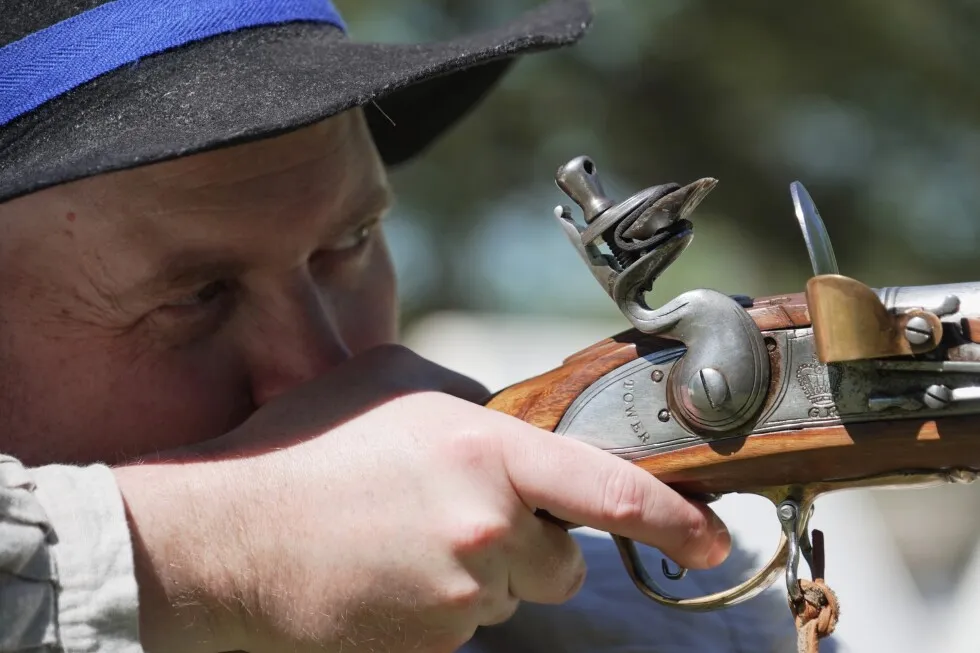
A.J. Drake, a historic interpreter, aims his Brown Bess flintlock replica musket during a Revolutionary War event in Halifax, N.C., on April 10, 2026. (AP Photo/Allen G. Breed) 2026-05-14T04:01:00Z Halifax, N.C. (AP) — With 165 grains of black powder in the barrel, a .75-caliber Brown Bess flintlock musket like the ones the redcoats carried in 1776 can hurl a lead ball at a velocity of around 1,000 feet (305 meters) per second. Imagine what that can do to a human body. Now, imagine that it’s almost completely exempt from gun regulations. How can that be? Well, under federal and most state laws, many antique or replica guns aren’t technically considered firearms. In most places, even convicted felons can own them. “I suspect the average judge would be surprised to find that out,” says Second Amendment scholar and gun-rights attorney Dave Hardy, himself the proud owner of two Civil War-era long guns. During a National Rifle Association event back in 2000, the late actor Charlton Heston famously hoisted a flintlock — the single-shot weapon that won the Revolution and was still in wide use a half century after Congress debated the Second Amendment — into the air and said the Democrats would have to take it “from my cold, dead hands.” He needn’t have worried. A blast from the past During debate over the Gun Control Act of 1968, Sen. John Goodwin Tower argued that flintlocks and many other antique or replica guns should be exempt from regulation. The Texas Republican said it was needed “to relieve an unnecessarily burdensome problem for serious collectors of antique firearms and for historians and museums.” Treating all weapons the same, he argued, would unfairly target collector items “which have little, if any, practical use as a firearm in the modern connotation.” The provision defines an antique as any weapon “with a matchlock, flintlock, percussion cap, or similar type of ignition system” manufactured “in or before 1898” — as long as it hasn’t been modified to fire modern ammunition. This generally means muzzleloaders that use black powder or a black powder substitute, though some early cartridge guns are included. You can even own and fire a cannon. (
SRCAssociated Press (AP)
LANGEN
LEANCenter
WORDS363
ENT10
THU · 2026-05-14 · 12:53 GMTBRIEF NSR-2026-0514-76246
NSR-2026-0514-76246News Report·EN·Legal & Judicial
Muskets like those from 1776 are mostly exempt from today’s gun laws
Many antique firearms, including replicas of 1776-era muskets like the Brown Bess, are largely exempt from current gun regulations in the United States. This exemption stems from the Gun Control Act of 1968, which defined antique firearms as those manufactured in or before 1898 with specific ignition systems, provided they haven't been modified for modern ammunition.
Associated Press (AP)Filed 2026-05-14 · 12:53 GMTLean · CenterRead · 2 min
Associated Press (AP)FIG 01
Reading time
2min
Word count
363words
Sources cited
3cited
Entities identified
10entities
Quality score
100%
§ 01
Briefing Summary
AI-generatedNEWSAR · AI
Many antique firearms, including replicas of 1776-era muskets like the Brown Bess, are largely exempt from current gun regulations in the United States. This exemption stems from the Gun Control Act of 1968, which defined antique firearms as those manufactured in or before 1898 with specific ignition systems, provided they haven't been modified for modern ammunition. This classification means these weapons are often not technically considered firearms under federal and state laws, allowing even convicted felons to possess them. The exemption was intended to protect collectors and historical artifacts, acknowledging their limited practical use in modern contexts.
Confidence 0.90Sources 3Claims 5Entities 10
§ 02
Article analysis
Model · rule-basedFraming
Legal & Judicial
Human Interest
Tone
Mixed Tone
AI-assessed
CalmNeutralAlarmist
Factuality
0.70 / 1.00
Factual
LowHigh
Sources cited
3
Well sourced
FewMany
§ 03
Key claims
5 extracted01
The provision defines an antique as any weapon manufactured in or before 1898 with a matchlock, flintlock, percussion cap, or similar ignition system, as long as it hasn’t been modified to fire modern ammunition.
factual
Confidence
0.95
02
Sen. John Goodwin Tower argued in 1968 that antique guns should be exempt from regulation to relieve collectors and historians.
quoteSen. John Goodwin Tower
Confidence
0.90
03
Muskets like those from 1776 are mostly exempt from today’s gun laws.
factual
Confidence
0.90
04
Under federal and most state laws, many antique or replica guns aren’t technically considered firearms.
factual
Confidence
0.85
05
In most places, even convicted felons can own antique or replica guns.
factual
Confidence
0.80
§ 04
Full report
2 min read · 363 words§ 05
Entities
10 identifiedKey playerOppositionContextPositiveNeutralNegative
People4
Organizations3
§ 06
Keywords & salience
8 termsantique firearms
1.00
gun laws
0.90
flintlock musket
0.80
firearm regulation
0.70
replica guns
0.60
second amendment
0.50
gun control act of 1968
0.40
legal exemptions
0.40
§ 07
Topic connections
Interactive graph No topic relationship data available yet. This graph will appear once topic relationships have been computed.