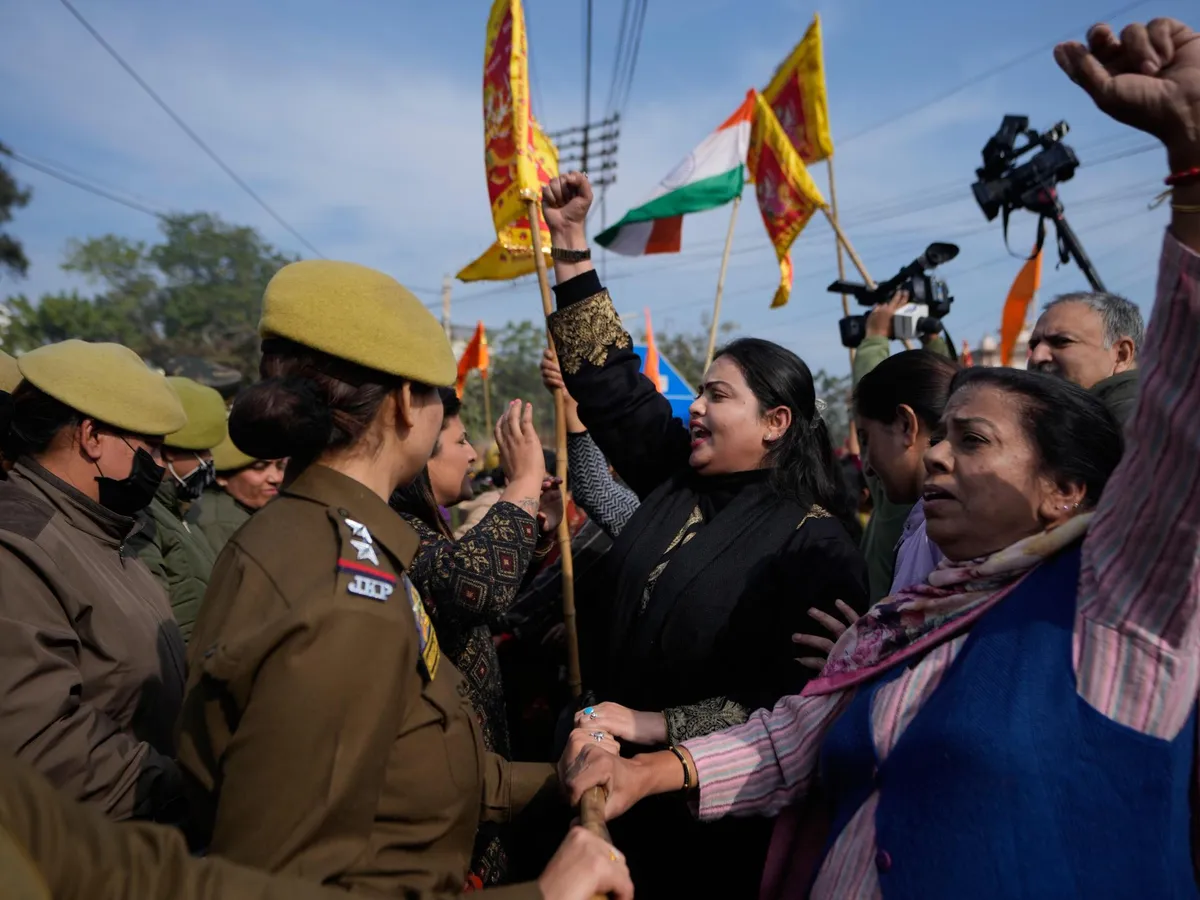
Hindu groups insisted that Muslims shouldn’t benefit from institutions funded by Hindu charity.Women supporters of right-wing Hindu groups shout slogans demanding revocation of admissions at the Shri Mata Vaishno Devi Institute of Medical Excellence in Jammu, outside the residence of the the governor of Indian-administered Kashmir on December 27, 2025 [Channi Anand/ AP Photo]Published On 15 Jan 2026India has shut down a medical college in Indian-administered Kashmir in an apparent capitulation to protests by right-wing Hindu groups over the admission of an overwhelming number of Muslim students into the prestigious course.The National Medical Commission (NMC), a federal regulatory authority for medical education and practices, on January 6 revoked the recognition of Shri Mata Vaishno Devi Medical Institute (SMVDMI), located in Reasi, a mountainous district overlooking the Pir Panjal range in the Himalayas, which separates the plains of Jammu from the Kashmir valley.Recommended Stories list of 4 itemslist 1 of 4India’s VPN ban in Kashmir ‘adds to psychological pressure’, say residentslist 2 of 4‘A nightmare’: Fear grips Indian students in Bangladesh amid unrestlist 3 of 4Why a Bollywood spy film sparked a political storm in India and Pakistanlist 4 of 4Uproar in India over Bihar chief minister pulling down Muslim woman’s hijabend of listOf the 50 pupils who joined the five-year bachelor’s in medicine (MBBS) programme in November, 42 were Muslims, most of them residents of Kashmir, while seven were Hindus and one was a Sikh. It was the first MBBS batch that the private college, founded by a Hindu religious charity and partly funded by the government, had launched.Admissions to medical colleges across India, whether public or private, follow a centralised entrance examination, called the National Entrance Examination Test (NEET), conducted by the federal Ministry of Education’s National Testing Agency (NTA).More than two million Indian students appear for NEET every year, hoping to secure one of approximately 120,000 MBBS seats. Aspirants usually prefer public colleges, where fees are lower but cutoffs for admission are high. Those who fail to meet the cutoff but meet a minimum NTA threshold join a private college.Like Saniya Jan*, an 18-year-old resident of Kashmir’s Baramulla district, who recalls being overwhelmed with euphoria when she passed the NEET, making her eligible to study medicine. “It was a dream come true – to be a doctor,” Saniya told Al Jazeera.When she joined a counselling session that determines which college a NEET qualifier joins, she chose SMVDMI since it was about 316km (196 miles) from her home – relatively close for students in Kashmir, who often otherwise have to travel much farther to go to college.Saniya’s thrilled parents drove to Reasi to drop her off at the college when the academic session started in November. “My daughter has been a topper since childhood. I have three daughters, and she is the brightest. She really worked hard to get a medical seat,” Saniya’s father, Gazanfar Ahmad*, told Al Jazeera.But things did not go as planned.Supporters of right-wing Hindu groups protesting against the governor of Indian-administered Kashmir, demanding that admissions to the Shri Mata Vaishno Devi Institute of Medical Excellence be revoked, in Jammu on Saturday, December 27, 2025 [Channi Anand/ AP Photo]‘No business being there’As soon as local Hindu groups found out about the religious composition of the college’s inaugural batch in November, they launched demonstrations demanding that the admission of Muslim students be scrapped. They argued that since the college was chiefly funded from the offerings of devotees at Mata Vaishno Devi Temple, a prominent Hindu shrine in Kashmir, Muslim students had “no business being there”.The agitations continued for weeks, with demonstrators amassing every day outside the iron gates of the college and raising slogans.Meanwhile, legislators belonging to Prime Minister Narendra Modi’s Bharatiya Janata Party (BJP) – which has been accused of pursuing anti-Muslim policies since coming to power in 2014 – even wrote petitions to Kashmir’s lieutenant governor, urging him to reserve admissions in SMVDMI only for Hindu students. The lieutenant governor is the federally appointed administrator of the disputed region.In the days that followed, their demands escalated to seeking the closure of the college itself.As the protests intensified, the National Medical Commission on January 6 announced that it had rescinded the college’s authorisation because it had failed to “meet the minimum standard requirements” specified by the government for medical education. The NMC claimed the college suffered from critical deficiencies in its teaching faculty, bed occupancy, patient flow in outpatient departments, libraries and operating theatres. The next day, a “letter of permission”, which authorised the college to function and run courses, was withdrawn.Hindu pilgrims on their way to the Vaishno Devi shrine rest under a shade and wait for transport outside a railway station on a hot day in Jammu, India, Wednesday, June 12, 2019. Far-right Hindu groups argue that because the Shri Mata Vaishno Devi Medical Institute is funded by donations from Hindu believers, the presence of Muslims as the majority in the student body is offensive to them [Channi Anand/ AP Photo]‘The college was good’But most students Al Jazeera talked to said they did not see any shortcomings in the college and that it was well-equipped to run the medical course. “I don’t think the college lacked resources,” Jahan*, a student who only gave her second name, said. “We have seen other colleges. Some of them only have one cadaver per batch, while this college has four of them. Every student got an opportunity to dissect that cadaver individually.”Rafiq, a student who only gave his second name, said that he had cousins in sought-after government medical colleges in Srinagar, the biggest city in Indian-administered Kashmir. “Even they don’t have the kind of facilities that we had here,” he said.Saniya’s father, Ahmad, also told Al Jazeera that when he dropped her off at the college, “everything seemed normal”.“The college was good. The faculty was supportive. It looked like no one cared about religion inside the campus,” he said.Zafar Choudhary, a political analyst based in Jammu, questioned how the medical regulatory body had sanctioned the college’s authorisation if there was an infrastructural deficit. “Logic dictates that their infrastructure would have only improved since the classes started. So we don’t know how these deficiencies arose all of a sudden,” he told Al Jazeera.Choudhary said the demand of the Hindu groups was “absurd” given that selections into medical colleges in India are based on religion-neutral terms. “There is a system in place that determines it. A student is supposed to give preference, and a lot of parameters are factored in before the admission lists are announced. When students are asked for their choices, they give multiple selections rather than one. So how is it their fault?” he asked.Al Jazeera reached out to SMVDMI’s executive head, Yashpal Sharma, via telephone for comments. He did not respond to calls or text messages. The college has issued no public statement since the revocation of its authorisation to offer medical courses.Supporters of right-wing Hindu groups shout slogans demanding the revocation of admissions at the Shri Mata Vaishno Devi Institute of Medical Excellence in Jammu on Saturday, December 27, 2025 [Channi Anand/ AP Photo]‘They turned merit into religion’Meanwhile, students at SMVDMI have packed their belongings and returned home.Salim Manzoor*, another student, pointed out that Indian-administered Kashmir, a Muslim-majority region, also had a medical college where Hindu candidates are enrolled under a quota reserved for them and other communities that represent a minority in the region.The BJP insists it never claimed that Muslim students were unwelcome at SMVDMI, but encouraged people to recognise the “legitimate sentiments” that millions of Hindu devotees felt towards the temple trust that founded it. “This college is named after Mata Vaishno Devi, and there are millions of devotees whose religious emotions are strongly attached to this shrine,” BJP’s spokesman in Kashmir, Altaf Thakur, told Al Jazeera. “The college recognition was withdrawn because NMC found several shortcomings. There’s no question of the issue being about Hindus and Muslims.”Last week, Omar Abdullah, chief minister of Indian-administered Kashmir, announced that SMVDMI students would not be made to “suffer due to NMC’s decision” and they would be offered admissions in other colleges in the region. “These children cleared the National Entrance Examination Test, and it is our legal responsibility to adjust them. We will have supernumerary seats, so their education is not affected. It is not difficult for us to adjust all 50 students, and we will do it,” he said.Abdullah condemned the BJP and its allied Hindu groups for their campaign against Muslims joining the college. “People generally fight for having a medical college in their midst. But here, the fight was put up to have the medical college shut. You have played with the future of the medical students of [Kashmir]. If ruining the future of students brings you happiness, then celebrate it.”Tanvir Sadiq, a regional legislator belonging to Abdullah’s National Conference party, said that the university that the medical college is part of received more than $13m in government aid since 2017 – making all Kashmiris, and not donors to the Mata Vaishno Devi shrine – stakeholders. “This means that anyone who is lawfully domiciled in [Indian-administered Kashmir] can go and study there. In a few decades, the college would have churned out thousands of fresh medical graduates. If a lot of them are Muslims today, tomorrow they would have been Hindus as well,” he told Al Jazeera.Nasir Khuehami, who heads the Jammu and Kashmir Students’ Association, told Al Jazeera the Hindu versus Muslim narrative threatened to “communalise” the region’s education sector. “The narrative that because the college is run by one particular community, only students from that community alone will study there, is dangerous,” he said.He pointed out that Muslim-run universities, not just in Kashmir but across India, that were recognised as minority institutions did not “have an official policy of excluding Hindus”.Back at her home in Baramulla, Saniya is worried about her future. “I appeared for a competitive exam, which is one of the hardest in India, and was able to get a seat at a medical college,” she told Al Jazeera.“Now everything seems to have crashed. I came back home waiting for what decision the government will take for our future. All this happened because of our identity. They turned our merit into religion.”
SRCAl Jazeera
LANGEN
LEANCenter
WORDS1 706
ENT7
THU · 2026-01-15 · 06:12 GMTBRIEF NSR-2026-0115-7627
NSR-2026-0115-7627News Report·EN·Social Justice
India shuts Kashmir medical college – after Muslims earned most admissions
India shut down the Shri Mata Vaishno Devi Medical Institute (SMVDMI) in Indian-administered Kashmir in January 2026 after protests by right-wing Hindu groups. The National Medical Commission revoked the college's recognition following the admission of a predominantly Muslim student body.
Al Jazeera StaffAl JazeeraFiled 2026-01-15 · 06:12 GMTLean · CenterRead · 7 min
Al JazeeraFIG 01
Reading time
7min
Word count
1 706words
Sources cited
2cited
Entities identified
7entities
Quality score
100%
§ 01
Briefing Summary
AI-generatedNEWSAR · AI
India shut down the Shri Mata Vaishno Devi Medical Institute (SMVDMI) in Indian-administered Kashmir in January 2026 after protests by right-wing Hindu groups. The National Medical Commission revoked the college's recognition following the admission of a predominantly Muslim student body. Of the 50 students admitted to the MBBS program in November 2025, 42 were Muslim, seven were Hindu, and one was Sikh. The college, founded by a Hindu religious charity and partly government-funded, admitted its first MBBS batch through the National Entrance Examination Test (NEET). Hindu groups protested that Muslims were unfairly benefiting from an institution funded by Hindu charity.
Confidence 0.90Sources 2Claims 5Entities 7
§ 02
Article analysis
Model · rule-basedFraming
Social Justice
Political Strategy
Tone
Mixed Tone
AI-assessed
CalmNeutralAlarmist
Factuality
0.70 / 1.00
Factual
LowHigh
Sources cited
2
Limited
FewMany
§ 03
Key claims
5 extracted01
"It was a dream come true – to be a doctor," Saniya told Al Jazeera.
quoteSaniya Jan
Confidence
1.00
02
Admissions to medical colleges across India follow a centralised entrance examination, called NEET.
factual
Confidence
1.00
03
Of the 50 pupils who joined the MBBS program, 42 were Muslims, 7 were Hindus, and 1 was a Sikh.
statistic
Confidence
1.00
04
The National Medical Commission revoked the recognition of Shri Mata Vaishno Devi Medical Institute on January 6.
factual
Confidence
1.00
05
India shut down a medical college in Indian-administered Kashmir after protests by right-wing Hindu groups.
factual
Confidence
0.90
§ 04
Full report
7 min read · 1 706 words§ 05
Entities
7 identifiedKey playerOppositionContextPositiveNeutralNegative
Organizations3
§ 06
Keywords & salience
9 termsmedical college closure
0.90
india
0.80
kashmir
0.80
muslim students
0.80
hindu groups
0.70
admissions
0.60
medical education
0.60
neet
0.50
religious charity
0.50
§ 07
Topic connections
Interactive graph Network visualization showing 51 related topics
View Full Graph Person Organization Location Event|Click node to navigate|Edge numbers = shared articles