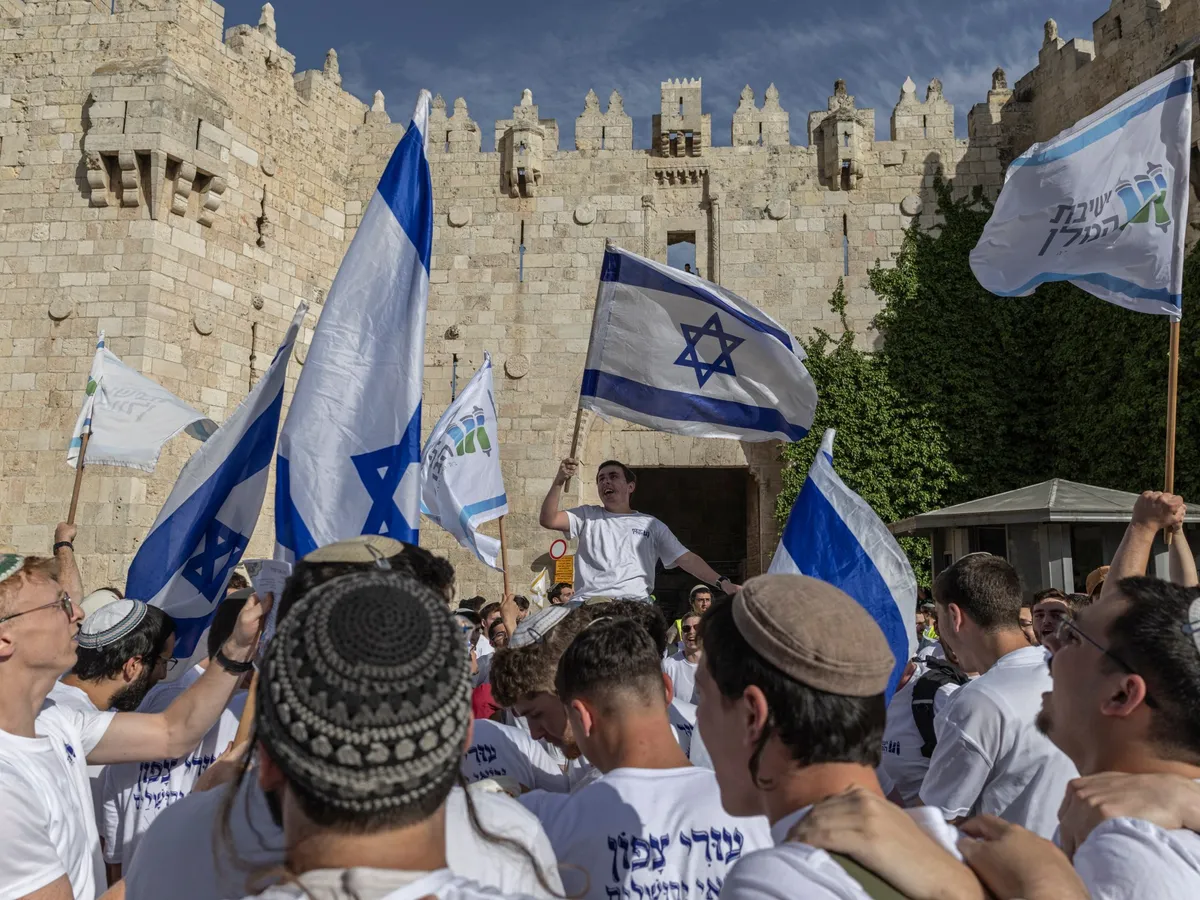
Far-right Israelis attack Palestinians during the Flag March, intensifying violence and racism in Jerusalem’s Old City.Israeli settlers join the Jerusalem-day" class="entity-link entity-event" data-entity-id="127127" data-entity-type="event">Jerusalem Day parade at the Damascus Gate in occupied Jerusalem" class="entity-link entity-location" data-entity-id="3077" data-entity-type="location">East Jerusalem, May 14, 2026 [AFP]Published On 14 May 2026Uri Weltmann was tense. He’s the national field director for Standing Together, an organisation of Jewish and Palestinian peace activists, who had gathered to resist the tens of thousands of far-right Jewish marchers heading for occupied Jerusalem" class="entity-link entity-location" data-entity-id="3077" data-entity-type="location">East Jerusalem’s Old City.He had reason to be worried. ‘Jerusalem-day" class="entity-link entity-event" data-entity-id="127127" data-entity-type="event">Jerusalem Day’, marked by Jewish Israelis every year to celebrate the 1967 capture and subsequent illegal occupation of the city, has become an opportunity for thousands to be bussed in from across Israel and the occupied West Bank to participate in the ‘Flag March’, where they maraud through the Old City and attack Palestinians – as well as Jewish peace activists. Palestinians from outside the Old City were not allowed in by police.Recommended Stories list of 4 itemslist 1 of 4Ben-Gvir ‘dreams’ of nooses in video posted to TikToklist 2 of 4Smotrich says he promised his son ‘more destruction’ in Lebanonlist 3 of 4Shoot Palestinians, not settlers: Israeli general exposes double standardlist 4 of 4Far-right Israelis storm Al-Aqsa, UNRWA compounds amid Jerusalem-day" class="entity-link entity-event" data-entity-id="127127" data-entity-type="event">Jerusalem Day marchend of listThis year’s event on Thursday saw fighting break out even before the march officially began, as ultranationalist Israelis – many of them young teenagers – attacked Palestinians in the Christian Quarter. The Israelis vandalised property, and Israeli police forced Palestinian shop owners to close.Many other Palestinian businesses had already closed for the day, fearing attacks and harassment.“It’s gotten much more extreme since October 7,” said Weltmann, referring to the Hamas-led attack on Israel in 2023, which led to Israel’s genocidal war on Gaza.Weltmann and approximately 200 other Standing Together activists, wearing purple vests, attempted to stand between the far-right Jewish marchers and Palestinians, but were often attacked themselves.As in previous years, the marchers shouted anti-Palestinian slogans, including ‘May your village burn’ and ‘Death to Arabs’. They have also been filmed spitting and hurling insults at Palestinians.Police have so far arrested 13 people, including both Jews and Palestinians.The ultranationalist marchers have the full support of the Israeli government. Earlier in the day, National Security Minister Itamar Ben-Gvir led a large group of Jewish Israelis into the Al-Aqsa Mosque compound, where he displayed the Israeli flag in front of the Dome of the Rock.Jordan condemned Ben-Gvir’s stunt, with the Foreign Ministry calling it a “blatant violation of international law, an unacceptable provocation, and a flagrant breach of the historical and legal status quo”.Jordan runs the Jerusalem Waqf Department, which supervises the holy sites in occupied Jerusalem" class="entity-link entity-location" data-entity-id="3077" data-entity-type="location">East Jerusalem, according to a long-standing agreement. Palestinians want Jerusalem" class="entity-link entity-location" data-entity-id="3077" data-entity-type="location">East Jerusalem to be the capital of any future Palestinian state.Violent societyLast year, hordes of far-right and ultra-Orthodox marchers flooded into the city, attacking Palestinians and chanting racist slogans. The Israeli newspaper Haaretz described the event as a state-sanctioned invitation for ultranationalist groups to enter the Muslim Quarter, smashing shop signs, breaking locks, battering metal doors with flagpoles and plastering racist stickers across large parts of the Old City.Weltmann said that the violence and anti-Palestinian rhetoric that characterised ‘Jerusalem-day" class="entity-link entity-event" data-entity-id="127127" data-entity-type="event">Jerusalem Day’ had already been increasing in tandem with the growth of the far-right ultranationalist movement in Israel pre-2023.Fuelling much of the violence, Weltmann said, was a police force overseen by Ben-Gvir, whose responsibility for policing the events has often run counter to his active participation in it.The Religious Zionism movement, which has drawn in much of Israel’s far-right, has been steadily increasing since Israel’s disengagement from Gaza in 2005, when many in Israel’s settler community first began to feel that the land captured in 1967 – Gaza, the West Bank, Jerusalem" class="entity-link entity-location" data-entity-id="3077" data-entity-type="location">East Jerusalem, and the Golan Heights – may be under threat, analysts told Al Jazeera.They describe how the Religious Zionist trend has since been adopted and exploited by Israeli Prime Minister Benjamin Netanyahu and his avowedly pro-settler Likud party to wield power and, in the wake of the October 7 attack, underpin its genocidal war on Gaza, killing more than 72,000 Palestinians.Under the watch of Netanyahu and his far-right Finance Minister, Bezalel Smotrich, the number of illegal settlements in the occupied West Bank has surged. The self-styled ‘Hilltop Youth‘, a loosely organised network of radical and violent young settlers, have also grown in both visibility and apparent impunity, while settler violence – which has long been a characteristic of Israel’s presence in the occupied West Bank – has exploded.Israeli Minister of National Security and far-right politician Itamar Ben-Gvir, surrounded by Israeli policemen, waves to other right-wing activists at last year’s Flag March [Ahmad Gharabli/AFP]“There’s a deeply confrontational element to the march,” researcher on Jewish-Arab relations, Eram Tzidkiyahu, said, “It’s not enough for us to celebrate our own victories. It’s about celebrating our victories in the living rooms of the people who lost. Celebrating on your own just doesn’t have the same baggage. It’s about going and chanting from the prayer book, affirming that you are the chosen people, deliberately within the Muslim Quarter [of the Old City].”“The violence is inherent to that, fuelled by hormonal young men seeking confrontation and united in their absolute rejection of the ‘other’,” he said. “This didn’t start on October 7. It’s deeply rooted into it.”Passive policeIsraeli police have often done little to prevent attacks on Palestinians during the Flag March, and few Jewish Israelis have been punished for the many crimes committed.“The so-called Flag March … has always been a violent event,” said Ofer Cassif of the left-wing Hadash party, adding that it became more violent in the past few years, especially since October 7.Cassif accused Netanyahu’s “fascist” government of encouraging the violence.The Israeli police, which Cassif describes as Ben-Gvir’s “private militia”, did not stop “the violence, the lynchings, the destruction of shops, the aggression and attacks against Palestinians in the Old City, and throughout the city as a whole”.Young Israelis gather outside Jerusalem’s Old City walls before a march marking Israel’s capture of Jerusalem" class="entity-link entity-location" data-entity-id="3077" data-entity-type="location">East Jerusalem in 1967 [File: Ohad Zwigenberg/AP]However, while it was easy for elements within Israeli society to regard the presence of Ben-Gvir, or the violence of the Flag March itself as somehow exceptional, to do so was to miss the point, observers said, particularly in light of the wars on Gaza, Lebanon, and Iran.“It’s easy to dismiss Ben-Gvir as a clown,” said Aviv Tatarsky, a researcher at the Ir Amim activist group. “Many Israeli liberals do this to feel better about themselves. It’s easy. They don’t want to recognise that this is part of Israeli society and, as long as they don’t feel confident enough to say in public that, yes, Palestinians do have rights, they’re part of that, too.“Ben-Gvir is not a clown. He’s Israel: 2026,” Tatarsky continued. “He’s part of a government and society that, despite wars with Iran and Lebanon, still prioritises the removal of Palestinians wherever they may be above everything else.”
SRCAl Jazeera
LANGEN
LEANCenter
WORDS1 154
ENT12
THU · 2026-05-14 · 17:50 GMTBRIEF NSR-2026-0514-76331
NSR-2026-0514-76331News Report·EN·Conflict
‘May your village burn’: Israeli Flag March returns to East Jerusalem
On May 14, 2026, the annual Israeli Flag March took place in occupied East Jerusalem, celebrating the 1967 capture of the city. Thousands of far-right Israelis participated, marching through the Old City.
Simon Speakman CordallAl JazeeraFiled 2026-05-14 · 17:50 GMTLean · CenterRead · 5 min
Al JazeeraFIG 01
Reading time
5min
Word count
1 154words
Sources cited
2cited
Entities identified
12entities
Quality score
100%
§ 01
Briefing Summary
AI-generatedNEWSAR · AI
On May 14, 2026, the annual Israeli Flag March took place in occupied East Jerusalem, celebrating the 1967 capture of the city. Thousands of far-right Israelis participated, marching through the Old City. The event saw violence and racist incidents, with ultranationalist marchers attacking Palestinians and vandalizing property. Israeli police reportedly forced Palestinian shop owners to close and arrested 13 individuals. Peace activists from the organization Standing Together attempted to intervene but were also targeted. The marchers chanted anti-Palestinian slogans, and the event occurred amidst heightened tensions following the October 7, 2023, Hamas attack and the subsequent war in Gaza.
Confidence 0.90Sources 2Claims 5Entities 12
§ 02
Article analysis
Model · rule-basedFraming
Conflict
Social Justice
Tone
Sensational
AI-assessed
CalmNeutralAlarmist
Factuality
0.70 / 1.00
Factual
LowHigh
Sources cited
2
Limited
FewMany
§ 03
Key claims
5 extracted01
Jordan condemned Ben-Gvir’s actions as a ‘blatant violation of international law’.
quoteJordan's Foreign Ministry
Confidence
0.95
02
Israeli settlers participated in the Jerusalem Day parade at the Damascus Gate in occupied East Jerusalem.
factualAFP
Confidence
0.95
03
National Security Minister Itamar Ben-Gvir led a group into the Al-Aqsa Mosque compound and displayed the Israeli flag.
factual
Confidence
0.90
04
Far-right Israelis attacked Palestinians and vandalized property during the Flag March in East Jerusalem.
factual
Confidence
0.90
05
Marchers shouted anti-Palestinian slogans including ‘May your village burn’ and ‘Death to Arabs’.
quote
Confidence
0.85
§ 04
Full report
5 min read · 1 154 words§ 05
Entities
12 identifiedKey playerOppositionContextPositiveNeutralNegative
Organizations2
Locations6
§ 06
Keywords & salience
10 termseast jerusalem
1.00
flag march
1.00
violence
0.90
racism
0.90
far-right israelis
0.80
palestinians
0.80
occupation
0.70
old city
0.60
jerusalem day
0.50
standing together
0.40
§ 07
Topic connections
Interactive graph Network visualization showing 51 related topics
View Full Graph Person Organization Location Event|Click node to navigate|Edge numbers = shared articles