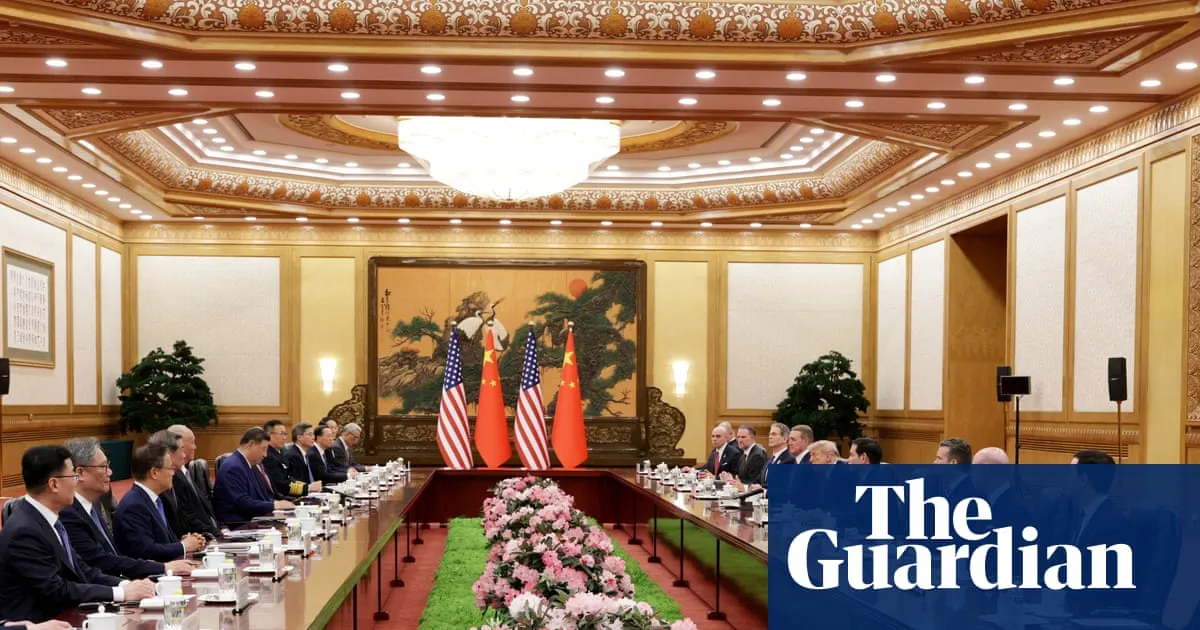
By the time Donald Trump and Xi Jinping met at Beijing’s Great Hall of the People on Thursday, the bilateral had featured all the expected pomp and pageantry: a meticulously choreographed display of Chinese soldiers, children waving American and Chinese flags, and rows of senior officials and the US’s top business executives.Conspicuously absent at the table, however, were women from either delegation – a stark visual that quickly drew criticism from observers who saw it as an unmistakable display of patriarchal power.In a tweet that has attracted over 22,000 likes overnight, Gita Gopinath, an economics professor at Harvard University, wrote: “A painting of the end of meritocracy: A meeting of the two largest economies and not one woman at the table.”Speaking to the Guardian, Gopinath elaborated on her comments, saying: “We have somehow gravitated back to this idea that what matters is your network and not your capabilities – and that matters [in terms of] whether or not you get a seat at the table.”She added: “It’s just inexplicable how you end up with a single-gender table, given the many talented women around the world.Halima Kazem, associate director for Stanford University’s program in feminist, gender and sexuality studies, echoed similar sentiments.Comparing Thursday’s images to bilateral meetings during Barack Obama’s presidency, Kazem said: “We’ve gone backward. Obama-era US-China summits included women at the table. Now neither superpower thinks women belong in the room where great power politics happens. This isn’t just American failure – it’s a bilateral signal that women’s voices don’t matter in shaping the global order.”China’s President Xi Jinping speaks during a bilateral meeting with Barack Obama in Washington DC in March 2016. Photograph: Mandel Ngan/AFP/Getty ImagesWomen seated at previous US-China bilateral meetings during Obama’s presidency included Liu Yandong, China’s then vice-premier, as well as Susan Rice, US national security adviser, and Hillary Clinton, the secretary of state.Kazem pointed to the type of power being ostensibly signaled by both sides, saying: “This wasn’t about lack of qualified women – both countries have plenty in their diplomatic and security establishments. This was a choice about what kind of authority to project: masculine, militarized, and exclusionary.“When both superpowers perform power this way, they’re jointly defining what ‘serious’ diplomacy looks like and who gets excluded from it,” she added.Despite the absence of women at Thursday’s bilateral meeting in the Great Hall of the People, a small handful of women did accompany Trump on his two-day visit to Beijing, including Lara Trump, his daughter-in-law, as well as Jane Fraser, the Citigroup CEO, and Dina Powell McCormick, the Meta president.
SRCThe Guardian - World News
LANGEN
LEANCenter-Left
WORDS426
ENT12
THU · 2026-05-14 · 21:15 GMTBRIEF NSR-2026-0514-76357
NSR-2026-0514-76357News Report·EN·Social Justice
Photo of US-China delegation criticized over absence of women: ‘masculine, militarized and exclusionary’
A photograph of a US-China delegation meeting in Beijing, featuring only men from both sides, has drawn criticism. Observers noted the absence of women at the table during the high-level bilateral meeting between US and Chinese officials, including Presidents Trump and Xi.
Maya YangThe Guardian - World NewsFiled 2026-05-14 · 21:15 GMTLean · Center-LeftRead · 2 min
The Guardian - World NewsFIG 01
Reading time
2min
Word count
426words
Sources cited
3cited
Entities identified
12entities
Quality score
100%
§ 01
Briefing Summary
AI-generatedNEWSAR · AI
A photograph of a US-China delegation meeting in Beijing, featuring only men from both sides, has drawn criticism. Observers noted the absence of women at the table during the high-level bilateral meeting between US and Chinese officials, including Presidents Trump and Xi. Economists and gender studies experts pointed to this as a visual representation of patriarchal power and a step backward from previous administrations. They argued that the all-male delegation signaled a projection of masculine, militarized, and exclusionary authority, suggesting that women's voices are not considered essential in shaping global politics. This visual has sparked debate about meritocracy and the inclusion of women in significant diplomatic discussions.
Confidence 0.90Sources 3Claims 5Entities 12
§ 02
Article analysis
Model · rule-basedFraming
Social Justice
Diplomatic
Tone
Mixed Tone
AI-assessed
CalmNeutralAlarmist
Factuality
0.60 / 1.00
Mixed
LowHigh
Sources cited
3
Well sourced
FewMany
§ 03
Key claims
5 extracted01
Kazem described the signaling of power by the delegations as 'masculine, militarized, and exclusionary'.
quoteHalima Kazem
Confidence
1.00
02
Previous US-China summits during Obama's presidency included women like Hillary Clinton and Susan Rice.
factual
Confidence
1.00
03
Halima Kazem argued that the absence of women signals that 'women’s voices don’t matter in shaping the global order'.
quoteHalima Kazem
Confidence
1.00
04
Gita Gopinath stated that the absence of women at the table is 'a painting of the end of meritocracy'.
quoteGita Gopinath
Confidence
1.00
05
A photo of the US-China delegation meeting showed no women at the table.
factual
Confidence
1.00
§ 04
Full report
2 min read · 426 words§ 05
Entities
12 identifiedKey playerOppositionContextPositiveNeutralNegative
People8
§ 06
Keywords & salience
10 termsus-china relations
1.00
gender representation
0.90
patriarchal power
0.80
exclusionary diplomacy
0.80
meritocracy
0.70
masculine and militarized
0.60
great power politics
0.60
global order
0.50
donald trump
0.40
xi jinping
0.40
§ 07
Topic connections
Interactive graph Network visualization showing 51 related topics
View Full Graph Person Organization Location Event|Click node to navigate|Edge numbers = shared articles