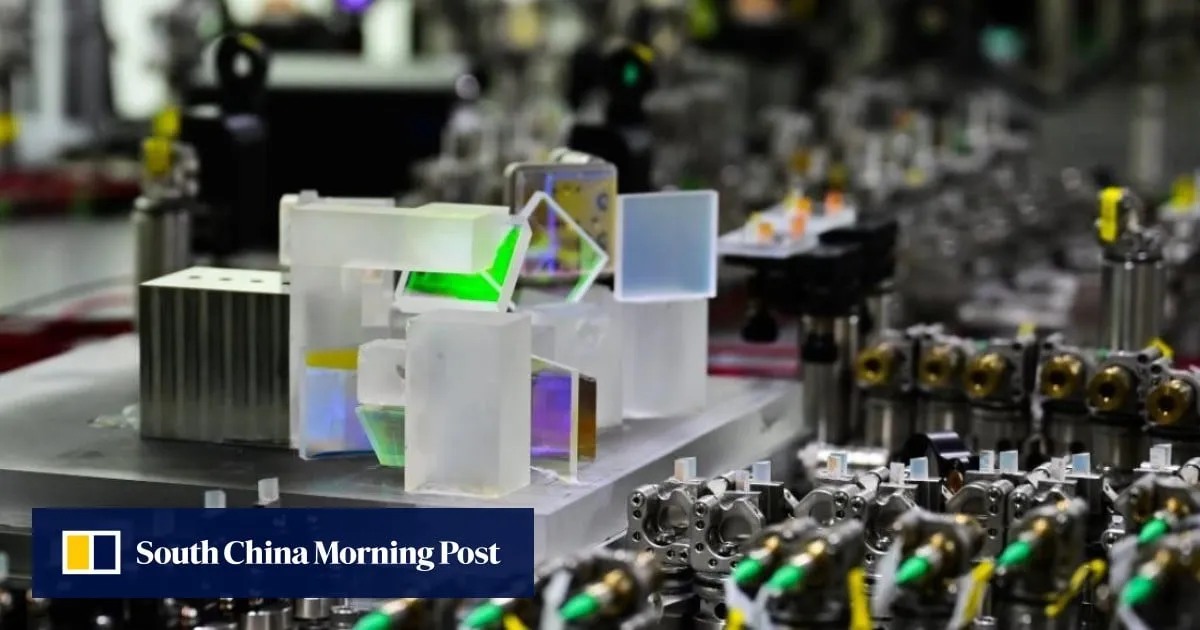
China has unveiled its latest photonic quantum computer, Jiuzhang 4.0, with researchers saying it can outperform the world’s fastest classical supercomputer by a vast margin, further strengthening Beijing’s push towards quantum supremacy.The results, published on May 13 in the peer-reviewed journal Nature, mark the latest milestone in China’s rapidly advancing quantum programme led by a team of scientists at the China" class="entity-link entity-location" data-entity-id="23976" data-entity-type="location">University of Science and Technology of China headed by renowned Chinese quantum physicist Pan Jianwei.Quantum physicist Pan Jianwei leads the China" class="entity-link entity-location" data-entity-id="23976" data-entity-type="location">University of Science and Technology of China team behind Jiuzhang 4.0, the country’s latest photonic quantum computer. Photo: SohoJiuzhang 4.0 completed a Gaussian boson sampling task in just 25 microseconds – a calculation they estimated would take the world’s most powerful supercomputer, El Capitan in the United States, a mind-boggling more than 10^42 years to finish, according to the university in the eastern city of Hefei.
SRCSouth China Morning Post
LANGEN
LEANCenter-Right
WORDS146
ENT8
FRI · 2026-05-15 · 01:00 GMTBRIEF NSR-2026-0515-76396
NSR-2026-0515-76396News Report·EN·Technology
Does China’s Jiuzhang 4.0 computer herald the age of quantum supremacy?
China has unveiled its latest photonic quantum computer, Jiuzhang 4.0, developed by a team at the University of Science and Technology of China led by Pan Jianwei. Published on May 13 in Nature, the research details Jiuzhang 4.0's ability to perform a Gaussian boson sampling task in 25 microseconds.
Chao KongSouth China Morning PostFiled 2026-05-15 · 01:00 GMTLean · Center-RightRead · 1 min
South China Morning PostFIG 01
Reading time
1min
Word count
146words
Sources cited
2cited
Entities identified
8entities
Quality score
100%
§ 01
Briefing Summary
AI-generatedNEWSAR · AI
China has unveiled its latest photonic quantum computer, Jiuzhang 4.0, developed by a team at the University of Science and Technology of China led by Pan Jianwei. Published on May 13 in Nature, the research details Jiuzhang 4.0's ability to perform a Gaussian boson sampling task in 25 microseconds. This calculation is estimated to take the world's fastest classical supercomputer, El Capitan, over 10^42 years to complete. This achievement signifies a significant advancement in China's quantum computing program and its pursuit of quantum supremacy.
Confidence 0.85Sources 2Claims 5Entities 8
§ 02
Article analysis
Model · rule-basedFraming
Technology
National Security
Tone
Mixed Tone
AI-assessed
CalmNeutralAlarmist
Factuality
0.80 / 1.00
Factual
LowHigh
Sources cited
2
Limited
FewMany
§ 03
Key claims
5 extracted01
The results were published on May 13 in the peer-reviewed journal Nature.
factualarticle
Confidence
1.00
02
China has unveiled its latest photonic quantum computer, Jiuzhang 4.0.
factualarticle
Confidence
1.00
03
Jiuzhang 4.0 completed a Gaussian boson sampling task in just 25 microseconds.
statisticresearchers
Confidence
0.90
04
Jiuzhang 4.0 can outperform the world’s fastest classical supercomputer by a vast margin.
factualresearchers
Confidence
0.90
05
The task would take the world’s most powerful supercomputer, El Capitan, more than 10^42 years to finish.
statisticuniversity
Confidence
0.80
§ 04
Full report
1 min read · 146 words§ 05
Entities
8 identifiedKey playerOppositionContextPositiveNeutralNegative
§ 06
Keywords & salience
9 termsquantum supremacy
1.00
photonic quantum computer
0.90
jiuzhang 4.0
0.90
quantum programme
0.80
gaussian boson sampling
0.70
classical supercomputer
0.60
university of science and technology of china
0.50
pan jianwei
0.50
nature
0.40
§ 07
Topic connections
Interactive graph Network visualization showing 51 related topics
View Full Graph Person Organization Location Event|Click node to navigate|Edge numbers = shared articles