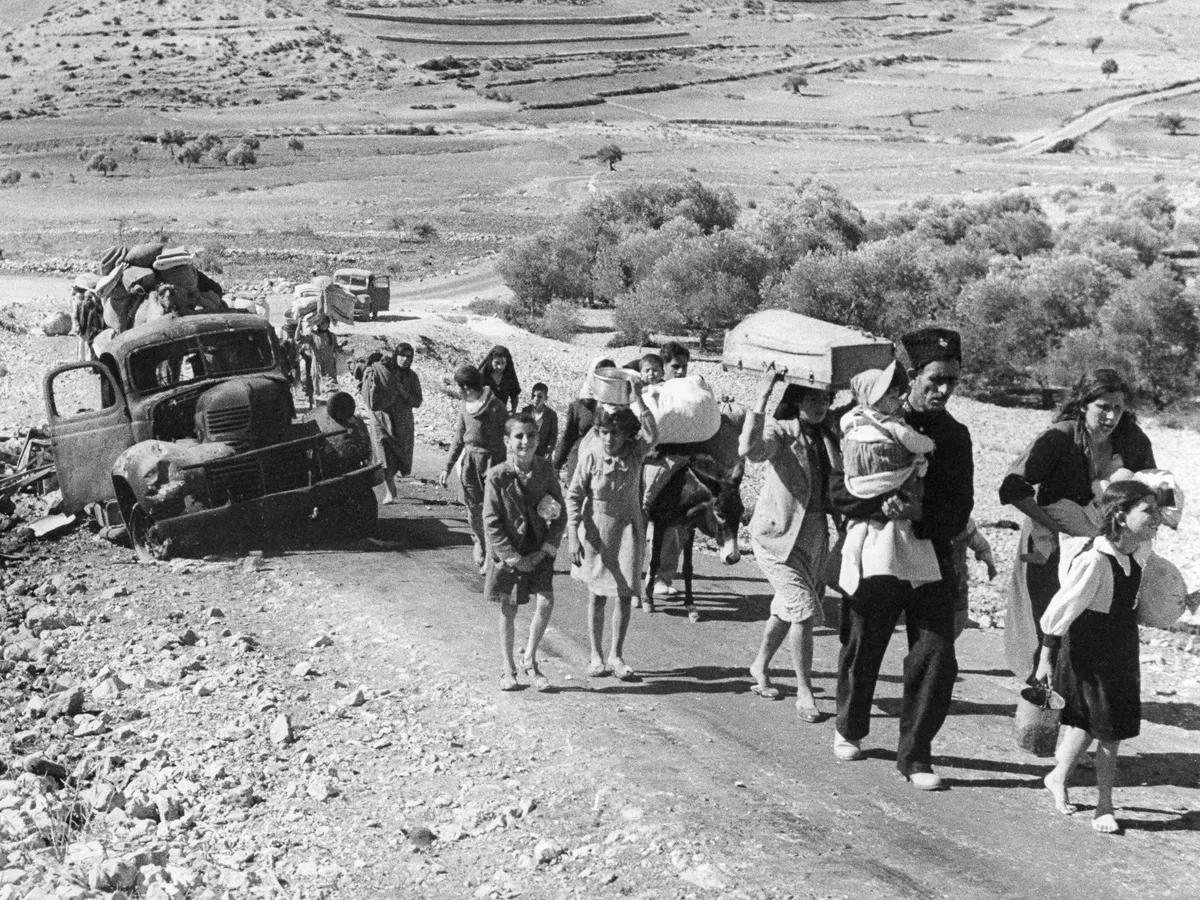
On the 78th anniversary of the mass expulsion of Palestinians, experts say US ‘political amnesia’ continues.Palestinian villagers who fled from their homes during fighting between Israeli and Arab troops, on November 4, 1948 [Jim Pringle/AP Photo]Published On 15 May 2026Washington, DC – It is a question that reaches a fever pitch this time of year for Palestinian survivors and rights advocates: Can the United States government create just policy in the Middle East without a full accounting — or recognition — of Palestinian history?Thursday marks the annual day of remembrance for the Nakba, a period that began in 1948 with the mass expulsion of Palestinians and the creation of the state of Israel.Recommended Stories list of 3 itemslist 1 of 3Walid Khalidi, historian of the Palestinian cause, dies aged 100list 2 of 3Palestinian refugees face new displacement as Israel’s bombs hit Lebanonlist 3 of 3Israel’s ‘two-tier’ policing and the crime epidemic in Palestinian townsend of listSince then, Palestinians have endured decades of displacement and ethnic cleansing.But the US government does not recognise the Nakba, which translates to the “catastrophe” in Arabic, even as it continues to assert gargantuan influence over the region and maintains ironclad support for the Israeli government.Under the second administration of President Donald Trump, the US has taken a further active role in Palestinian affairs, establishing the controversial “Board of Peace” to oversee the reconstruction of Gaza, even as it continues to take a permissive approach towards Israel’s genocide.When faced with the question of whether the US can responsibly address Palestinian issues without acknowledging the Nakba, Khaled Elgindy, a senior fellow at the Quincy Institute, believes the answer is simple: No.“If you only acknowledge the humanity and suffering of one side, that forces you also to ignore historical realities that are still with us today,” he told Al Jazeera.Elgindy said “political amnesia” has long defined the US government’s approach to the Israel-Palestine conflict.For decades, the US has supported Israel with billions in foreign assistance and military aid, despite the Israeli occupation of Palestinian territory and a system of segregation that rights groups say constitutes apartheid.Since October 7, 2023, Israel’s genocidal war in Gaza has killed at least 75,000 Palestinians. Elgindy told Al Jazeera that the US has played a key role in underwriting the conflict.“For better or worse, mostly for worse, the United States is inextricably tied to the Palestinian issue,” Elgindy said.A fundamental – if long delayed – corrective step would be recognition of the Nakba, he said. “It is a historical reality that Palestinians have a collective trauma that is part of their identity and part of their political psychology.”‘The ongoing Nakba’On Thursday, US Representative Rashida Tlaib introduced a resolution to officially recognise “the ongoing Nakba and Palestinian refugees’ rights”.It was the fifth consecutive time she has put forward the bill, with the latest version carrying 12 co-sponsors, up from six when it was first introduced in 2022.In a video conference this week, she explained that it was necessary to draw attention to the Nakba, given that the human rights abuses against Palestinians continue.“Too many of my colleagues in Congress like to act like … the state violence against the Palestinian people began with [Israeli Prime Minister Benjamin] Netanyahu,” Tlaib said.“We know that Palestinian history has been one of the ongoing Nakba and the ethnic cleansing campaign since the creation [of Israel] in 1948.”All told, about 750,000 Palestinians were violently expelled during the Nakba, displaced to refugee camps across the West Bank, Gaza and neighbouring Arab countries.About 400 cities and villages were depopulated, with massacres committed in Balad al-Sheikh, Saasaa, Deir Yassin, Saliha and Lydda, among others.Like in past years, Tlaib’s latest legislative effort is largely symbolic, with little chance of progressing in Congress, which remains predominantly pro-Israel.Still, the latest resolution comes amid signs of shifting public awareness, with polls showing increasing sympathy for Palestinians and a rise in negative views towards Israel’s government. Polls have shown tanking support for Israel, particularly among Democrats, amid the genocide in Gaza.Attitudes in Congress have also shown significant, if more incremental, signs of change. Though support for Israel was once considered sacrosanct, legislation to block arms sales to the country has garnered growing support.In April, 40 Democrats in the 100-member Senate voted to block the sale of military bulldozers to Israel, a tool in the ongoing occupation of the Palestinian territories. While legislation to prevent the sale did not pass, advocates hailed the tally as “historic”.Thirty members of Congress earlier this month also challenged the longstanding US policy of “official ambiguity” towards Israel’s alleged nuclear programme, a subject that had been seen as off limits for decades.“[Tlaib’s] resolution is not something that may necessarily pass today,” Yousef Munayyer, a senior fellow at the Arab Center Washington DC, told Al Jazeera.“When it does pass — and I do think we will one day get to that point — it will be because of all the efforts that came to build the critical mass necessary, in the past, today and tomorrow and so on.”‘Less than a generation to forget’Even acknowledging the Nakba on the May 15 anniversary, however, remains controversial.The United Nations held its first-ever commemoration of the Nakba in 2023, marking the 75th anniversary.The US, the United Kingdom, Germany and 30 other countries had voted against a UN resolution recognising the event, though. The US subsequently did not attend the proceedings, with a spokesperson pointing to “longstanding concerns over anti-Israel bias within the UN system”.That same year, a similar clash over the Nakba took place in the halls of Congress.Tlaib held a first-of-its-kind Nakba commemoration at the US Capitol in 2023. Republican leaders, however, sought to cancel the event amid pressure from the pro-Israel Anti-Defamation League (ADL).While the arms-length approach has become typical for the US government, that was not always the case.Elgindy pointed out that, in the 1940s and 50s, President Harry Truman “spoke out about the terrorism and terror inflicted by Jewish militias and underground groups”, even as his government was the first to recognise the state of Israel.Truman’s administration, for instance, supported UN General Assembly Resolution 194, which established a so-called “right to return” for displaced Palestinian refugees – approximately six million are registered with UNRWA today.The resolution also created the now-defunct Palestine Conciliation Commission, a panel tasked with mediating the conflict, upon which the US held a seat.There is also ample evidence that the US government was aware of the violence facing Palestinians, even if officials didn’t have the “vocabulary and the lexicon to call it the Nakba, or even to describe it as an act of ethnic cleansing or genocide”, according to Josh Ruebner, the director of the Institute for Middle East Understanding (IMEU).“What’s very, very clear from the archives of the US Consulate in Jerusalem, the US Consulate in Haifa, other US diplomatic outposts throughout the Middle East [is that] they saw and described very accurately what Israel was doing to the Palestinian people,” Ruebner said.“They recognised the systematic looting, the systematic despoliation of Palestinian property, the systematic expulsion of Palestinians from their homes, the systematic atrocities that they were subjected to, and above all else, the failure of Israel to repatriate Palestinian refugees.”
SRCAl Jazeera
LANGEN
LEANCenter
WORDS1 191
ENT10
FRI · 2026-05-15 · 14:31 GMTBRIEF NSR-2026-0515-76553
NSR-2026-0515-76553News Report·EN·Human Rights
Historical reckoning: The push for the US to acknowledge the Nakba
On the 78th anniversary of the Nakba, the mass expulsion of Palestinians in 1948, experts argue the US government continues to exhibit "political amnesia" by not acknowledging this historical event. Despite significant US influence and unwavering support for Israel, the US government does not officially recognize the Nakba, which translates to "catastrophe." This lack of recognition hinders the US's ability to create just policies in the Middle East, according to analysts like Khaled Elgindy.
Joseph StepanskyAl JazeeraFiled 2026-05-15 · 14:31 GMTLean · CenterRead · 5 min
Al JazeeraFIG 01
Reading time
5min
Word count
1 191words
Sources cited
2cited
Entities identified
10entities
Quality score
100%
§ 01
Briefing Summary
AI-generatedNEWSAR · AI
On the 78th anniversary of the Nakba, the mass expulsion of Palestinians in 1948, experts argue the US government continues to exhibit "political amnesia" by not acknowledging this historical event. Despite significant US influence and unwavering support for Israel, the US government does not officially recognize the Nakba, which translates to "catastrophe." This lack of recognition hinders the US's ability to create just policies in the Middle East, according to analysts like Khaled Elgindy. Representative Rashida Tlaib has reintroduced a resolution for the fifth time to officially recognize the "ongoing Nakba and Palestinian refugees' rights," though it faces little chance of passing Congress. However, public awareness and sympathy for Palestinians are reportedly increasing, with polls showing declining support for the Israeli government, particularly among Democrats, amid the ongoing conflict in Gaza.
Confidence 0.90Sources 2Claims 5Entities 10
§ 02
Article analysis
Model · rule-basedFraming
Human Rights
Political Strategy
Tone
Mixed Tone
AI-assessed
CalmNeutralAlarmist
Factuality
0.60 / 1.00
Mixed
LowHigh
Sources cited
2
Limited
FewMany
§ 03
Key claims
5 extracted01
US Representative Rashida Tlaib introduced a resolution to officially recognize the ongoing Nakba.
factual
Confidence
1.00
02
Political amnesia has long defined the US government's approach to the Israel-Palestine conflict.
quoteKhaled Elgindy
Confidence
1.00
03
US policy in the Middle East cannot create just policy without a full accounting of Palestinian history.
quoteKhaled Elgindy
Confidence
1.00
04
The US government does not recognize the Nakba, despite its influence in the Middle East and support for Israel.
factual
Confidence
1.00
05
Since October 7, 2023, Israel’s war in Gaza has killed at least 75,000 Palestinians.
statistic
Confidence
0.90
§ 04
Full report
5 min read · 1 191 words§ 05
Entities
10 identifiedKey playerOppositionContextPositiveNeutralNegative
People3
Locations4
Events1
§ 06
Keywords & salience
10 termsnakba
1.00
palestinian history
0.90
us policy
0.80
political amnesia
0.70
displacement
0.60
ethnic cleansing
0.60
apartheid
0.50
israeli occupation
0.50
genocide
0.40
middle east
0.40
§ 07
Topic connections
Interactive graph No topic relationship data available yet. This graph will appear once topic relationships have been computed.