The Palestinian reality has drastically changed since the last general conference at the end of 2016.In 2023, the deadly Hamas-led assault on Israel triggered the brutal Gaza War. Palestinians have been "slaughtered, displaced and devastated", Abbas said in his opening address to the conference, leaving an "unprecedented humanitarian catastrophe".At the same time, a key Israeli minister has pledged "to bury the idea of a Palestinian state". Palestinians in the occupied West Bank and East Jerusalem increasingly face being pushed from their homes and land as Jewish settlements grow faster than ever.Settlements are illegal under international law.This is further weakening the PA – dominated by Fatah – which governs parts of the West Bank.On top of that, Israel is withholding tax transfers that it collects for the PA – deepening its economic woes – because of an ongoing dispute about Palestinian school texts which Israel claims incite violence, and stipends to the families of those jailed or killed by Israel, including attackers.The PA says it is now owed some $5bn (£3.7bn; 4.3bn euros), meaning it pays most civil servants only part of their salaries and restricts some public services.ReutersMahmoud Abbas (right) has ruled by decree for nearly 20 yearsPresident Abbas, an architect of the breakthrough 1993 Oslo peace agreement with Israel, originally came to power promising to use non-violent means to work towards creating a Palestinian state – in the West Bank and Gaza Strip, with East Jerusalem as its capital.However, Palestinian opinion polls indicate profound dissatisfaction with their leader. In a survey late last year, 80% wanted him to resign. At a party level, Hamas was more popular than Fatah. Many Palestinians believe Fatah has lost its way.There is anger over cronyism and corruption and the PA's continued security co-ordination with Israel - which involves sharing information about Palestinian armed groups and is seen as benefiting the occupying power."When we talk about Fatah, we're talking about the backbone of the Palestinian national movement, at least since the 1960s," says political analyst, Xavier Abu Eid, in Ramallah. "And it's a movement that's going through a deep crisis.""The identity of Fatah is a revolutionary identity. It was about changing the status quo for the sake of liberating Palestine and turning the Palestinian cause from a humanitarian issue into a political issue.""But today this identity is being questioned. Is Fatah a national liberation movement or is it a group of bureaucrats that are going to work for the PA? Is it about the survival of the PA, or is it about the liberation of Palestine, or can you combine both?"ReutersPalestinian opinion polls suggest Hamas is more popular than FatahThe conference is being attended by more than 2,500 Fatah members – most of them in Ramallah, the administrative capital of the PA – but with a few hundred also spread between Beirut, Cairo and Gaza.They are due to elect 18 representatives to the central committee and 80 to the movement's parliament, known as the revolutionary council.Speaking among the ruins of Gaza, a Fatah activist, Samah al-Rawagh – who is joining the conference via video link – told the BBC that change was possible. "The symbolism of having a conference hall in Gaza is profoundly significant," she said."We are carrying a message that Fatah is united across the entire geographic spectrum. Our message is that Fatah is like the phoenix that never dies. From the heart of the ashes, it comes back to life anew. Fatah is united, united, united."But inevitably with political succession being discussed behind the scenes – and the Fatah central committee expected to play a pivotal role in the post-Abbas era – many Fatah insiders admit there is internal division.Important figures vying to replace Abbas include the current secretary general of the committee, Jibril Rjoub, and the PA Vice-President Hussein al-Sheikh.Meanwhile, the president's eldest son, Yasser Abbas – a businessman – is on the ballot for the first time to join the central committee.For many that move – raising questions of nepotism - underlines the disconnect between the party and Palestinian public sentiment and deepens doubts about whether the PA really can make the significant reforms that it has pledged.
SRCBBC News - World
LANGEN
LEANCenter
WORDS689
ENT12
FRI · 2026-05-15 · 23:05 GMTBRIEF NSR-2026-0516-76718
NSR-2026-0516-76718News Report·EN·Political Strategy
Palestinian leaders hold rare party meeting as polls show rising discontent
Fatah, the dominant Palestinian faction, is holding a rare party conference to elect top decision-makers amidst widespread Palestinian discontent. The meeting occurs as the Gaza war, triggered by Hamas's assault on Israel, has caused immense devastation, and Israeli settlement expansion in the West Bank intensifies.
BBC News - WorldFiled 2026-05-15 · 23:05 GMTLean · CenterRead · 3 min
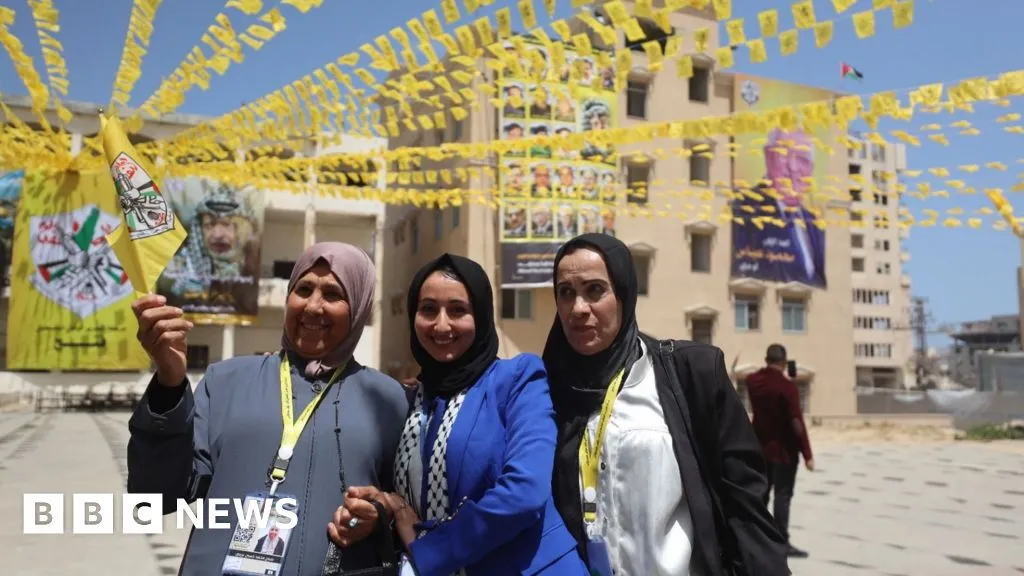
BBC News - WorldFIG 01
Reading time
3min
Word count
689words
Sources cited
1cited
Entities identified
12entities
Quality score
100%
§ 01
Briefing Summary
AI-generatedNEWSAR · AI
Fatah, the dominant Palestinian faction, is holding a rare party conference to elect top decision-makers amidst widespread Palestinian discontent. The meeting occurs as the Gaza war, triggered by Hamas's assault on Israel, has caused immense devastation, and Israeli settlement expansion in the West Bank intensifies. The Palestinian Authority (PA), led by Fatah's Mahmoud Abbas, faces severe economic hardship due to withheld tax transfers from Israel and a perceived disconnect from ordinary Palestinians. Opinion polls indicate significant dissatisfaction with Abbas, with many questioning Fatah's direction and its continued security coordination with Israel. The conference, attended by thousands of Fatah members, aims to elect new leadership for the central committee and revolutionary council, with potential successors to Abbas vying for influence, while concerns about nepotism arise.
Confidence 0.90Sources 1Claims 5Entities 12
§ 02
Article analysis
Model · rule-basedFraming
Political Strategy
Conflict
Tone
Mixed Tone
AI-assessed
CalmNeutralAlarmist
Factuality
0.70 / 1.00
Factual
LowHigh
Sources cited
1
Limited
FewMany
§ 03
Key claims
5 extracted01
Palestinians have been 'slaughtered, displaced and devastated', leading to an 'unprecedented humanitarian catastrophe'.
quoteAbbas
Confidence
1.00
02
Palestinian leaders hold rare party meeting amid rising discontent.
factual
Confidence
1.00
03
Hamas was more popular than Fatah in recent Palestinian opinion polls.
statistic
Confidence
0.90
04
Palestinian opinion polls indicate 80% wanted President Abbas to resign in a survey late last year.
statistic
Confidence
0.90
05
A key Israeli minister has pledged 'to bury the idea of a Palestinian state'.
factual
Confidence
0.90
§ 04
Full report
3 min read · 689 words§ 05
Entities
12 identifiedKey playerOppositionContextPositiveNeutralNegative
Locations6
Events1
§ 06
Keywords & salience
10 termspalestinian state
1.00
gaza war
0.90
palestinian discontent
0.90
fatah
0.80
israeli settlements
0.70
palestinian authority
0.70
mahmoud abbas
0.60
oslo peace agreement
0.50
humanitarian catastrophe
0.50
security co-ordination
0.40
§ 07
Topic connections
Interactive graph Network visualization showing 51 related topics
View Full Graph Person Organization Location Event|Click node to navigate|Edge numbers = shared articles