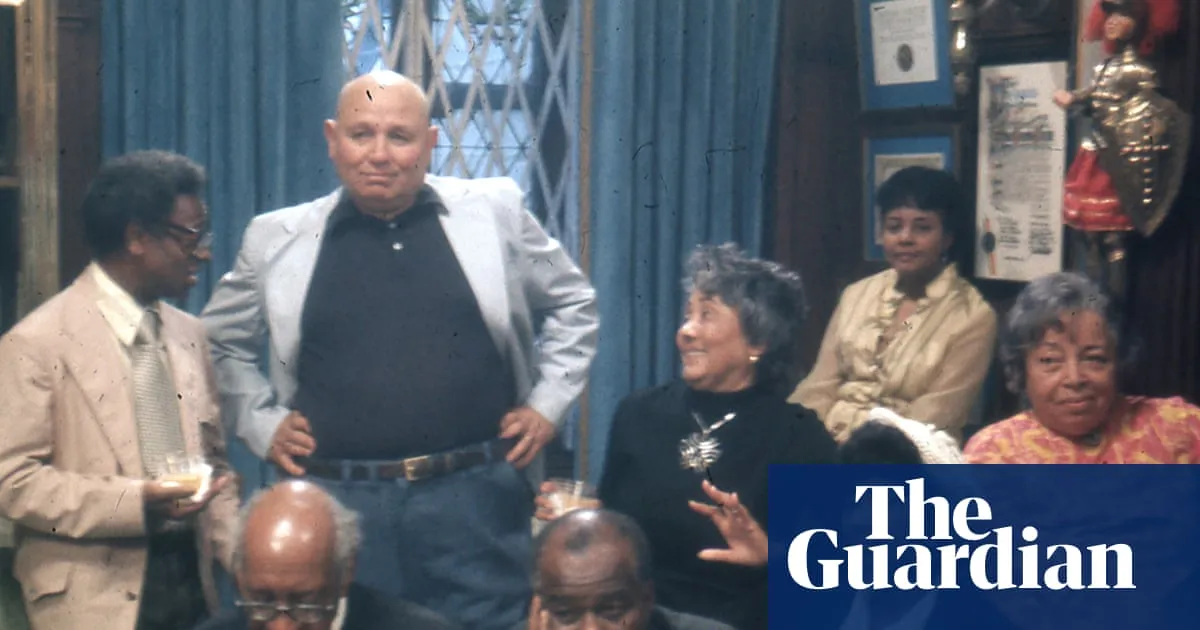
In 1969, the pioneering documentarian William Greaves wrote of his fury over the racially degrading stereotypes that white film producers threw up on American screens. “It became clear to me that unless we black people began to produce information for screen and television there would always be a distortion of the ‘black image,’” he said.Three years later, Greaves began work on what he considered the most important footage he ever shot: a feature documentary gathering surviving figures of the Harlem-renaissance" class="entity-link entity-event" data-entity-id="110822" data-entity-type="event">Harlem Renaissance to reflect on the movement they had built half a century earlier.Now, more than 50 years after cameras rolled, Once Upon a Time in Harlem is finally receiving its international premiere in Cannes’ Directors’ Fortnight – completed not by William Greaves, who died in 2014, but by his son David and granddaughter Liani.The documentary centres on a cocktail party Greaves hosted at Duke Ellington’s townhouse in Harlem in August 1972 – an attempt to capture the voices of artists, writers, musicians and organisers whose work had transformed Black American culture in the 1920s, but whose stories were already at risk of being sidelined.Greaves invited every surviving participant he could locate. Many had not seen one another for decades. They included the painter Aaron Douglas; the queer artist and writer Richard Bruce Nugent; the poet Arna Bontemps; the musicians Eubie Blake and Noble Sissle; the photographer James Van Der Zee; and Ida Mae Cullen, the widow of Countee Cullen.For four hours, Greaves filmed them as they laughed, reminisced and debated. The resulting film follows the rhythm of the party itself: tentative greetings and warm memories gradually giving way to animated debates over politics, language and legacy.David Greaves, who was there in 1972 aged 22, worked on the shoot as a cameraman under his father. “I was aware of the people involved and how important they were,” he told the Guardian. “My father thought they were extraordinary, and there we were to capture them.”Duke Ellington himself was unwell and did not attend, but his sister Ruth was present. “There were four cameras, two crews circulating through the apartment catching conversations, these little moments between them,” David said. “Mostly my father just let them freestyle, it was very fluid.”Among the film’s strengths is precisely that looseness. At one point, guests debate whether the term “Negro” should be discarded in favour of “Afro-American”. Elsewhere, they discuss Marcus Garvey and Langston Hughes and the global reverberations of anti-colonial struggle. Aaron Douglas reflects on jazz, telling the room: “It would be considered a revolution in relation to other music. It was not a revolution to us.”For David Greaves, those conversations feel strikingly current. “When they talk about whether to call themselves Black or Negro, that’s a discussion still happening now – you’ve got Black, African American, people of colour. And then there is still this question of what the diaspora should do in relation to Africa.”He points to footage in the film of Haile Selassie’s 1936 appeal to the League of Nations after Italy’s invasion of Ethiopia. While editing it, he thought of Volodymyr Zelenskyy seeking international support after Russia’s invasion of Ukraine. “Selassie didn’t get help, but Zelenskyy was able to. And now they’re at a point where they’re building their own munitions, they’re fighting off the Russians with one hand and helping the Gulf states with the other.”The film also reminds viewers how recent America’s racial violence remains. David points to footage accompanying the anti-lynching poem The Lynching, ending on a young white girl watching with what he calls “fiendish glee”.“She would have been about the same age as my father, which means her child would be my age, her grandchild my daughter’s age,” he said. “All three of us vote. The US is not that far away from that time, just three generations. That is kind of bracing.”For him, the film arrives as Black history is once again being fought over in the US. Asked about Donald Trump’s recent attacks on the Smithsonian over race-focused programming, he said: “You look at it and think, Jesus, who is this? Why do they do this kind of thing? It’s who he is, and we just have to deal with it.”He added: “They’ve been doing everything they can to erase the Black experience in America, even removing signage from park service sites. What this film does is show a group of wonderful people sitting around talking about a time 50 years ago, and about their own present. These giant intellectuals that the media didn’t even realise existed.”The footage was originally shot but unused for Greaves’ 1974 documentary From These Roots. Though he went on to make dozens more films, including the experimental landmark documentary Symbiopsychotaxiplasm, he never finished the Harlem project closest to his heart.After William’s death, the material passed to his widow Louise, who continued working on it until her own death in 2023. David and Liani then took over, restoring and digitising 60,000 feet of 16mm film.In the process, David says he came to understand his father more deeply. Reading notes in his books on eastern philosophy, he discovered the intellectual roots of conversations William often had about pain, suffering and consciousness. “He was a much heavier dude than I had realised,” he said, laughing.When shaping the final cut, he followed one of his father’s principles: “My dad used to say if there’s something that affects you viscerally, go with it.”The unfinished film screened in fragments in 2024 and 2025, where it drew rapturous responses. Richard Brody of The New Yorker called it “one of the greatest talking pictures” he had ever seen.David, who has spent the past three decades publishing Our Time Press, a Brooklyn community newspaper focused on Black civic and cultural life, with his wife, Bernice Green, said he hoped to release the film in time for Greaves’ centenary in October, with retrospectives planned in New York and at the Barbican in London.“My dad was appreciated by those who knew documentary film, but he didn’t have the acclaim that he has now,” he said. “This film should cement him as a chronicler of the history of African Americans.”
SRCThe Guardian - World News
LANGEN
LEANCenter-Left
WORDS1 018
ENT12
SAT · 2026-05-16 · 12:00 GMTBRIEF NSR-2026-0516-76786
NSR-2026-0516-76786News Report·EN·Human Interest
Harlem Renaissance documentary finally gets global premiere 50 years after cameras rolled
Pioneering documentarian William Greaves began filming a feature documentary in 1972 to capture surviving figures of the Harlem Renaissance reflecting on their movement. The film, titled *Once Upon a Time in Harlem*, centers on a 1972 cocktail party Greaves hosted at Duke Ellington's townhouse, bringing together artists, writers, and musicians.
Nadia Khomami Arts and culture correspondentThe Guardian - World NewsFiled 2026-05-16 · 12:00 GMTLean · Center-LeftRead · 5 min
The Guardian - World NewsFIG 01
Reading time
5min
Word count
1 018words
Sources cited
2cited
Entities identified
12entities
Quality score
100%
§ 01
Briefing Summary
AI-generatedNEWSAR · AI
Pioneering documentarian William Greaves began filming a feature documentary in 1972 to capture surviving figures of the Harlem Renaissance reflecting on their movement. The film, titled *Once Upon a Time in Harlem*, centers on a 1972 cocktail party Greaves hosted at Duke Ellington's townhouse, bringing together artists, writers, and musicians. After Greaves' death in 2014, his son David and granddaughter Liani completed the project. Now, over 50 years after filming, *Once Upon a Time in Harlem* is having its international premiere at Cannes' Directors' Fortnight. The documentary showcases candid conversations among the Harlem Renaissance figures about politics, language, and legacy, with Greaves' family highlighting the film's enduring relevance to contemporary discussions.
Confidence 0.90Sources 2Claims 5Entities 12
§ 02
Article analysis
Model · rule-basedFraming
Human Interest
Social Justice
Tone
Measured
AI-assessed
CalmNeutralAlarmist
Factuality
0.70 / 1.00
Factual
LowHigh
Sources cited
2
Limited
FewMany
§ 03
Key claims
5 extracted01
David Greaves stated that his father believed the Harlem Renaissance figures were extraordinary and they were there to capture them.
quoteDavid Greaves
Confidence
1.00
02
Participants in the documentary included Aaron Douglas, Richard Bruce Nugent, Arna Bontemps, Eubie Blake, Noble Sissle, James Van Der Zee, and Ida Mae Cullen.
factualarticle
Confidence
1.00
03
The film centers on a 1972 cocktail party hosted by William Greaves to capture reflections from Harlem Renaissance participants.
factualarticle
Confidence
1.00
04
The documentary, 'Once Upon a Time in Harlem', is receiving its international premiere at Cannes’ Directors’ Fortnight.
factualarticle
Confidence
1.00
05
William Greaves began work on a documentary about surviving figures of the Harlem Renaissance in 1972.
factualarticle
Confidence
1.00
§ 04
Full report
5 min read · 1 018 words§ 05
Entities
12 identifiedKey playerOppositionContextPositiveNeutralNegative
People9
WG
William Greaves
EntertainerKey Player
5x
100
DG
David Greaves
EntertainerKey Player
3x
90
DE
Duke Ellington
EntertainerContext
2x
70
AD
Aaron Douglas
EntertainerContext
50
AB
Arna Bontemps
EntertainerContext
50
LG
Liani Greaves
EntertainerKey Player
50
EB
Eubie Blake
EntertainerContext
50
NS
Noble Sissle
EntertainerContext
50
RB
Richard Bruce Nugent
EntertainerContext
50
§ 06
Keywords & salience
10 termsharlem renaissance
1.00
documentary film
0.90
william greaves
0.80
black image
0.70
cultural legacy
0.60
racial stereotypes
0.60
cannes directors' fortnight
0.50
filmmaking
0.50
black american culture
0.40
documentary premiere
0.40
§ 07
Topic connections
Interactive graph No topic relationship data available yet. This graph will appear once topic relationships have been computed.