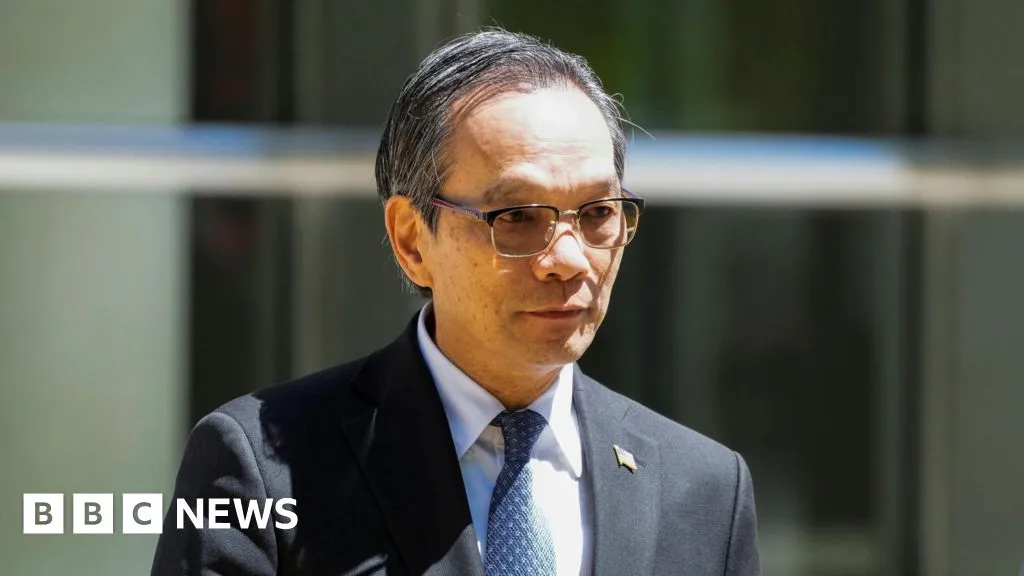
"It's part of the same sort of strategic approach, which is to tamp down on dissent and to shape a clear narrative around the PRC, and to do that in bolder ways, as we're seeing," said Lauryn Williams, a deputy director with the Center for Strategic and International Studies, which has tracked cases of Chinese espionage in the US since 2000.Mahjong, ping pong and overseas 'police stations'Lu, who was supported by dozens of community members during his one-week trial in Brooklyn, could face up to 30 years in prison for the charges linked to the illegal police station.China has been accused of setting up such stations around the world, with at least 100 reported across 53 countries. Just last week, a UK immigration officer was found guilty of working for Chinese intelligence as part of a "shadow policing operation".The Chinese government has at times denied that the stations exist or has described them as places where volunteers help their fellow Chinese citizens with administrative services."They are not so-called police stations or police service centres at all," China's Ministry of Public Security said in 2023. The BBC has contacted the Chinese Embassy in the US for comment.A police investigation into "secret Chinese police stations" in London concluded that "no criminal activity" has taken place.Lu - the 64-year-old president of the American Changle Association, a Chinese community group - argued he was simply trying to help people renew driver's licenses and facilitate social activities like mahjong and ping pong."This isn't 'Spy Time'," his lawyer, John Carman said, according to Courthouse News. "This is license renewal."But prosecutors say Lu used the office building for more nefarious purposes - keeping tabs on critics of China.In one instance, prosecutors said Chinese officials asked Lu to help "verify" that a longtime critic of China, Xu Jie, who fled the country in 2013, was in the US.Lu's co-defendant, Chen Jinping, had already pleaded guilty to acting as an unauthorised foreign agent for helping set up the centre.A 'volume enterprise' of espionageChina's attempts to crack down on opposition is just one part of its overreaching espionage campaign abroad, including hacking, stealing military and technology secrets and other sensitive information, said Douglas London, a Georgetown University professor who worked as a CIA officer for 34 years.For years, China has sought to exert influence abroad through a "vast bureaucracy and network" of resources, people and funding, said Lyle Morris, a senior fellow with the Asia Society Policy Institute.China's campaign of keeping tabs on dissidents around the world is motivated by the belief that criticism threatens the country's stability, said Claire Chu, a nonresident fellow at the Atlantic Council's Global China Hub.The Chinese government believes that dissent is actively supported by Western governments for the purpose of smearing China's image, Morris said."China sees ulterior motives when Western countries provide platforms for Chinese dissidents who harshly criticize the Chinese government, and doesn't buy the argument that such voices are part of a healthy democracy based on free speech," he said.The country uses a number of harassment and bullying strategies to silence dissidents, Morris added, including tracking people's cell phones or even recruiting dissidents to spy on their friends. He added that it can be dangerous for those who still have family left in China who are more vulnerable to intimidation from the government.The cost of speaking up against ChinaA cartoon cat has been vexing China's censors – now he says they are on his tailFor decades, Beijing has also sought to cultivate relationships with so-called "talents" across the US government and business community, Chu said.The Chinese government targeted Wang, the Arcadia mayor, who pleaded guilty this week to taking orders from Chinese officials to publish pro-China content.Prosecutors say she published an essay arguing that there was no genocide in the Xinjiang province of China and "no such thing as forced labour". China has faced mounting criticism from around the world over its treatment of the mostly Muslim Uyghur population in the north-western Xinjiang autonomous region, where there is evidence of millions of Uyghurs being held in camps subjected to forced labour. China says the are for "re-education" purposes only.These types of cases pose a challenge for US prosecutors, because there are so many of them, and they require years of work and resources to prove, espionage experts said.
SRCBBC News - World
LANGEN
LEANCenter
WORDS716
ENT12
SAT · 2026-05-16 · 23:15 GMTBRIEF NSR-2026-0517-76870
NSR-2026-0517-76870News Report·EN·National Security
Secret police and propaganda: The Chinese agents spying on expats in US
Recent espionage cases in the US highlight China's efforts to suppress dissent and shape its global narrative. Experts point to the establishment of overseas "police stations," which China denies are official law enforcement, as a tactic to monitor critics.
BBC News - WorldFiled 2026-05-16 · 23:15 GMTLean · CenterRead · 3 min
BBC News - WorldFIG 01
Reading time
3min
Word count
716words
Sources cited
4cited
Entities identified
12entities
Quality score
100%
§ 01
Briefing Summary
AI-generatedNEWSAR · AI
Recent espionage cases in the US highlight China's efforts to suppress dissent and shape its global narrative. Experts point to the establishment of overseas "police stations," which China denies are official law enforcement, as a tactic to monitor critics. One case involved a Chinese community group president accused of using an office building to track a critic of China, while another saw a US mayor plead guilty to publishing pro-China content under the direction of Chinese officials. These actions are part of a broader espionage campaign aimed at silencing opposition, driven by the belief that criticism threatens China's stability and is often supported by Western governments.
Confidence 0.90Sources 4Claims 5Entities 12
§ 02
Article analysis
Model · rule-basedFraming
National Security
Political Strategy
Tone
Mixed Tone
AI-assessed
CalmNeutralAlarmist
Factuality
0.70 / 1.00
Factual
LowHigh
Sources cited
4
Well sourced
FewMany
§ 03
Key claims
5 extracted01
Lu's co-defendant, Chen Jinping, pleaded guilty to acting as an unauthorized foreign agent.
factualArticle
Confidence
0.90
02
A UK immigration officer was found guilty of working for Chinese intelligence as part of a 'shadow policing operation'.
factualArticle
Confidence
0.90
03
Prosecutors allege Chinese officials asked Lu to help 'verify' that a critic of China, Xu Jie, was in the US.
factualProsecutors
Confidence
0.80
04
Chinese agents are spying on expats in the US through overseas 'police stations'.
factualArticle
Confidence
0.80
05
China has been accused of setting up such stations around the world, with at least 100 reported across 53 countries.
factualArticle
Confidence
0.70
§ 04
Full report
3 min read · 716 words§ 05
Entities
12 identifiedKey playerOppositionContextPositiveNeutralNegative
People5
Organizations3
§ 06
Keywords & salience
10 termssecret police stations
1.00
chinese espionage
1.00
prc narrative
0.90
dissent suppression
0.80
foreign agent
0.70
china influence
0.60
propaganda
0.50
expats
0.50
administrative services
0.40
community group
0.40
§ 07
Topic connections
Interactive graph Network visualization showing 51 related topics
View Full Graph Person Organization Location Event|Click node to navigate|Edge numbers = shared articles