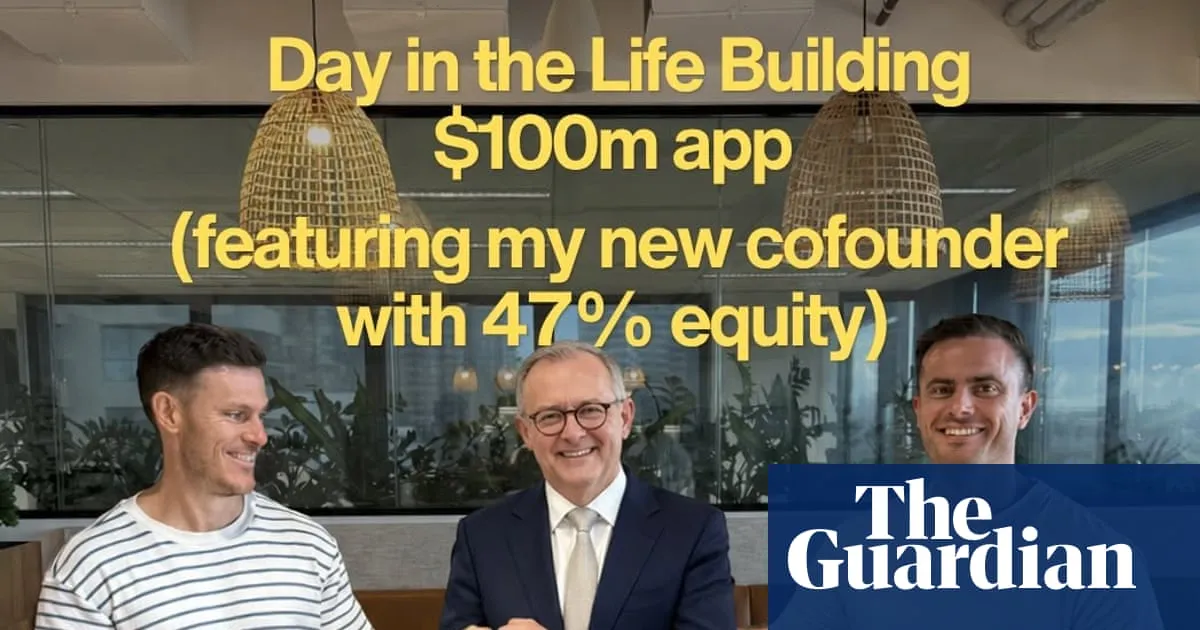
Jacques and Frank Greeff with Anthony Albanese in an AI-generated image created to protest against Capital Gains Tax changes View image in fullscreen Jacques and Frank Greeff with Anthony Albanese in an AI-generated image created to protest against Capital Gains Tax changes Tech founders use AI-generated images to poke fun at Anthony Albanese in protest against tax changes ‘He’s having a great time with his new 47% equity,’ one entrepreneur jokes, warning that some startups may leave Australia behind Get our breaking news email, free app or daily news podcast Tech entrepreneurs have mocked the government’s Capital Gains Tax changes by posting AI-generated photos of Anthony Albanese as their “new founder” and warning that increased taxes could push people away from working for new businesses or send startups overseas. Startups and entrepreneurs may yet receive a carve-out in the federal government’s planned changes to the CGT discount, with the prime minister saying he wanted to support innovation and the treasurer, Jim Chalmers, revealing that consultation was continuing with the sector. The CGT changes – replacing the 50% tax discount on profits with “cost-base indexation”, meaning tax on profits after inflation, and a minimum 30% tax rate – were strongly opposed by some tech founders. Early stage startup companies with little cashflow often offer employees equity in the company, or stock options, in lieu of higher pay, while founders can be motivated to take risks with new ventures by a large potential payday when they sell their companies. Both could be affected by the CGT changes, the Australia" class="entity-link entity-organization" data-entity-id="128406" data-entity-type="organization">Tech Council of Australia warned. “There is work to do to ensure Australia’s startup community doesn’t become collateral damage as a result of proposed changes,” said the council’s chief executive, Kate Cornick. Tim Wilson, the shadow treasurer, warned of “founder flight” overseas. The cofounder of Boost Juice, Janine Allis, also warned that winding back CGT discounts would discourage innovative businesses. A minor trend emerged among startup founders after budget night, with several posting AI-generated photos of Albanese in their offices. View image in fullscreen Julian Fayad with the PM in his AI-generated post “He’s having a great time with his new 47% equity,” wrote Jacques Greeff, the founder of the communications app Kinso, who posted AI images of the prime minister in the office with his staff, coding their product and working with customers. “With the tax changes, [the] incentive to grow a business is greatly reduced, but all the normal risks remain,” Greeff told Guardian Australia, warning it would be harder to attract talented employees if their equity stake was less lucrative. “Australia should be encouraging young founders to build the next Canva. My fear is they don’t even attempt it now or, worse, they go overseas and build the next unicorn and Australia misses out entirely.” Julian Fayad, the chief executive of the loan comparison platform LoanOptions.ai, posted AI images of Albanese sleeping in his company’s office and scrolling on his phone. He also warned of the impact on attracting workers and risk-taking. Fayad took part in a roundtable meeting in Sydney on Saturday hosted by Wilson, where founders were critical of the government’s changes, and joined the shadow treasurer at a media conference afterward. “With the 47% CGT, the government’s message to founders like me is that if we succeed, they want nearly half of the hard-earned reward,” Fayad said. “When I look at what countries like Singapore and the UAE are doing to attract and retain founders; the incentives, the structures, the genuine support, and then look at what Canberra is doing, it’s hard not to feel abandoned and hindered.” View image in fullscreen Alfie Robertson ‘welcomes’ Albanese to his office in another AI-generated image Alfie Robertson, the founder of the video editing app Roll, posted AI images of Albanese in the gym, recording a podcast and working on strategy. He also feared startups could look overseas. “The concern is not just about tax,” he said. “It’s about incentives. Policies like this shape where founders choose to build, invest and stay. “If Australia wants to compete globally for talent and innovation, it should be rewarding people who take productive risks to build companies, create jobs and grow the economy, not reducing the incentive to do so.” Asked about the backlash on Friday, Albanese said he supported the startup sector, pointing to a range of budget incentives for research and development and instant asset write-offs. Chalmers conceded that startups may have “a different kind of cost base” to other industries. “We had already been engaging with the tech sector, in particular, with the VC and startup sector to make sure that the changes accurately reflect the contribution that we seek from that really important part of the economy,” he said. Cornick said the Tech Council welcomed the new R&D tax incentives and reforms to venture capital regulation, and was keen to continue consulting on the CGT. The economist Saul Eslake said there may be a case for more generous treatment for CGT, specifically for new businesses starting from scratch, as they may be paying tax on all profits due to having no cost base to index. He backed the government’s moves to alter CGT for property and shares, and said it wasn’t unfair to expect startup founders to pay tax on business earnings but conceded some new businesses like startups may need incentives to encourage innovation and risk-taking. “There are still pretty powerful incentives,” Eslake said. “If, instead of becoming a billionaire, you make $800m, is that less incentive?” Another economist, Chris Richardson, warned that it would be a mistake to “bend” on the CGT. He said incentives including R&D tax offsets and the instant asset write-off were better than carve-outs for future profits to support early-stage businesses. Richardson also backed the broader move towards taxing income from assets and income from labour in a more equal way. “There’s a Warren Buffett quote: ‘You may run into someone with a terrific investment idea, who won’t go forward with it because of the tax he would owe when it succeeds. Send him my way. Let me unburden him.’” Explore more on these topics Tax Business Anthony Albanese AI (Artificial Intelligence) Jim Chalmers Australian politics Tim Wilson news Share Reuse this content
SRCThe Guardian - World News
LANGEN
LEANCenter-Left
WORDS1 039
ENT12
SUN · 2026-05-17 · 07:38 GMTBRIEF NSR-2026-0517-76904
NSR-2026-0517-76904News Report·EN·Economic Impact
Tech founders use AI-generated images to poke fun at Anthony Albanese in protest against tax changes
Australian tech founders are using AI-generated images of Prime Minister Anthony Albanese to protest proposed changes to the capital gains tax (CGT) discount. Entrepreneurs are posting images of Albanese as their "new founder" to highlight concerns that increased taxes could discourage innovation, deter employees from accepting equity, and lead startups to relocate overseas.
Josh ButlerThe Guardian - World NewsFiled 2026-05-17 · 07:38 GMTLean · Center-LeftRead · 5 min
The Guardian - World NewsFIG 01
Reading time
5min
Word count
1 039words
Sources cited
4cited
Entities identified
12entities
Quality score
100%
§ 01
Briefing Summary
AI-generatedNEWSAR · AI
Australian tech founders are using AI-generated images of Prime Minister Anthony Albanese to protest proposed changes to the capital gains tax (CGT) discount. Entrepreneurs are posting images of Albanese as their "new founder" to highlight concerns that increased taxes could discourage innovation, deter employees from accepting equity, and lead startups to relocate overseas. The government is reportedly consulting with the tech sector regarding potential carve-outs for startups. Founders argue that the proposed changes, which would replace the 50% CGT discount with cost-base indexation and a minimum 30% tax rate, reduce incentives for risk-taking and business growth. The Prime Minister has stated his support for the startup sector, while the Treasurer acknowledged that startups may have unique cost bases.
Confidence 0.90Sources 4Claims 5Entities 12
§ 02
Article analysis
Model · rule-basedFraming
Economic Impact
Technology
Tone
Mixed Tone
AI-assessed
CalmNeutralAlarmist
Factuality
0.60 / 1.00
Mixed
LowHigh
Sources cited
4
Well sourced
FewMany
§ 03
Key claims
5 extracted01
The proposed capital gains tax changes could reduce the incentive to grow a business and make it harder to attract talented employees.
quoteJacques Greeff
Confidence
0.95
02
The CGT changes involve replacing the 50% tax discount on profits with cost-base indexation and a minimum 30% tax rate.
factualarticle
Confidence
0.90
03
Tech entrepreneurs are using AI-generated images of Anthony Albanese to protest against capital gains tax changes.
factualarticle
Confidence
0.90
04
Startups and entrepreneurs may receive a carve-out in the federal government’s planned changes to the CGT discount.
factualarticle
Confidence
0.80
05
Increased taxes could push startups overseas or discourage people from working for new businesses.
predictionarticle
Confidence
0.70
§ 04
Full report
5 min read · 1 039 words§ 05
Entities
12 identifiedKey playerOppositionContextPositiveNeutralNegative
People7
Locations1
§ 06
Keywords & salience
9 termscapital gains tax
1.00
ai-generated images
1.00
tax changes
0.90
startups
0.80
tech founders
0.80
anthony albanese
0.70
cgt discount
0.60
founder flight
0.50
equity
0.40
§ 07
Topic connections
Interactive graph Network visualization showing 51 related topics
View Full Graph Person Organization Location Event|Click node to navigate|Edge numbers = shared articles