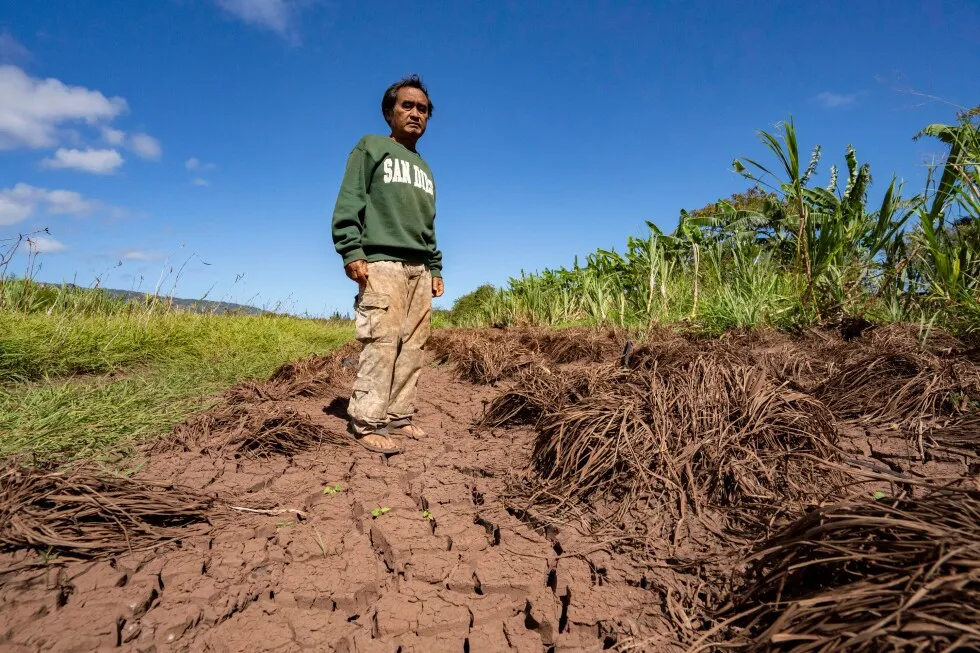
Hawaii’s worst flooding in 20 years leaves farmers struggling and fewer veggies at the market 1 of 5 | Bok Kongphan poses for a photo at his farm, Monday, May 4, 2026, in Waialua, Hawaii. (AP Photo/Mengshin Lin) 2 of 5 | Jeni Balanay poses for a portrait at Bok Kongphan’s farm, Monday, May 4, 2026, in Waialua, Hawaii. (AP Photo/Mengshin Lin) 3 of 5 | A drone view shows dried and cracked mud covering a farm, Monday, May 4, 2026, in Waialua, Hawaii. (AP Photo/Mengshin Lin) 4 of 5 | Bok Kongphan, left, walks across his farm with his grandson, Monday, May 4, 2026, in Waialua, Hawaii. (AP Photo/Mengshin Lin) 5 of 5 | Dried mud on a wall shows where floodwater reached at Bok Kongphan’s farm, Monday, May 4, 2026, in Waialua, Hawaii. (AP Photo/Mengshin Lin) 1 of 5 | Bok Kongphan poses for a photo at his farm, Monday, May 4, 2026, in Waialua, Hawaii. (AP Photo/Mengshin Lin) 1 of 5 Bok Kongphan poses for a photo at his farm, Monday, May 4, 2026, in Waialua, Hawaii. (AP Photo/Mengshin Lin) Add AP News on Google Add AP News as your preferred source to see more of our stories on Google. Share 2 of 5 | Jeni Balanay poses for a portrait at Bok Kongphan’s farm, Monday, May 4, 2026, in Waialua, Hawaii. (AP Photo/Mengshin Lin) 2 of 5 Jeni Balanay poses for a portrait at Bok Kongphan’s farm, Monday, May 4, 2026, in Waialua, Hawaii. (AP Photo/Mengshin Lin) Add AP News on Google Add AP News as your preferred source to see more of our stories on Google. Share 3 of 5 | A drone view shows dried and cracked mud covering a farm, Monday, May 4, 2026, in Waialua, Hawaii. (AP Photo/Mengshin Lin) 3 of 5 A drone view shows dried and cracked mud covering a farm, Monday, May 4, 2026, in Waialua, Hawaii. (AP Photo/Mengshin Lin) Add AP News on Google Add AP News as your preferred source to see more of our stories on Google. Share 4 of 5 | Bok Kongphan, left, walks across his farm with his grandson, Monday, May 4, 2026, in Waialua, Hawaii. (AP Photo/Mengshin Lin) 4 of 5 Bok Kongphan, left, walks across his farm with his grandson, Monday, May 4, 2026, in Waialua, Hawaii. (AP Photo/Mengshin Lin) Add AP News on Google Add AP News as your preferred source to see more of our stories on Google. Share 5 of 5 | Dried mud on a wall shows where floodwater reached at Bok Kongphan’s farm, Monday, May 4, 2026, in Waialua, Hawaii. (AP Photo/Mengshin Lin) 5 of 5 Dried mud on a wall shows where floodwater reached at Bok Kongphan’s farm, Monday, May 4, 2026, in Waialua, Hawaii. (AP Photo/Mengshin Lin) Add AP News on Google Add AP News as your preferred source to see more of our stories on Google. Share Updated [hour]:[minute] [AMPM] [timezone], [monthFull] [day], [year] Waialua, Hawaii (AP) — The reddish-brown mud that smothered Bok Kongphan’s Hawaii farm has hardened in the tropical sun. Irrigation tubes lie in a tangle where his lemongrass, cucumber and okra once flourished.His niece, Jeni Balanay, lost her crops too — a mustardy green called choy sum, bitter melon, tomato. The leaves of her recently planted banana, coconut and mango have gone yellow, the trees unlikely to survive.Across Oahu’s North Shore, an area famed for its big-wave surfing, the small farms that help supply the island’s food are struggling after back-to-back storms in March brought the state’s worst flooding in two decades. Officials are pleading with farmers not to give up, stressing that local agriculture is crucial for the isolated archipelago.“In some cases entire farms have been wiped out,” said Brian Miyamoto, executive director of the Hawaii Farm Bureau. “These are farmers who were just days or weeks away from harvesting and now they have to start over.” According to data collected by farming advocates, more than 600 of Hawaii’s 6,500 farms reported nearly $40 million in damage, including to crops, livestock and machinery. But Miyamoto said the farm bureau estimates that the full extent of the destruction is much broader — $50 million at close to 2,000 farms. 4 MIN READ 1 MIN READ 4 MIN READ A particular type of agricultureFor most of the late 19th and 20th centuries, plantation-style agriculture dominated Hawaii, as companies like Dole and conglomerates founded by missionary descendants grew immense fields of sugarcane or pineapple for export. The operations drew large numbers of immigrants, primarily from Asia and Portugal.But that large-scale monoculture faded by the 1990s amid international competition, and officials began to promote smaller farms — some, like Kongphan’s, just a few acres — with a wider array of crops that could be sold to local grocery stores or at farmers markets.Worldwide shipping disruptions during the COVID-19 pandemic reinforced the importance of having a local food supply in Hawaii, and the state in recent years has offered additional support to the farms. That includes money for infrastructure, a farm-to-school program and loans for those who have been denied credit from banks. But they still face challenges. Unlike many of their counterparts on the mainland, Hawaii farms are often too small and diversified to be able to afford or qualify for crop insurance. Many of the farmers are immigrants who were barely eking out a living even before the storms, Miyamoto noted.The majority of Hawaii’s farms report less than $10,000 in annual sales, according to the U.S. Department of Agriculture. The flooding, along with high winds and power outages, killed or stressed livestock and destroyed equipment, vehicles and infrastructure. farmers in despairWithout insurance, Kongphan, an immigrant from Thailand, has been trying to obtain government aid and figure out how to level earth moved by the floodwaters. His niece has been helping him and other Thai farmers navigate the process. Available help includes federal disaster relief, one-time $1,500 emergency grants and long-term loans from the state, and a charitable fund that raised about $850,000 in the weeks after the floods. Many farmers also have online fundraising pages.In an interview interpreted by Balanay, Kongphan called the floods “very devastating,” but said he will continue working the 5-acre (2-hectare) plot he’s leased for five years, growing vegetables he sells at farmers markets, a swap meet, and at shops and stalls in Honolulu’s Chinatown.Kongphan pointed to a faint, thigh-high line on a plywood wall showing where the water reached inside his home, which he built from a shipping container. Inside, there’s now a donated tent, but he usually sleeps outside.Flies swarmed as he carried a dirt-caked generator he hopes to salvage. Nearby sat a Toyota Yaris, covered inside and out in the same dried sludge.Balanay, who learned farming from her mom after the family immigrated to Hawaii, isn’t sure she wants to keep at it. She recalled the torrent rising to her waist in seconds and wiping out her crops in the middle of the night. “Will it happen again?” she asked. “When you look at the land and it’s all destroyed, you want to give up.”The flooding is the latest crisis for Hawaii’s farmers, on top of wildfires, pests and volcanic tephra — ash and debris ejected by an erupting Big Island volcano, said the state’s top agriculture official, Sharon Hurd.“These are the farms that we really need to get started again,” Hurd said. “We cannot have them give up.”Officials have been conducting tests to assure farmers that their soil is safe and providing them with seeds and plant starts, she said. Sparser offerings at farmers marketsSome farmers have been unable to make it to farmers markets, a key source of their income. Many who do have less to offer, Miyamoto said.Farmer Kula Uliʻi said her family has been bringing roughly one-quarter of their usual output. Instead of 200 pounds (90.7 kilograms) of tomatoes at weekend farmers markets, they might sell 60 pounds (27.2 kilograms). They lost starts that were due to be planted this month and face months of limited harvest, she said. She’s unsure about the status of her farm’s contracts with grocery stores, given that it can’t meet demand.Even the taro, which thrives in water, is lost, she said, after it was submerged in the contaminants carried by the floods.“It’s all gone,” Uliʻi said. “We can’t use any of it.”___Associated Press writer Audrey McAvoy in Honolulu contributed.
SRCAssociated Press (AP)
LANGEN
LEANCenter
WORDS1 395
ENT8
SUN · 2026-05-17 · 10:23 GMTBRIEF NSR-2026-0517-76968
NSR-2026-0517-76968News Report·EN·Economic Impact
Hawaii’s worst flooding in 20 years leaves farmers struggling and fewer veggies at the market
Hawaii experienced its worst flooding in two decades in March, devastating small farms across Oahu's North Shore. The storms buried crops in mud, destroyed irrigation systems, and killed young trees, forcing farmers to start over.
By
JENNIFER SINCO KELLEHERAssociated Press (AP)Filed 2026-05-17 · 10:23 GMTLean · CenterRead · 6 min
Associated Press (AP)FIG 01
Reading time
6min
Word count
1 395words
Sources cited
0cited
Entities identified
8entities
Quality score
100%
§ 01
Briefing Summary
AI-generatedNEWSAR · AI
Hawaii experienced its worst flooding in two decades in March, devastating small farms across Oahu's North Shore. The storms buried crops in mud, destroyed irrigation systems, and killed young trees, forcing farmers to start over. Damage estimates range from $40 million to $50 million, affecting hundreds of farms. This disaster highlights the vulnerability of Hawaii's local agriculture, which is crucial for the isolated archipelago's food supply. Many farmers, often immigrants with limited resources and no crop insurance, are struggling to access aid and rebuild. Officials are urging farmers not to give up, emphasizing the importance of local food production, especially after pandemic-related shipping disruptions. The reduced harvest is already leading to sparser offerings at farmers markets.
Confidence 0.90Claims 5Entities 8
§ 02
Article analysis
Model · rule-basedFraming
Economic Impact
Human Interest
Tone
Measured
AI-assessed
CalmNeutralAlarmist
Factuality
0.70 / 1.00
Factual
LowHigh
Sources cited
0
No named sources
FewMany
§ 03
Key claims
5 extracted01
Jeni Balanay lost her crops, including choy sum, bitter melon, and tomato.
factual
Confidence
1.00
02
Bok Kongphan's farm was covered in reddish-brown mud, and irrigation tubes were tangled.
factual
Confidence
1.00
03
There are fewer vegetables available at the market as a result of the flooding.
factual
Confidence
1.00
04
Farmers in Hawaii are struggling due to the flooding.
factual
Confidence
1.00
05
Hawaii experienced its worst flooding in 20 years.
factual
Confidence
1.00
§ 04
Full report
6 min read · 1 395 words§ 05
Entities
8 identifiedKey playerOppositionContextPositiveNeutralNegative
People3
Organizations1
§ 06
Keywords & salience
8 termsflooding
1.00
farmers
0.90
agriculture
0.80
food supply
0.70
crop damage
0.70
hawaii
0.60
market impact
0.50
extreme weather
0.50
§ 07
Topic connections
Interactive graph Network visualization showing 43 related topics
View Full Graph Person Organization Location Event|Click node to navigate|Edge numbers = shared articles