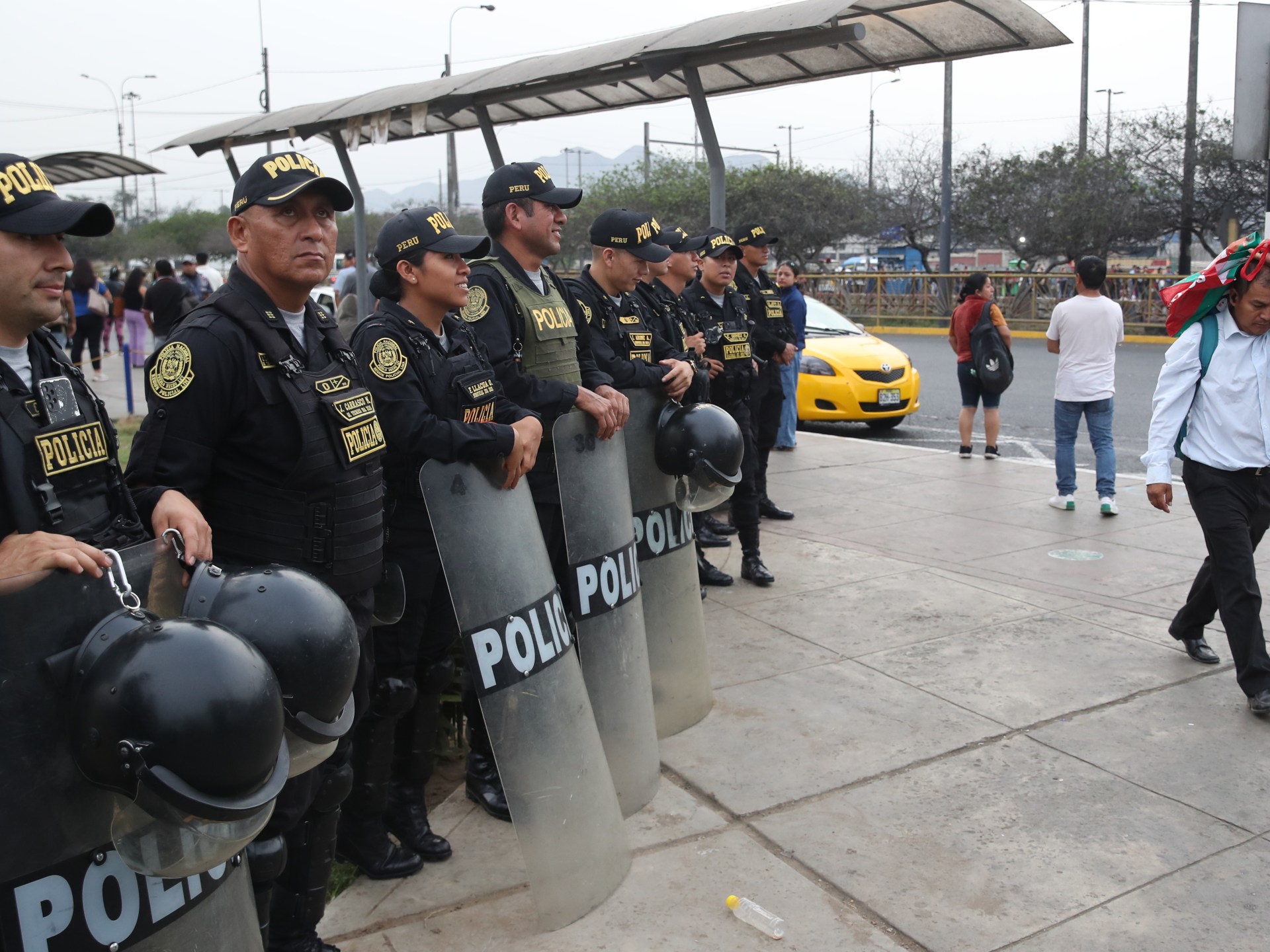
From Peru to Venezuela, insecurity and militarised politics are eroding democratic legitimacy.Published On 15 Jan 2026Members of the Peruvian Police guard a street in Lima, Peru, 14 January 2026. Urban transport unions in Lima are protesting against the government over the increase in extortion and murders of their workers by organised crime. [Paolo Aguilar/EPA]South America is at a crossroads. The attack on Caracas, the abduction of Nicolas Maduro and the threats towards the Colombian and Mexican presidents by the US president are an ominous sign of the years ahead. In addition to armed external meddling, elections have sharpened political tensions from La Paz to Santiago, Buenos Aires to Quito, and the region’s biggest democracies are heading to the polls again later in 2026. Unequal dividends from decades of growth, combined with the post-pandemic erosion of state capacity, have widened the appeal of hard-line, populist responses. The danger is not only domestic: the region’s drift towards militarised politics, and the open threats by the US, surface the risks of external influence, a modern rehash of the banana republic and gunboat diplomacy playbook.Taken together, these dynamics point to a dangerous convergence. Rising insecurity, hollowed-out political representation and renewed external coercion are reinforcing one another, weakening institutions and making the region once again vulnerable to domination rather than self-determination.Peru is a stark cautionary tale. For two decades, the country had above-average economic growth, attracted heavy foreign investment, and even sought OECD membership. By early 2026, the sol is widely regarded as South America’s most stable currency. Yet prosperity has not translated into institutional stability: seven presidents in nine years speak to a deeper political dysfunction. The sociologist Julio Cotler has argued that Peru’s elites, enriched by exports of raw materials, had scant incentives to share gains or build capable and inclusive institutions. The result is a brittle political economy, where colonial hierarchies linger, inequalities across gender, class and ethnicity persist, and state services are dysfunctional, weakening legitimacy and representation.That brittleness is now colliding with insecurity. In Lima, transport strikes over rising violence and extortion have repeatedly paralysed the city; dozens of bus drivers were murdered in broad daylight throughout 2025. Protests turned deadly in October 2025, when a rapper and street artist was shot near the government palace during demonstrations against the new president, José Jerí. The president of Congress called the victim a “terruco” (once a label for terrorists), illustrating the toxicity of Peru’s political landscape, as this term is a slur aimed at dissenters, often Indigenous or peasant, to delegitimise their protests and demands. This is not an isolated phenomenon, but a symptom of how political systems treat social conflict as a policing problem, something to be repressed rather than addressed.Peru’s response has been the militarisation of public space. Under Jerí, the government declared a state of emergency and sent soldiers to patrol the streets “until insecurity is eradicated”. Ecuador has tried something similar, going so far as to declare an “internal armed conflict”, leading to increasing human rights violations. When political demands are marginalised in favour of military or police force, political representation collapses into patronage or fear. Peru’s Congress illustrates this collapse of representation. It has become a plutocratic trading house where vested interests are waved through, rather than a forum for undertaking the reforms necessary for the state to respond to the demands of its citizens.The 2026 presidential campaign in Peru is amplifying this logic. Frontrunners promise mega-prisons, drone surveillance, and even transferring inmates to Salvadoran prisons. Keiko Fujimori, the daughter of former president Alberto Fujimori, openly invokes “mano dura” (a militarised response to the crisis of the state and representation). Across the Andes, “order” is back as a magical solution and political proposal, reinforced by US support for repression as a policy response, though it rarely fixes the causes of violence: social exclusion, impunity and hollowed-out states.Chile offers a cautionary example. The celebratory chants for Pinochet heard after Jose Antonio Kast’s electoral victory illustrate a nostalgia for the certainty of authoritarianism and dictatorship, one that was sponsored by US intervention. Yet the appeal of “strong hand” governance is less about ideology than about disillusionment with parties and governments that feel distant and self-serving. When elites ignore citizens’ needs, toughness is performed, replacing political representation. The military is politicised and society is militarised. From this shift, it is a short step to a symbiosis in which politicians and uniforms defend predatory interests, local or foreign, under the banner of security, as authoritarian arrangements take hold and soldiers receive “warrior dividends”.The return of hard-line populism in the region, as well as open US military intervention and bombing, resonates with a wider revival of militarised responses to social and political problems. The revival of the Monroe Doctrine in the Caribbean, the breach of international law and the use of sheer force, the so-called “Don Doctrine”, point to a governing logic that substitutes coercion for political legitimacy. Financial pressure, visible in Argentina’s most recent legislative elections, and the summary execution of alleged drug traffickers follow the same pattern. These are not isolated phenomena but variations of the same response: the gaslighting of social problems through force. Ultimately, this produces fragile states, fragmented societies and politicised militaries that undermine the very capacity needed to deliver safety, fairness and democracy, making external interference easier, not harder.As leaders in the region pursue militarisation as a means of repressing dissent, they weaken states and position countries much as they were when banana republics first emerged. Weak institutions, corrupted legislatures and politicised security forces once again define political life. Today, the script is updated, more overt, raw and transactional, as the missiles and the aftermath of the abduction of Nicolas Maduro in Venezuela illustrate.A different path is possible, but it begins by describing the problem correctly. Violence is real, yet security without legitimacy is ephemeral, and force without institution-building is brittle. The Andes will not escape the current trend of insecurity and instability by doubling down on emergency powers, larger prisons and sweeping the streets with soldiers in full gear. The only way to bypass this path is to invest in justice and tackle the institutionalised inequalities that make violence feasible and profitable. This cannot happen without recasting political representation away from current predatory dynamics.If the region continues the chant of right-wing populism in 2026, it will see more states of emergency, more “internal conflicts” and more militarised campaigns, and inevitably more room for foreign actors to set the terms and priorities in the region. A reboot of banana republics with a “security” add-on. It might even hand the US president the geopolitical equivalent of a “FIFA Peace Prize”, something that resembles a prize for the performance of success, but that ultimately fails in real life. The only way out of this trajectory is to ensure that politics takes place without the shadow of a uniform and populism, and that citizens’ voices are not eclipsed by the interests of cliques and short-sighted elites. This task will be more difficult given the pressures from the US for transactional deals that do not care for democracy, human rights or legitimacy.The views expressed in this article are the author’s own and do not necessarily reflect Al Jazeera’s editorial stance.
SRCAl Jazeera
LANGEN
LEANCenter
WORDS1 200
ENT11
THU · 2026-01-15 · 13:32 GMTBRIEF NSR-2026-0115-7700
NSR-2026-0115-7700Analysis·EN·Political Strategy
Banana republics are making a comeback in Latin America
A news article published on January 15, 2026, reports that Latin America is facing a resurgence of instability reminiscent of "banana republics." The article cites rising insecurity, weakened political representation, and external coercion as contributing factors across the region. Peru is highlighted as an example, where economic growth has failed to translate into institutional stability, leading to political dysfunction and vulnerability to organized crime.
Fabio Andrés Díaz Pabón,Pedro AlarcónAl JazeeraFiled 2026-01-15 · 13:32 GMTLean · CenterRead · 5 min
Al JazeeraFIG 01
Reading time
5min
Word count
1 200words
Sources cited
1cited
Entities identified
11entities
Quality score
100%
§ 01
Briefing Summary
AI-generatedNEWSAR · AI
A news article published on January 15, 2026, reports that Latin America is facing a resurgence of instability reminiscent of "banana republics." The article cites rising insecurity, weakened political representation, and external coercion as contributing factors across the region. Peru is highlighted as an example, where economic growth has failed to translate into institutional stability, leading to political dysfunction and vulnerability to organized crime. The article also mentions external threats from the US and the attack on Caracas. These combined issues are eroding democratic legitimacy and self-determination in South America.
Confidence 0.90Sources 1Claims 5Entities 11
§ 02
Article analysis
Model · rule-basedFraming
Political Strategy
Economic Impact
Tone
Mixed Tone
AI-assessed
CalmNeutralAlarmist
Factuality
0.60 / 1.00
Mixed
LowHigh
Sources cited
1
Limited
FewMany
§ 03
Key claims
5 extracted01
Julio Cotler argued that Peru's elites had scant incentives to share gains or build capable and inclusive institutions.
quoteJulio Cotler
Confidence
1.00
02
Peru has had seven presidents in nine years.
factual
Confidence
1.00
03
Peru had above-average economic growth for two decades and sought OECD membership.
factual
Confidence
1.00
04
The attack on Caracas, the abduction of Nicolas Maduro and the threats towards the Colombian and Mexican presidents by the US president are an ominous sign.
factual
Confidence
0.90
05
Insecurity and militarised politics are eroding democratic legitimacy in Latin America.
factual
Confidence
0.80
§ 04
Full report
5 min read · 1 200 words§ 05
Entities
11 identifiedKey playerOppositionContext
P
Peru location · Context
90
SA
South America location · Context
80
US
United States location · Opposition
70
V
Venezuela location · Context
70
L
Lima location · Context
60
NM
Nicolás Maduro (Maduro) person · Context
60
M
Mexico location · Context
50
C
Colombia location · Context
50
BA
Buenos Aires location · Context
30
LP
La Paz location · Context
30
S
Santiago location · Context
30
§ 06
Keywords & salience
10 termsbanana republic
1.00
latin america
0.90
political instability
0.80
militarized politics
0.70
external influence
0.70
us influence
0.60
democratic legitimacy
0.60
state capacity
0.50
economic inequality
0.50
peru
0.40
§ 07
Topic connections
Interactive graph Network visualization showing 48 related topics
View Full Graph Person Organization Location Event|Click node to navigate|Edge numbers = shared articles