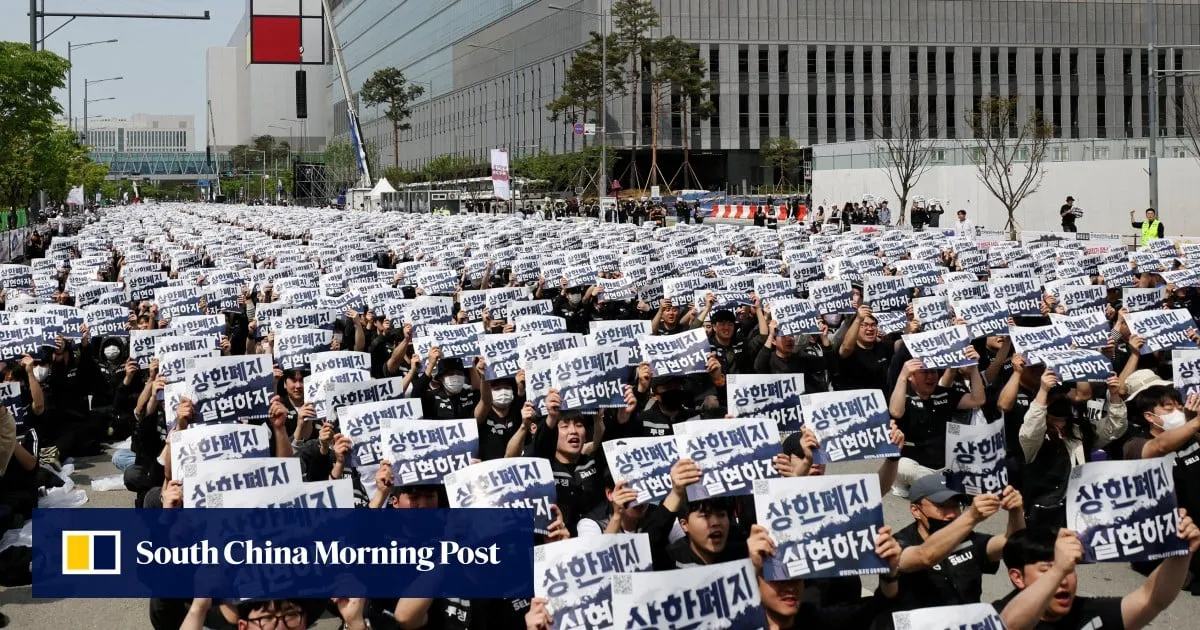
South Korea will pursue all options, including emergency arbitration, to avoid a labour strike at the country’s biggest employer Samsung Electronics and to minimise any damage if one does occur, its prime minister said on Sunday.The world’s largest memory chipmaker and its South Korean labour union will resume pay talks on Monday with a government mediator, in a move that could ease concerns over a potentially disruptive strike at the tech giant that accounts for nearly a quarter of the country’s exports.“Just one day of suspension at Samsung Electronics’ semiconductor factory is expected to incur direct losses of as much as 1 trillion won (US$667.68 million),” Prime Minister Kim Min-seok said after an emergency meeting with ministers on Sunday.Choi Seung-ho, head of Samsung Electronics’ largest labour union, meets the press at a district court in Suwon, South Korea, on Wednesday. Photo: EPA“What is more concerning is that a temporary pause on semiconductor manufacturing lines leads to months of inactivity,” Kim said, adding there were worries about economic damage ballooning to as much as 100 trillion won if materials had to be disposed of due to a strike.
SRCSouth China Morning Post
LANGEN
LEANCenter-Right
WORDS187
ENT9
SUN · 2026-05-17 · 15:18 GMTBRIEF NSR-2026-0517-77017
NSR-2026-0517-77017News Report·EN·Economic Impact
South Korea weighs arbitration to avoid Samsung semiconductor plant strike
South Korea's Prime Minister announced on Sunday that the government will explore all options, including emergency arbitration, to prevent a labor strike at Samsung Electronics, the country's largest employer and world's largest memory chipmaker. Pay talks between the company and its South Korean labor union are set to resume on Monday with a government mediator.
ReutersSouth China Morning PostFiled 2026-05-17 · 15:18 GMTLean · Center-RightRead · 1 min
South China Morning PostFIG 01
Reading time
1min
Word count
187words
Sources cited
2cited
Entities identified
9entities
Quality score
100%
§ 01
Briefing Summary
AI-generatedNEWSAR · AI
South Korea's Prime Minister announced on Sunday that the government will explore all options, including emergency arbitration, to prevent a labor strike at Samsung Electronics, the country's largest employer and world's largest memory chipmaker. Pay talks between the company and its South Korean labor union are set to resume on Monday with a government mediator. The government is concerned about the significant economic impact of a strike, estimating direct losses of up to 1 trillion won (US$667.68 million) for just one day of suspension at its semiconductor plant. Prime Minister Kim Min-seok also warned that a temporary halt in semiconductor manufacturing could lead to months of inactivity, potentially causing economic damage to balloon to as much as 100 trillion won if materials must be disposed of.
Confidence 0.90Sources 2Claims 5Entities 9
§ 02
Article analysis
Model · rule-basedFraming
Economic Impact
Legal & Judicial
Tone
Measured
AI-assessed
CalmNeutralAlarmist
Factuality
0.70 / 1.00
Factual
LowHigh
Sources cited
2
Limited
FewMany
§ 03
Key claims
5 extracted01
South Korea will pursue all options, including emergency arbitration, to avoid a labor strike at Samsung Electronics.
quoteSouth Korean Prime Minister
Confidence
1.00
02
Samsung Electronics accounts for nearly a quarter of South Korea's exports.
factual
Confidence
0.90
03
A one-day suspension at Samsung Electronics' semiconductor factory is expected to incur direct losses of up to 1 trillion won (US$667.68 million).
statisticSouth Korean Prime Minister
Confidence
0.90
04
A temporary pause on semiconductor manufacturing lines could lead to months of inactivity.
predictionSouth Korean Prime Minister
Confidence
0.80
05
Economic damage could balloon to as much as 100 trillion won if materials have to be disposed of due to a strike.
predictionSouth Korean Prime Minister
Confidence
0.70
§ 04
Full report
1 min read · 187 words§ 05
Entities
9 identifiedKey playerOppositionContextPositiveNeutralNegative
§ 06
Keywords & salience
9 termslabour strike
1.00
samsung semiconductor plant
1.00
emergency arbitration
0.90
pay talks
0.80
economic damage
0.80
semiconductor manufacturing
0.70
south korea
0.60
labour union
0.50
government mediator
0.40
§ 07
Topic connections
Interactive graph Network visualization showing 16 related topics
View Full Graph Person Organization Location Event|Click node to navigate|Edge numbers = shared articles