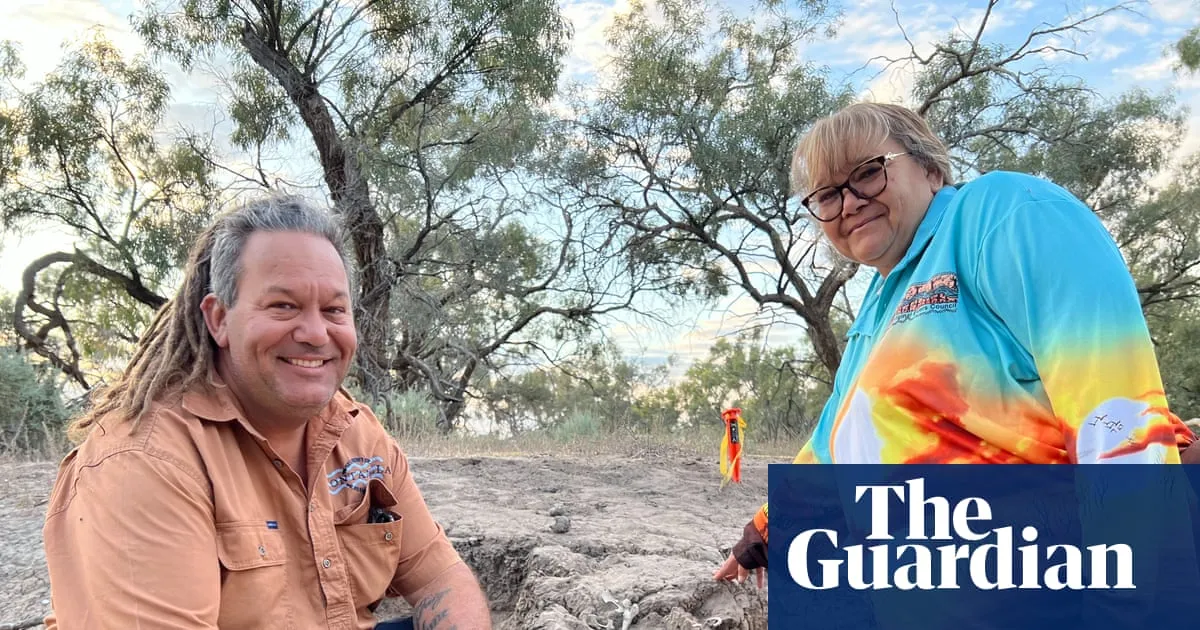
Barkindji custodian David Doyle lifts the first bone from a millennium-old dingo burial site in Kinchega national park. Dingoes ‘were a companion animal right up until colonisation’, he says. Photograph: Amy Way View image in fullscreen Barkindji custodian David Doyle lifts the first bone from a millennium-old dingo burial site in Kinchega national park. Dingoes ‘were a companion animal right up until colonisation’, he says. Photograph: Amy Way Signs of ‘feeding’ ritual at dingo burial site shed new light on bond between First Nations people and canines Never documented archaeologically before, evidence points to First Nations people caring for and nursing the animal Get our breaking news email, free app or daily news podcast The discovery of a millennium-old dingo burial site in western New South Wales, including evidence of a “feeding” ritual never before documented archaeologically, has shed new light on the longstanding relationship between the canines and First Nations people. The dingo was buried along the Baaka, or Darling River, in Kinchega national park near the Menindee Lakes. Radiocarbon dating suggests the animal was buried between 916 and 963 years ago in a midden, which the Barkindji people tended to by adding river mussel shells for about 500 years afterwards. Scientists say the practice of “feeding” the site with shells had never been observed archaeologically anywhere in the world before. “Barkindji Elders propose that ongoing additions to the Kinchega midden may have formed a ‘feeding’ ritual … which was maintained over multiple generations,” the researchers write in a study published in Australian Archaeology. The project’s lead, Dr Amy Way, an archaeologist at the Australian Museum and lecturer at the University of Sydney, said that while Aboriginal dingo burial sites had previously been discovered, they had not been analysed in context. “What was really significant in this work is that we showed that the midden was created at the time of burial, so these two processes happened together as a way of interring the dingo … into that landscape.” The dingo, a male that lived an estimated four to seven years old, had “broken ribs and a broken leg, which are very typical injuries from hunting with kangaroos”, Way said. “That it had lived through these injuries and been nursed back to health, it just tells you how much the community at the time cared for that animal.” The burial was first identified in 2000 by Barkindji elder Uncle Badger Bates and a National Parks and Wildlife Service archaeologist, after the site was exposed by roadworks. A salvage excavation was conducted in September 2023 to recover the dingo’s remains, after its skull was lost to floods in 2021. View image in fullscreen A millennium-old dingo burial site was discovered in Kinchega national park near the Menindee Lakes. Photograph: Amy Way View image in fullscreen Research shows Indigenous dingo burial sites were further north and west along the Baaka system than previously documented. Photograph: Amy Way David Doyle, a Barkindji custodian involved in the excavation, described the practice of continuously adding to the shell midden as “a way of keeping connection and also respecting the ancestors”. Dingoes “were a companion animal right up until colonisation”, Doyle said. “Now, we actually don’t even have any on country here; they were hunted to regional extinction. “Some of our Barkindji people still carry dingo as their totem. Even though we don’t have it in our region now, it’s still significant.” Though Indigenous dingo burial sites have been previously documented, the research, funded by the Australian Museum Foundation, showed the practice extended further north and west along the Baaka system than previously documented. Dr Kylie Cairns, a conservation biologist at the University of New South Wales who was not involved in the research, said the excavation showed “how some dingoes were really important to First Nations people and included in their daily life and kept as companions”. The vast majority of dingoes lived in the wild, she said. “Dingoes are really important ecologically and culturally in Australia, and I think that at the moment, the way that dingoes are treated in legislation and on [the] ground … doesn’t reflect that. “Something that a lot of Australians don’t realise is that we’re actively killing dingoes in national parks. “We really need to have a discussion … about how we’re managing dingoes in the landscape, how we can make sure that we’re protecting livestock, but also valuing them for their cultural value and also for their ecological value,” she said. Her research showed in 2023 that more than half of Australia’s dingoes were genetically pure, while a separate study, published this week, showed there are eight genetically distinct dingo populations. Explore more on these topics Archaeology Indigenous Australians Wildlife Animals news Share Reuse this content
SRCThe Guardian - World News
LANGEN
LEANCenter-Left
WORDS789
ENT12
MON · 2026-05-18 · 14:01 GMTBRIEF NSR-2026-0518-77239
NSR-2026-0518-77239News Report·EN·Human Interest
Signs of ‘feeding’ ritual at dingo burial site shed new light on bond between First Nations people and canines
Archaeologists have discovered a millennium-old dingo burial site along the Baaka (Darling River) in western New South Wales, revealing a previously undocumented "feeding" ritual. Barkindji people created a shell midden at the burial site, adding river mussel shells for approximately 500 years after the dingo's interment.
Donna Lu Assistant editor, climate, environment and scienceThe Guardian - World NewsFiled 2026-05-18 · 14:01 GMTLean · Center-LeftRead · 4 min
The Guardian - World NewsFIG 01
Reading time
4min
Word count
789words
Sources cited
3cited
Entities identified
12entities
Quality score
100%
§ 01
Briefing Summary
AI-generatedNEWSAR · AI
Archaeologists have discovered a millennium-old dingo burial site along the Baaka (Darling River) in western New South Wales, revealing a previously undocumented "feeding" ritual. Barkindji people created a shell midden at the burial site, adding river mussel shells for approximately 500 years after the dingo's interment. This practice, maintained over generations, suggests a deep connection and care for the animal, which had sustained injuries but was nursed back to health. The discovery, made in Kinchega National Park, indicates that dingoes were companion animals for First Nations people until colonization. The research also shows these burial practices extended further north and west along the Baaka system than previously documented.
Confidence 0.90Sources 3Claims 5Entities 12
§ 02
Article analysis
Model · rule-basedFraming
Human Interest
Social Justice
Tone
Measured
AI-assessed
CalmNeutralAlarmist
Factuality
0.80 / 1.00
Factual
LowHigh
Sources cited
3
Well sourced
FewMany
§ 03
Key claims
5 extracted01
Dingoes 'were a companion animal right up until colonisation'.
quoteDavid Doyle
Confidence
1.00
02
Radiocarbon dating indicates the dingo was buried between 916 and 963 years ago.
factual
Confidence
1.00
03
A millennium-old dingo burial site with evidence of a 'feeding' ritual has been discovered in Kinchega national park.
factual
Confidence
1.00
04
The dingo had broken ribs and a broken leg, suggesting it was nursed back to health by the community.
factualDr Amy Way
Confidence
0.90
05
The practice of 'feeding' the burial site with shells had never been observed archaeologically anywhere in the world before.
factualResearchers
Confidence
0.90
§ 04
Full report
4 min read · 789 words§ 05
Entities
12 identifiedKey playerOppositionContextPositiveNeutralNegative
People3
Organizations3
§ 06
Keywords & salience
10 termsfirst nations people
1.00
dingo burial site
1.00
canine-human bond
0.90
feeding ritual
0.80
archaeological discovery
0.70
companion animal
0.60
barkindji people
0.50
kinchega national park
0.50
midden
0.40
colonisation
0.40
§ 07
Topic connections
Interactive graph No topic relationship data available yet. This graph will appear once topic relationships have been computed.