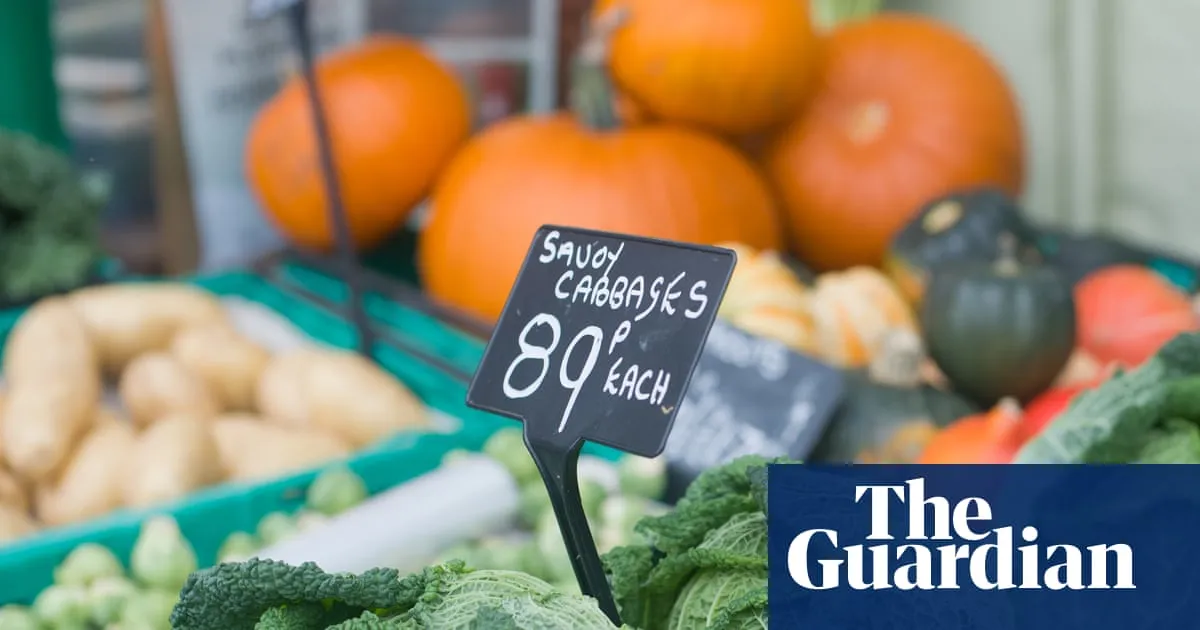
rural Britain is becoming a “food desert” for lower-income families as the closure of local shops and poor public transport leaves them at disproportionately high risk of hunger and cost of living pressures, research shows.Over half of households with an annual income of under £40,000 a year living in the countryside struggle to access affordable and healthy food including fresh fruit and vegetables, the University of Sheffield study estimates.It identifies a stark city-country divide, with families in relatively affluent rural areas at significantly higher risk of food insecurity than similar households in deprived urban neighbourhoods with high levels of poverty.While just 7% of lower-income households in deprived urban neighbourhoods lived more than 20 minutes’ walk from the nearest shop selling fresh fruit and vegetables, this rose to 52.5% for households with identical incomes in rural areas.food insecurity is defined as poor access to nutritious food caused by lack of money or nearby shops, leading to meal-skipping and poor diet. About one in eight UK households were estimated in February to have experienced food insecurity.More than half of lower-income households in rural areas live more than 20 minutes from the nearest shop selling fresh fruit and vegetables. Photograph: Murdo MacLeod/The Guardian“For ‘struggling middle’ families in rural areas, food security is not just about bank balance but physical and geographical barriers that make navigating the cost of living crisis nearly impossible,” said the study’s author, Dr Megan Blake, a senior lecturer and food security expert at the University of Sheffield.“When a struggling household lives in a ‘food desert’ with no nearby shop and poor quality food options their risk of food insecurity is over 22 times higher than a household in the same income bracket that can walk five minutes to a budget supermarket,” she said.“It’s not just about being poor. It’s about the environment punishing you for being poor. Ironically, these are the regions that grow the food we eat and are central to the UK’s food production.”High food and energy costs, the disappearance of village stores, meagre public transport options and supermarket food logistics systems that favour cities combine to create food deserts and ratchet up the risks of food insecurity.“‘Village life’ or ‘country way of life’ is not all it’s cracked up to be. Being financially very poor and a lack of access [to food] just do not help,” said one rural dweller interviewed in the study.Food deserts also appear in isolated edge-of-city social housing estates and coastal areas. Community activists in Castlemilk, a suburb of Glasgow with 15,000 residents, have for years campaigned unsuccessfully for a large supermarket – typically the best guarantee of cheap, fresh produce – to be built locally.The study calls for a national review of areas with poor access to food shops. Photograph: Martin Godwin/The GuardianThe Sheffield study, based on a survey of 14,158 households in England and Scotland earning under £40,000, says persistent household food insecurity “exposes deep cracks in the structural foundations of our communities” and is linked to poor mental and physical health, stress and social stigma.The study calls for a national review of areas with poor access to food shops, focusing on rural areas, post-industrial and coastal communities, and support for low-cost and subsidised food retail alternatives such as food clubs and social supermarkets.UK food costs have risen as a whole by 50% since 2021 but prices are significantly higher in food deserts. Research by South Cotswolds food bank in 2024 found the cost of a basic basket of food was up to 62% higher in village convenience stores than in the nearest market town low-cost superstore.However, food insecurity was not reducible to income alone, the study found. While lower-income households in full-time work were far more likely to be above the poverty line than those reliant solely on welfare benefits, both groups experienced similar levels of food insecurity.A government spokesperson said: “Our goal is to build a food system that ensures everyone can access safe, affordable and healthy food.“Through outcomes set out in our Good Food Cycle we are tackling food insecurity head-on, improving access to good food in deprived communities and delivering on our manifesto commitment to end mass dependence on food parcels.“We have already expanded free breakfast clubs, widened free school meals to half a million more children, and proudly removed the two-child limit on benefits, lifting 450,000 children out of poverty.”
SRCThe Guardian - World News
LANGEN
LEANCenter-Left
WORDS725
ENT9
MON · 2026-05-18 · 14:43 GMTBRIEF NSR-2026-0518-77242
NSR-2026-0518-77242News Report·EN·Social Justice
Rural Britain is becoming ‘food desert’ for lower-income families, study finds
A University of Sheffield study reveals that lower-income households in rural Britain are increasingly becoming "food deserts," struggling to access affordable, healthy food. Over half of rural households earning under £40,000 annually face this challenge, with 52.5% living more than a 20-minute walk from a shop selling fresh produce, compared to 7% in deprived urban areas.
Patrick Butler Social policy editorThe Guardian - World NewsFiled 2026-05-18 · 14:43 GMTLean · Center-LeftRead · 3 min
The Guardian - World NewsFIG 01
Reading time
3min
Word count
725words
Sources cited
2cited
Entities identified
9entities
Quality score
100%
§ 01
Briefing Summary
AI-generatedNEWSAR · AI
A University of Sheffield study reveals that lower-income households in rural Britain are increasingly becoming "food deserts," struggling to access affordable, healthy food. Over half of rural households earning under £40,000 annually face this challenge, with 52.5% living more than a 20-minute walk from a shop selling fresh produce, compared to 7% in deprived urban areas. This food insecurity is driven by the closure of local shops, poor public transport, and high food costs. The study highlights that geographical barriers exacerbate the cost of living crisis for these families, making them over 22 times more likely to experience food insecurity than those with similar incomes near budget supermarkets. The research calls for a national review of areas with poor food access and support for alternative food retail models.
Confidence 0.90Sources 2Claims 5Entities 9
§ 02
Article analysis
Model · rule-basedFraming
Social Justice
Economic Impact
Tone
Mixed Tone
AI-assessed
CalmNeutralAlarmist
Factuality
0.70 / 1.00
Factual
LowHigh
Sources cited
2
Limited
FewMany
§ 03
Key claims
5 extracted01
Food insecurity is defined as poor access to nutritious food caused by lack of money or nearby shops, leading to meal-skipping and poor diet.
factual
Confidence
1.00
02
High food and energy costs, disappearance of village stores, and poor public transport create food deserts in rural Britain.
factual
Confidence
0.90
03
52.5% of lower-income households in rural areas live more than 20 minutes’ walk from the nearest shop selling fresh fruit and vegetables, compared to 7% in deprived urban neighbourhoods.
statisticUniversity of Sheffield study
Confidence
0.90
04
Over half of households with an annual income of under £40,000 a year living in the countryside struggle to access affordable and healthy food.
statisticUniversity of Sheffield study
Confidence
0.90
05
Rural lower-income households are over 22 times more at risk of food insecurity than similar income households near a budget supermarket.
statisticDr Megan Blake, University of Sheffield
Confidence
0.80
§ 04
Full report
3 min read · 725 words§ 05
Entities
9 identifiedKey playerOppositionContextPositiveNeutralNegative
§ 06
Keywords & salience
8 termsfood desert
1.00
food insecurity
0.90
rural britain
0.80
lower-income families
0.70
cost of living
0.60
access to food
0.50
public transport
0.40
university of sheffield
0.40
§ 07
Topic connections
Interactive graph Network visualization showing 51 related topics
View Full Graph Person Organization Location Event|Click node to navigate|Edge numbers = shared articles