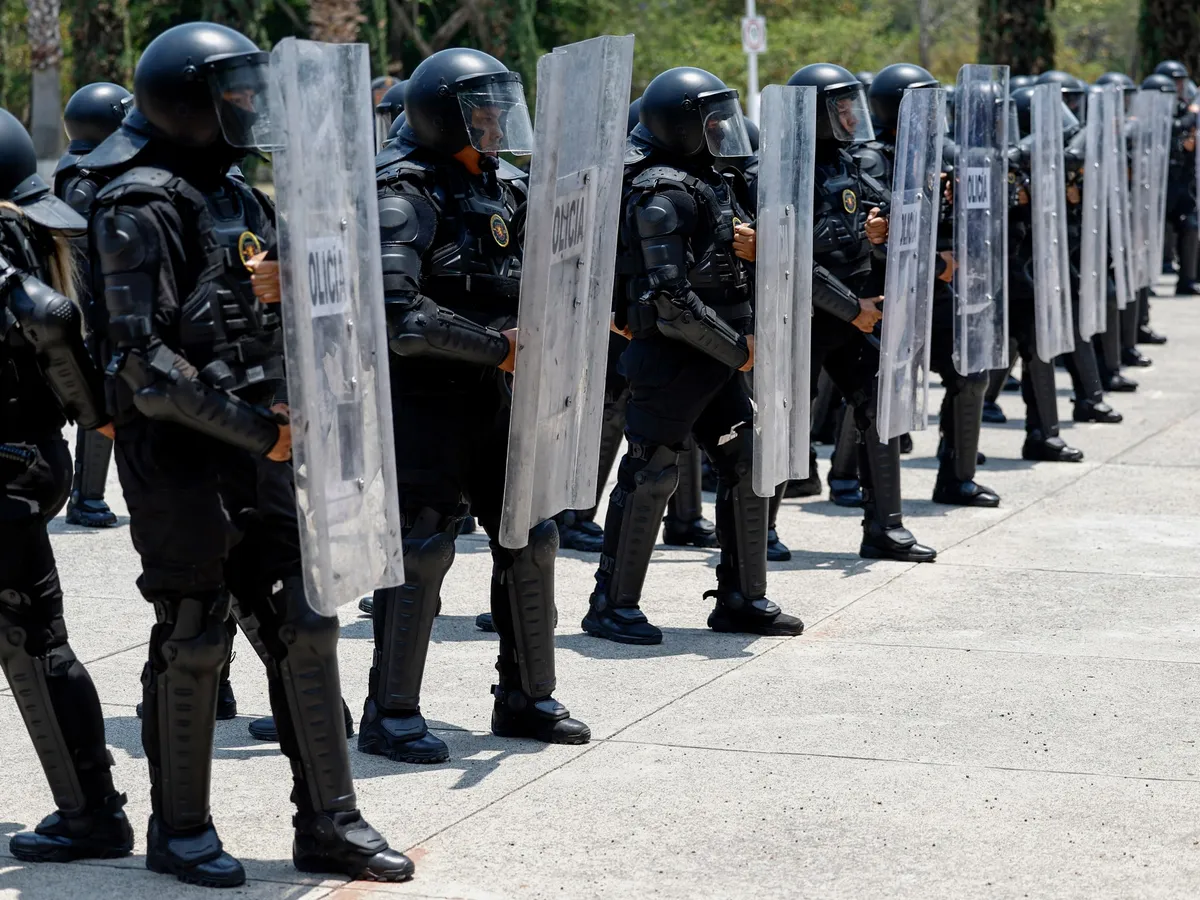
Fans and rights groups have raised safety concerns in Mexico, which opens the FIFA World Cup on June 11.Security forces in Mexico have been undergoing training, led by Spain's National Police riot units ahead of the World Cup [Ulises Ruiz/AFP]Published On 18 May 2026The ongoing scrutiny of the United States as World Cup cohost, and FIFA’s role as tournament organiser, has overshadowed the growing list of security concerns and protests in Mexico where the tournament opener kicks off next month.The World Cup 2026 opens in Mexico-city" class="entity-link entity-location" data-entity-id="1779" data-entity-type="location">Mexico City on June 11, with the home team taking on South Africa at the Estadio Azteca. But football fans are wary of recent incidents of violence and frequent protests in tournament host cities across Mexico.Recommended Stories list of 4 itemslist 1 of 4World Cup train and shuttle bus fares slashed in New York, New Jerseylist 2 of 4Israeli minister blasts Barcelona’s Lamine Yamal for Palestinian flag wavelist 3 of 4Sardar Azmoun left out as Iran announce World Cup 2026 squadlist 4 of 4All to know about Neymar’s angry outburst and World Cup selectionend of listA mass shooting that killed 10 people in the Mexican state of Puebla on Sunday has exacerbated security fears previously raised by human rights bodies and international fans travelling to North America for the tournament.Here’s what’s happened in Mexico in the months leading up to the World Cup:Shootings, cartel violence raise security fearsSix men, three women and a minor were victims of an armed attack at a residence in Tehuitzingo, 200 kilometres from Mexico-city" class="entity-link entity-location" data-entity-id="1779" data-entity-type="location">Mexico City, where the tournament opener is scheduled in just over three weeks.The state Attorney General’s Office announced it had opened an investigation into the shooting. Prior to the attack, Mexican President Claudia Sheinbaum pledged to bolster security, including the deployment of 100,000 security personnel involving National Guard troops, police officers and employees of private security firms.The shooting comes less than a month after a gunman killed a Canadian tourist and injured 13 others at Teotihuacan, a popular tourist and archaeological site outside Mexico-city" class="entity-link entity-location" data-entity-id="1779" data-entity-type="location">Mexico City.The US Department of Homeland Security Secretary, Markwayne Mullin, is due to visit Mexico this week, President Sheinbaum said on Monday but did not specify why.In April, Human Rights Watch emphasised ahead of the World Cup that Mexico remains one of the most dangerous countries in the world for the media. It also highlighted that FIFA had not addressed direct risks to journalists working in Mexico’s World Cup host cities.Amnesty International also called upon FIFA and World Cup hosts to take urgent action to protect fans, players, journalists, workers and local communities as the tournament is being staged at a time of “acute human rights crisis”.Mexico saw a wave of violence in February, after security forces killed cartel leader Nemesio “El Mencho” Oseguera, a member of the Jalisco New Generation Cartel (CJNG).FIFA President Gianni Infantino has said he’s “very reassured” about Mexico hosting the tournament, following the violence triggered by the killing of the drug cartel leader.Repeated incidents have brought the country’s ability to combat violent crime into question, with its leadership attempting to allay fears and criticism.(Al Jazeera)Enforced disappearancesSeveral human rights groups in Mexico are using the World Cup to draw attention to sociopolitical issues that have long remained unaddressed.On Sunday, relatives of missing persons in Mexico played a football match outside the Nuevo Leon government palace to demand answers about the whereabouts of their loved ones.The mother of missing person Roy Rivera Hidalgo, Irma Leticia Hidalgo, criticised authorities for investing in what she called “frivolous and superficial activities” while cutting resources from institutions tasked with searching for the disappeared.There are 133,960 people missing in Mexico, according to official government data, a crisis driven largely by decades of cartel violence and institutional neglect.Earlier this month on Mother’s Day in North America, thousands of people, led by mothers of the disappeared during decades of drug violence, marched to protest against the violence and impunity plaguing the country.The mothers of the missing called on football fans to join them, saying “there is nothing to celebrate, because the mothers of Mexico are playing the most difficult match: the one for justice”.“Mexico, champion in disappearances,” protesters chanted.“We had to start fighting, because no one wanted to take charge of the disappearance [case],” said Graciela Perez Rodriguez, whose daughter and four other relatives disappeared in 2012.Members of the United Forces for Our Disappeared in Nuevo Leon (FUNDENL), play a match in Monterrey in memory of missing persons, ahead of the FIFA 2026 World Cup, May 17, 2026. [Daniel Becerril/Reuters]Teachers’ strike for higher wagesOn Friday, teachers and activists marched through Mexico-city" class="entity-link entity-location" data-entity-id="1779" data-entity-type="location">Mexico City on Teachers’ Day demanding higher wages and policy changes, with union leaders warning of a nationwide strike that could disrupt the opening of the World Cup next month.The teachers’ union, the National Coordination of Education Workers (CNTE), dismissed the government announcement of a nine per cent pay increase and demanded the doubling of salaries and reversal of education reforms.Pedro Hernandez Morales, General Secretary of CNTE Section 9 in Mexico-city" class="entity-link entity-location" data-entity-id="1779" data-entity-type="location">Mexico City, warned that if demands are not met before Mexico’s opening match on June 11, “the ball will not roll”, and threatened a national teachers’ strike.The warning heightens tension to an already fraught education debate, after authorities last week reversed a plan to cut short the school year due to the tournament, following a backlash from parents and educators.
SRCAl Jazeera
LANGEN
LEANCenter
WORDS892
ENT12
MON · 2026-05-18 · 17:13 GMTBRIEF NSR-2026-0518-77258
NSR-2026-0518-77258News Report·EN·National Security
World Cup 2026: Will violence and protests test Mexico’s cohost status?
Mexico is facing significant security concerns and protests ahead of co-hosting the FIFA World Cup 2026, with the tournament opener scheduled for June 11 in Mexico City. Recent incidents, including a mass shooting in Puebla and the killing of a Canadian tourist near Mexico City, have heightened fears among fans and rights groups.
Al Jazeera StaffAl JazeeraFiled 2026-05-18 · 17:13 GMTLean · CenterRead · 4 min
Al JazeeraFIG 01
Reading time
4min
Word count
892words
Sources cited
4cited
Entities identified
12entities
Quality score
100%
§ 01
Briefing Summary
AI-generatedNEWSAR · AI
Mexico is facing significant security concerns and protests ahead of co-hosting the FIFA World Cup 2026, with the tournament opener scheduled for June 11 in Mexico City. Recent incidents, including a mass shooting in Puebla and the killing of a Canadian tourist near Mexico City, have heightened fears among fans and rights groups. Human rights organizations like Human Rights Watch and Amnesty International have highlighted the ongoing dangers for journalists and called for urgent action to protect all involved. Additionally, relatives of the estimated 133,960 missing persons in Mexico are using the World Cup to draw attention to the country's human rights crisis and demand action from authorities. Despite these issues, FIFA President Gianni Infantino has expressed reassurance about Mexico's hosting capabilities.
Confidence 0.90Sources 4Claims 5Entities 12
§ 02
Article analysis
Model · rule-basedFraming
National Security
Human Rights
Tone
Mixed Tone
AI-assessed
CalmNeutralAlarmist
Factuality
0.70 / 1.00
Factual
LowHigh
Sources cited
4
Well sourced
FewMany
§ 03
Key claims
5 extracted01
Amnesty International called for urgent action to protect individuals and communities during the World Cup.
quoteAmnesty International
Confidence
1.00
02
Human Rights Watch stated Mexico is one of the most dangerous countries for the media.
quoteHuman Rights Watch
Confidence
1.00
03
A mass shooting in Puebla killed 10 people, exacerbating security fears for the tournament.
factualarticle
Confidence
0.95
04
Mexican President Claudia Sheinbaum pledged to deploy 100,000 security personnel.
factualarticle
Confidence
0.90
05
Fans and rights groups have raised safety concerns in Mexico for the World Cup 2026.
factualarticle
Confidence
0.90
§ 04
Full report
4 min read · 892 words§ 05
Entities
12 identifiedKey playerOppositionContextPositiveNeutralNegative
Locations8
§ 06
Keywords & salience
10 termsmexico security concerns
1.00
world cup 2026
1.00
violence
0.90
protests
0.80
fifa
0.70
cohost status
0.60
cartel violence
0.50
human rights
0.50
security forces
0.40
mexico city
0.40
§ 07
Topic connections
Interactive graph Network visualization showing 51 related topics
View Full Graph Person Organization Location Event|Click node to navigate|Edge numbers = shared articles