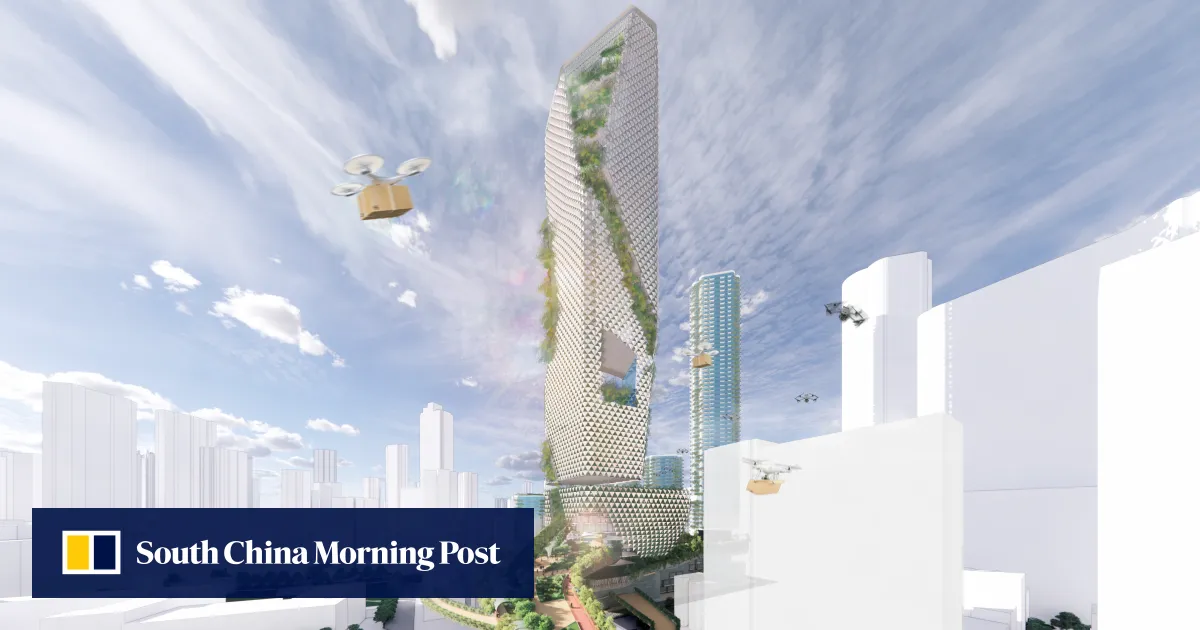
[The content of this article has been produced by our advertising partner.]Ronald Lu & Partners (RLP Asia) has won first prize of the Urban Renewal Authority (URA) and Hong Kong Institute of Architects (HKIA) Urban Renewal Design Ideas Competition in the District Study for Yau Ma Tei and Mong Kok (YMDS). The competition invited cross-disciplinary professional teams to apply the new planning tools introduced in the YMDS to concrete scenarios across two sites, namely the Central Urban Park in Mong Kok (Site 1) and the Heritage Park in Yau Ma Tei (Site2).RLP Asia’s idea for Site 1 provides an early indication of how the YMDS’s Master Renewal Concept Plans (MRCP) can be implemented in practice. Titled “Mong Kok: 100% Open City Vision”, the winning proposal is anchored by a prominent central structure, the Sky Tower. Through the Transfer of Plot Ratio (TPR)—one of the key planning tools introduced in the YMDS—the design consolidates development rights from an entire street block at the heart of Mong Kok along Mong Kok Road. This approach frees up the ground plane to create a Central Urban Park, aligning with the YMDS’s open space strategy and its objective of providing high-quality public spaces for community enjoyment.The design also incorporates another new planning tool, Street Consolidation Area (SCA) under the YMDS. This mechanism allows the amalgamation of street blocks and the closure of intervening road segments, thereby creating a consolidated development site of sufficient scale to accommodate the iconic Sky Tower, a series of secondary towers, and at-grade green space. The proposed green space functions as a connective open-space corridor, linking Waterway Park and Central Urban Park in the north-east with the Green Link in the south-west, as illustrated below. This arrangement strengthens the open space network and supports the planning intent established in the study.But for RLP Asia, applying these tools was not merely a technical exercise. It was a response to a deeper question. “What interested us was that the question was not only about design,” M K Leung, the Director of Sustainable Design at RLP Asia and the Principal Behaviourist at its research arm, Behave, explaining the firm’s motivation for entering the competition. “It was about exploring how new institutional mechanisms, in themselves, foster innovation.”Ar. M K Leung (left), Director of Sustainable Design, RLP Asia and Professor Edward Ng (right), during the interview on their award-winning “Mong Kok: 100% Open City Vision” proposal.He added that the team focused on the potential impact and value the completed work could create: “Winning or not was secondary. We asked ourselves what impact and what value we could create from this.”The new planning tools do more than introduce flexibility; they change the challenges of urban renewal and the redevelopment of older districts. “The flexibility is so great that it becomes another game altogether,” Leung observed.The design of the Sky Tower exemplifies this “new game”. It not only accommodates development in line with the MRCP+ scenario—where the overall permissible gross floor area (GFA) is increased to unlock redevelopment potential—but also supports a reduction in population density, thereby enhancing living conditions and expanding the provision of open space.The team pushed beyond existing regulatory frameworks to tackle the challenges of urban decay and sustainable development by introducing a key innovation: the Skyline-for-Comfort (SfC) Index. Developed in collaboration with Professor Edward Ng and Professor Yueyang He Aaron at the School of Architecture of the Chinese University of Hong Kong (CUHK), the SfC guides a climate-responsive building height disposition for the high-density remodelling of the neighbourhood to achieve better urban ventilation while adding the GFA in the MRCP+ scenario. The research-derived tool works by calculating how different building height scenarios affect urban ventilation and thermal comfort. Additionally, it can incorporate other district-specific parameters, such as landscape views, allowing a more balanced and context-sensitive optimisation. Professor Edward Ng, who has long studied urban climate and ventilation at CUHK, noted that many prevailing planning assumptions derive from low-density city models. “Once density reaches a certain level, you need a new way of thinking,” he said. The SfC Index provides a practical and objective tool that both regulators and practitioners can apply, without the need to undertake a full academic study for every project.Nature-based design forms another strand of the proposal, making sustainability a core principle of the design. Vertical sponge elements on the Sky Tower façade serve as shading devices and help manage rainwater run-off, applying sponge-city principles in a high-rise context.Leung described the broader approach: “We are not separating the city from nature. But instead, we are bringing nature back into the city.”This principle of sustainability also extends to the project’s lifecycle. The proposal adopts a longer time horizon that aligns with the Three-Cycle Urban Renewal framework. It incorporates the concept of space mining – the transfer from MRCP+ to MRCP 0/– scenarios – whereby certain floor areas are repurposed to public space over time for non-residential uses, thereby reducing population density while the physical structure remains in place prior to the end of life of the redeveloped buildings in the MRCP 0 scenario.The space mining concept also comprises the idea of physical urban mining, where certain parts of the buildings are designed not only for manufacture-in-factory and assembly-on-site to minimise material waste, but also for disassembly and reuse to create more open public realm. The concept imagines a building as a material bank.In RLP Asia’s “Mong Kok 100%: Open City Vision”, urban mining turns buildings into material banks. Components from future demolitions are catalogued with digital passports, designed for disassembly, and stored within the new structures for reuse in later renewal phases.“A building is not only a building,” said Leung. “It’s also a bank account.” Components receive digital identities through building material passports so they can be catalogued, recovered and redeployed in future phases rather than treated as waste.Leung believes these visionary mechanisms and strategies are not just limited to Yau Ma Tei and Mong Kok redevelopment, but also applicable to other developments across the industry.Looking ahead, Leung said: “The industry now has the mechanisms and the tested examples. What remains is for architects, developers and planners to apply these tools across other districts, to explore new possibilities together with the URA, and to build a more sustainable and liveable urban future over the decades to come.”RLP Asia’s winning team for “Mong Kok: 100% Open City Vision” at the URA x HKIA Urban Renewal Design Ideas Competition Award Ceremony, led by Ar. M K Leung (centre).
SRCSouth China Morning Post
LANGEN
LEANCenter-Right
WORDS1 074
ENT12
MON · 2026-05-18 · 16:00 GMTBRIEF NSR-2026-0518-77284
NSR-2026-0518-77284Press Release·EN·Technology
A new model for urban regeneration demonstrated in practice
Ronald Lu & Partners (RLP Asia) won first prize in the Urban Renewal Authority and Hong Kong Institute of Architects' Urban Renewal Design Ideas Competition for their proposal in the Yau Ma Tei and Mong Kok District Study. Their winning idea, "Mong Kok: 100% Open City Vision," demonstrates the practical application of new planning tools like Transfer of Plot Ratio and Street Consolidation Area.
Advertising partnerSouth China Morning PostFiled 2026-05-18 · 16:00 GMTLean · Center-RightRead · 5 min
South China Morning PostFIG 01
Reading time
5min
Word count
1 074words
Sources cited
1cited
Entities identified
12entities
Quality score
100%
§ 01
Briefing Summary
AI-generatedNEWSAR · AI
Ronald Lu & Partners (RLP Asia) won first prize in the Urban Renewal Authority and Hong Kong Institute of Architects' Urban Renewal Design Ideas Competition for their proposal in the Yau Ma Tei and Mong Kok District Study. Their winning idea, "Mong Kok: 100% Open City Vision," demonstrates the practical application of new planning tools like Transfer of Plot Ratio and Street Consolidation Area. These tools enabled the creation of a Central Urban Park in Mong Kok by consolidating development rights and closing road segments, freeing up the ground plane for public space. The proposal also introduced the innovative Skyline-for-Comfort (SfC) Index, developed with CUHK, to guide climate-responsive building heights for improved urban ventilation and thermal comfort in high-density redevelopment. The design integrates nature-based solutions, such as vertical sponge elements, to enhance sustainability.
Confidence 0.90Sources 1Claims 4Entities 12
§ 02
Article analysis
Model · rule-basedFraming
Technology
Economic Impact
Tone
Measured
AI-assessed
CalmNeutralAlarmist
Factuality
0.70 / 1.00
Factual
LowHigh
Sources cited
1
Limited
FewMany
§ 03
Key claims
4 extracted01
The new planning tools introduce flexibility and change the challenges of urban renewal.
quoteM K Leung
Confidence
1.00
02
The design consolidates development rights to free up ground plane for a Central Urban Park.
factualarticle
Confidence
1.00
03
RLP Asia's proposal, 'Mong Kok: 100% Open City Vision', utilizes new planning tools like Transfer of Plot Ratio (TPR) and Street Consolidation Area (SCA).
factualarticle
Confidence
1.00
04
Ronald Lu & Partners (RLP Asia) won first prize in the Urban Renewal Design Ideas Competition for Yau Ma Tei and Mong Kok.
factualarticle
Confidence
1.00
§ 04
Full report
5 min read · 1 074 words§ 05
Entities
12 identifiedKey playerOppositionContextPositiveNeutralNegative
Organizations3
§ 06
Keywords & salience
10 termsurban regeneration
1.00
yau ma tei and mong kok
0.90
planning tools
0.80
transfer of plot ratio
0.70
master renewal concept plans
0.70
street consolidation area
0.70
open space strategy
0.60
public spaces
0.50
urban renewal authority
0.40
ronald lu & partners
0.40
§ 07
Topic connections
Interactive graph No topic relationship data available yet. This graph will appear once topic relationships have been computed.