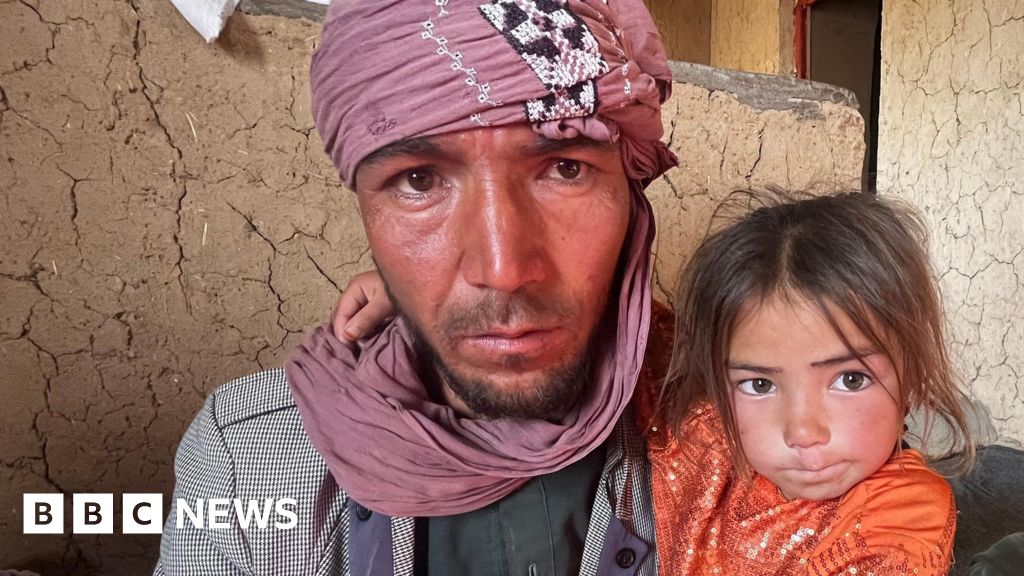
"We are starving. My older children died, so I need to work to feed my family. But I'm old, so no one wants to give me work," he says.When a local bakery near the square opens up, the owner distributes stale bread among the crowd. Within seconds, the loaves have been pulled apart, half a dozen men clutching onto precious pieces.Suddenly another scrum occurs. A man on a motorcycle comes by wanting to hire one labourer to carry bricks. Dozens of men throw themselves at him.In the two hours we were there, only three men got hired.In the communities nearby - bare homes scattered over barren, brown hills, set against the snowy peaks of the Siah Koh mountain range - the devastating impact of unemployment is clear.Abdul Rashid Azimi takes us into his home and brings out two of his children – seven-year-old twins Roqia and Rohila. He holds them close, eager to explain why he's making unbearable choices."I'm willing to sell by daughters," he weeps. "I'm poor, in debt and helpless. "I come home from work with parched lips, hungry, thirsty, distressed and confused. My children come to me saying 'Baba, give us some bread'. But what can I give? Where is the work?"He hugs Rohila, kissing her as he cries. "It breaks my heart but it's the only way to feed my other children."Imogen Anderson/BBCLabourers gather early in a bid to find the little work there is "All we have to eat is bread and hot water, not even tea," says their mother, Kayhan.Two of her teenage sons work polishing shoes in the town centre. Another collects rubbish, which Kayhan uses as fuel for cooking.Saeed Ahmad tells us he has already been forced to sell his five-year-old daughter, Shaiqa, after she got appendicitis and a cyst in her liver."I had no money to pay the medical expenses. So I sold my daughter to a relative," he says.Shaiqa's surgery was successful. The money for it came from the 200,000 Afghani ($3,200/£2,400) she has been sold for."If I had taken the whole sum at that time, he would have taken her away. So I told him just give me enough for her treatment now, and in the next five years you can give me the rest after which you can take her," explains Saeed.She puts her tiny arms around his neck. Their close bond is evident, but in five years, she will have to leave and go to the relative's home."If I had money, I would never have taken this decision," Saeed says."But then I thought, what if she dies without the surgery? This way at least she will be alive."Imogen Anderson/BBCSaeed Ahmad says he has sold his five-year-old daughter, ShaiqaJust two years ago, Saeed was getting some help.Back then, he and his family – like millions of other Afghans - received food aid: flour, cooking oil, lentils and supplements for children.But massive cuts in aid over the past few years have deprived a large majority of this life-saving assistance.The US – once the top donor to Afghanistan – cut nearly all aid to the country last year. Many other key donors have also significantly reduced contributions, including the UK. Current UN figures show that the aid received so far this year is 70% lower than in 2025.Severe drought – which has affected more than half the provinces in the country - is compounding problems."We've had help from no one - not the government, not NGOs," says villager Abdul Malik.The Taliban government, which seized power in 2021, also places blame at the door of Afghanistan's previous administration – forced out as foreign forces withdrew from the country."During the 20 years of invasion, an artificial economy was created due to the influx of US dollars," Hamdullah Fitrat, deputy spokesman for the Taliban government, tells the BBC. "After the end of the invasion, we inherited poverty, hardship, unemployment and other problems." However, the Taliban's own policies, particularly its restrictions against women, are also a key reason why donors are turning away.When asked, the Taliban government rejected any responsibility for donors walking away, stating instead that "humanitarian assistance should not be politicised".Fitrat also points to Taliban plans "to reduce poverty and create jobs by implementing major economic projects", naming a few infrastructure and mining projects.But while long-term projects might help one day, it is clear that there are millions who will simply not survive without urgent assistance.Like Mohammad Hashem, whose 14-month-old baby girl died a few weeks ago."My child died of hunger and a lack of medicine... When a child is sick and hungry, it is obvious they will die," he says.A local elder says that child mortality, mainly due to malnutrition, has "really gone up" in the last two years.Here, though, there are no formal records of deaths. The graveyard is the only place to find evidence of a surge in child deaths. And so, like we've done in the past, we counted the small and big graves separately. There were roughly twice as many small graves as big ones – suggesting twice as many children as adults.Imogen Anderson/BBCNurse Fatima Husseini says infant deaths have become normal There was more evidence at the main provincial hospital in Chaghcharan.The neonatal, or newborn, unit is the busiest. Every bed is full, some with two babies in them. Most of them are underweight and a majority are struggling to breathe on their own.Imogen Anderson/BBCThe twins were born prematurely and struggling to breatheNurse Fatima Husseini says there are days when as many as three babies die."In the beginning, I found it very hard when I saw children dying. But now it has almost become normal for us," she says.Dr Muhammad Mosa Oldat, who runs the neonatal unit, says the mortality rate climbs as high as 10%, which is "not acceptable"."But because of poverty, the patient load is increasing every day," he says. "And here we also don't have the resources to treat the babies properly."In the paediatric intensive care unit, six-week-old Zameer is suffering from meningitis and pneumonia. Both are curable, but doctors would need to conduct an MRI scan and they don't have the right equipment.But perhaps the most shocking thing the medics tell us is that the public hospital doesn't have medicine for most patients, with families having to buy their medication from pharmacies outside."Sometimes, if medicines are leftover from the baby of a better-off family, we use it for the babies whose families cannot afford it," Fatima says.
SRCBBC News - World
LANGEN
LEANCenter
WORDS1 075
ENT12
MON · 2026-05-18 · 21:09 GMTBRIEF NSR-2026-0518-77327
NSR-2026-0518-77327News Report·EN·Human Interest
Selling children to survive: Afghan fathers forced to make impossible choices
In Afghanistan, extreme poverty and widespread unemployment are forcing fathers to make desperate choices, including selling their children to survive. Three in four people cannot meet basic needs, leading to starvation and lack of medical care.
BBC News - WorldFiled 2026-05-18 · 21:09 GMTLean · CenterRead · 5 min
BBC News - WorldFIG 01
Reading time
5min
Word count
1 075words
Sources cited
3cited
Entities identified
12entities
Quality score
100%
§ 01
Briefing Summary
AI-generatedNEWSAR · AI
In Afghanistan, extreme poverty and widespread unemployment are forcing fathers to make desperate choices, including selling their children to survive. Three in four people cannot meet basic needs, leading to starvation and lack of medical care. One father is willing to sell his twin daughters to feed his other children, while another sold his five-year-old daughter to a relative for $3,200 to cover her medical expenses, with the agreement she will live with the relative in five years. These dire circumstances are exacerbated by significant cuts in international aid and a severe drought. The Taliban government blames the previous administration and foreign intervention for the economic hardship, while donors cite the Taliban's policies, particularly restrictions on women, as reasons for reduced aid.
Confidence 0.90Sources 3Claims 4Entities 12
§ 02
Article analysis
Model · rule-basedFraming
Human Interest
Economic Impact
Tone
Sensational
AI-assessed
CalmNeutralAlarmist
Factuality
0.60 / 1.00
Mixed
LowHigh
Sources cited
3
Well sourced
FewMany
§ 03
Key claims
4 extracted01
One father is willing to sell his daughters because he is poor, in debt, and helpless, unable to feed his other children.
quoteAbdul Rashid Azimi
Confidence
1.00
02
Saeed Ahmad sold his five-year-old daughter, Shaiqa, for 200,000 Afghani ($3,200/£2,400) to cover medical expenses for appendicitis and a liver cyst.
factualSaeed Ahmad
Confidence
0.95
03
Massive cuts in aid, including from the US, have deprived many Afghans of life-saving assistance.
factual
Confidence
0.90
04
Afghan fathers are being forced to sell their children due to extreme poverty and starvation.
factual
Confidence
0.90
§ 04
Full report
5 min read · 1 075 words§ 05
Entities
12 identifiedKey playerOppositionContextPositiveNeutralNegative
People6
Organizations1
§ 06
Keywords & salience
10 termspoverty
1.00
child trafficking
1.00
economic hardship
0.90
unemployment
0.80
afghanistan
0.70
forced choices
0.70
starvation
0.60
healthcare costs
0.50
laborers
0.40
family survival
0.40
§ 07
Topic connections
Interactive graph Network visualization showing 51 related topics
View Full Graph Person Organization Location Event|Click node to navigate|Edge numbers = shared articles