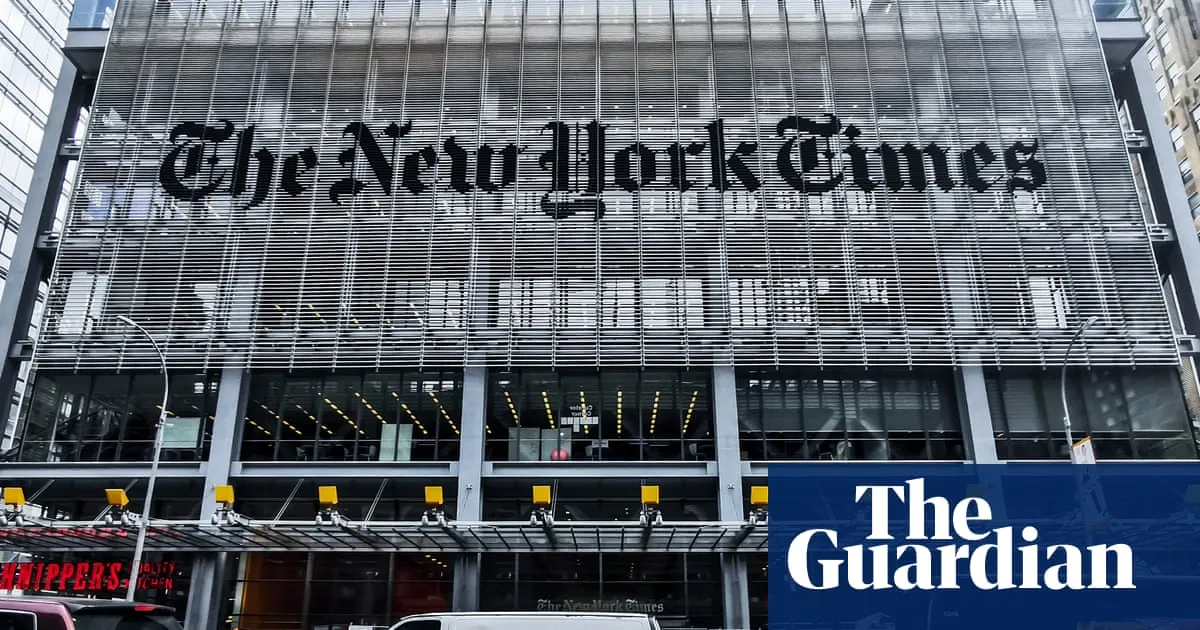
The New York Times has filed a second lawsuit against the Pentagon, arguing that its recent policy requiring journalists to have official escorts when on Pentagon grounds is unconstitutional.The Trump administration unveiled sweeping restrictions on press access at the US Department of Defense, which it calls the Department of War, last September.In a suit filed in the US district court in Washington on Monday, the Times argued that an interim policy introduced in the spring had imposed “utterly unreasonable” restrictions on journalists attempting to cover the department.The lawsuit, brought on behalf of the New York Times and reporter Julian E Barnes, names the Department of Defense, the secretary, Pete Hegseth, Pentagon chief spokesperson, Sean Parnell, and special adviser Timothy Parlatore as defendants.In the complaint, the Times argues that “to report effectively on the Department, a reporter often must speak with over a dozen officials sitting in Public Affairs offices spread throughout the building”. For decades, it added, the Pentagon’s press access policies “reflected this physical reality” by allowing reporters unescorted access in unsecured corridors, “so that they can move from press office to press office and ask questions on short notice as events unfolded”.But a policy that the Pentagon adopted in March “breaks sharply from that history and tradition”, the paper argued. “Now, to ask even one question, Barnes and other reporters must call or email for an appointment, wait for a response, get an escort, ask their question, and return to the library outside the Pentagon – only to repeat the process for the next source.“Reporters must either forgo conversations or else spend hours chasing schedulers by phone and shuttling in and out of the building,” the complaint adds.In response to the lawsuit, Parnell, the Pentagon spokesperson, released a statement on social media on Monday afternoon, dismissing the Times’s lawsuit as “nothing more than an attempt to remove the barriers to them getting their hands on classified information”.Parnell said: “They want to roam the halls of the Pentagon freely and without an escort – a privilege that they do not have in any other federal building.”He maintained that the “department’s policy is completely lawful and narrowly designed to protect national security information from unlawful criminal disclosure”.The Times said that without “meaningful access to the Pentagon”, Barnes and other journalists and news organizations are “deprived of unique, newsworthy information that can only be obtained in person and through such exchanges”.It added: “This loss is made more urgent by recent events that have exacerbated the importance of independent reporting, including the capture of the President of Venezuela, the Iran war, and Secretary Hegseth’s firings of multiple high ranking military officials.”The lawsuit is asking the court to force the Pentagon to lift the restriction.This is the second time that the Times has sued the defense department over press access. In December, it sued the Pentagon over newly imposed restrictions, which included requiring reporters to sign a form that included strict rules on the “solicitation” of information from defense employees. The new restrictions prompted many leading news organizations to turn in their credentials in protest.In March, a federal judge ruled that key parts of the new press policy were unconstitutional, and undid much of the policy. But soon after, the Pentagon announced new press rules, including that it would permanently close a designated workspace for journalists, and also issued an “interim” policy requiring journalists to be escorted into the building.In April, the judge ruled that the interim policy violated his court order, but the Pentagon appealed against the ruling and asked the appeals court to allow the escort requirement to remain in place during the appeal process. The appeals court allowed the escort policy to remain in place while the appeal proceeds.In its new lawsuit filed on Monday, the Times argued: “The Interim Policy is patently retaliatory, utterly unreasonable, and manifestly arbitrary and capricious.”
SRCThe Guardian - World News
LANGEN
LEANCenter-Left
WORDS641
ENT11
MON · 2026-05-18 · 20:22 GMTBRIEF NSR-2026-0518-77351
NSR-2026-0518-77351News Report·EN·Legal & Judicial
New York Times sues Pentagon again over ‘utterly unreasonable’ press restrictions
The New York Times has filed a second lawsuit against the Pentagon in U.S. district court in Washington, D.C., arguing that its interim policy requiring journalists to have official escorts on Pentagon grounds is unconstitutional.
Anna BettsThe Guardian - World NewsFiled 2026-05-18 · 20:22 GMTLean · Center-LeftRead · 3 min
The Guardian - World NewsFIG 01
Reading time
3min
Word count
641words
Sources cited
2cited
Entities identified
11entities
Quality score
100%
§ 01
Briefing Summary
AI-generatedNEWSAR · AI
The New York Times has filed a second lawsuit against the Pentagon in U.S. district court in Washington, D.C., arguing that its interim policy requiring journalists to have official escorts on Pentagon grounds is unconstitutional. This policy, implemented in March, significantly restricts reporters' ability to gather information by requiring appointments and escorts for even brief conversations. The Times contends this breaks from decades of tradition and hinders effective reporting on critical national security issues. The Pentagon spokesperson, Sean Parnell, dismissed the lawsuit, stating the policy is lawful and designed to protect classified information, comparing it to restrictions at other federal buildings. This marks the second legal challenge by the Times against the Pentagon over press access restrictions imposed by the Trump administration.
Confidence 0.90Sources 2Claims 4Entities 11
§ 02
Article analysis
Model · rule-basedFraming
Legal & Judicial
National Security
Tone
Measured
AI-assessed
CalmNeutralAlarmist
Factuality
0.70 / 1.00
Factual
LowHigh
Sources cited
2
Limited
FewMany
§ 03
Key claims
4 extracted01
The Times claims that without meaningful access, journalists are deprived of unique, newsworthy information, citing recent events like the capture of the President of Venezuela and the Iran war.
factualThe New York Times
Confidence
1.00
02
Pentagon spokesperson Sean Parnell stated the lawsuit is an attempt to remove barriers to classified information and that the policy is lawful and designed to protect national security.
quoteSean Parnell
Confidence
1.00
03
The lawsuit argues that the Pentagon's policy requiring journalists to have official escorts is unconstitutional and imposes 'utterly unreasonable' restrictions.
factualThe New York Times
Confidence
1.00
04
The New York Times has filed a second lawsuit against the Pentagon over press restrictions.
factualThe New York Times
Confidence
1.00
§ 04
Full report
3 min read · 641 words§ 05
Entities
11 identifiedKey playerOppositionContextPositiveNeutralNegative
People4
Organizations4
Locations1
§ 06
Keywords & salience
9 termspentagon
1.00
new york times
1.00
press restrictions
1.00
lawsuit
0.90
journalists
0.80
department of defense
0.70
national security
0.60
press access
0.50
unconstitutional
0.40
§ 07
Topic connections
Interactive graph Network visualization showing 51 related topics
View Full Graph Person Organization Location Event|Click node to navigate|Edge numbers = shared articles