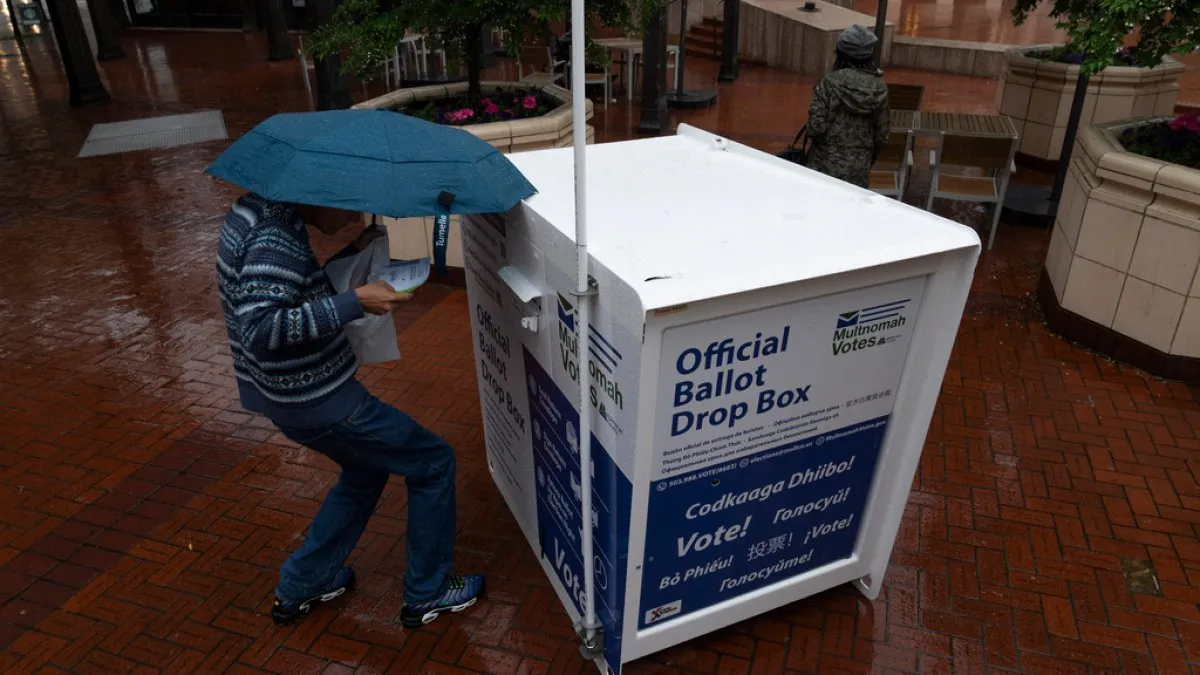
The primaries should winnow down the nearly two dozen candidates seeking to challenge incumbent Governor Tina Kotek.A voter drops off their mail-in ballot in Pioneer Square in Portland, Oregon, during primary voting on May 21, 2024 [Jenny Kane/AP]Published On 18 May 2026In the northwest corner of the United States, Oregon has fostered a reputation as a left-wing stronghold. Since the 1980s, the Beaver State has consistently elected Democrats in most of its statewide races.But even in a comfortably blue state like Oregon, the fight to hold onto political power can be competitive.Recommended Stories list of 3 itemslist 1 of 3What to know about Georgia’s primary as Republicans set sights on Senatelist 2 of 3Kentucky primaries test Trump’s grip on Republican voterslist 3 of 3What to know about the primary elections in the US state of Pennsylvaniaend of listOn Tuesday, the state will hold its latest primary races, with each of the major parties picking its nominees for November’s midterm elections.But a packed field of roughly 25 contenders, both Democrats and Republicans, is jockeying to replace Tina Kotek as she seeks a second term as governor.Tuesday’s vote could also serve as an economic bellwether. Voters will weigh in on a referendum that could repeal a state fuel tax, as the US-Israel war on Iran heaps strain on consumers at the gas pump.Who is running? And which races have attracted the most attention? We tackle those questions and more in this brief explainer.What time do polls open?Polls will open on Tuesday at 7am Pacific US time (15:00 GMT) and close at 8pm (4:00 GMT).Oregon Governor Tina Kotek is seeking re-election in 2026 [File: John Rudoff/Reuters]Who is running for governor?Incumbent Governor Kotek is making a bid for a second four-year term. But she is fielding competition from dozens of other candidates, including nine Democrats.Going into the Democratic primary, Kotek is the frontrunner. Her challengers include a children’s book author, the leader of an Indigenous nonprofit and an inventor who hopes to address water shortages.Even more contenders are angling for the Republican gubernatorial nomination.Among them is State Senator Christine Drazan, who ran against Kotek in 2022. Drazan has been critical of President Donald Trump’s tariff policies but supportive of his tough stance on immigration.Also on the Republican ballot is former NBA player Chris Dudley, who was the Republican gubernatorial candidate in 2010. He had the smallest losing margin of any Republican candidate in decades.State Representative Ed Diehl, meanwhile, is hoping to capitalise on the momentum he gained after leading the charge to block Kotek’s gas tax and fee increase package.What are the opinion polls saying about the governor’s race?Polls show Drazan leading the race to receive the Republican nomination, with 35 percent support.Kotek is likely to grab an easy victory in the Democratic primary, with none of her opponents polling close behind.What about the Senate race?Another Democratic incumbent attempting to hold onto his seat is US Senator Jeff Merkley.The 69-year-old, who began his career working on affordable housing, is running for a fourth consecutive six-year term. He first took office in 2009.But while the senator faces eight rivals on the campaign trail – one Democrat and seven Republicans – his seat is considered relatively safe.He is expected to win the Democratic primary on Tuesday and become the frontrunner for November’s general election.Jeff Merkley is defending what is considered a safe seat for Democrats in the US Senate [File: Annabelle Gordon/Reuters]What other positions are up for grabs?All six of Oregon’s members of the US House of Representatives are running for re-election and will face the primary process on Tuesday.Five are Democrats. One, Cliff Bentz, is a Republican, and he represents Oregon’s second congressional district, a sprawling area encompassing the entire eastern half of the state.Also on Tuesday, voters will choose their party representatives in races for the state Senate and House.The election will also determine a nonpartisan commissioner to lead the state Bureau of Labor and Industries.Why does this race matter?Oregon is a closed primary state, meaning that voters choose nominees only for the party they are registered under.Given the state’s left-wing bent, the winners of the statewide Democratic primaries will likely emerge as frontrunners in November’s midterm races.Still, there is room for surprise. According to state voter rolls, less than 25 percent of Oregonians are registered Republicans. But only 32 percent are registered Democrats, with the largest proportion of voters identifying as “non-affiliated” with any party.Primary races in right-leaning areas like Oregon’s second congressional district could signify how closely the state’s Republican politicians want to align with President Trump.Voters will also have a chance to vote on the referendum that could repeal the gas tax increase on Tuesday’s ballot.Democrats in the state legislature raised Oregon’s gas tax to pay for roads and supplement the state’s transportation budget.But as the US-Israel war on Iran causes gas prices to skyrocket, Republicans have used the referendum to appeal to voters on the cost of living. Gas is now averaging about 80 cents more in Oregon.In addition, there are nearly 100 local measures sprinkled on ballots across the state, tailored to different counties. Many will focus on funding local fire departments, schools and libraries.Preliminary results are expected on Tuesday evening, shortly after polls close at 8pm local time.But ballots will continue to arrive after election day, as mail-in votes and provisional ballots are counted, and some races may not be officially called until days later.
SRCAl Jazeera
LANGEN
LEANCenter
WORDS897
ENT12
MON · 2026-05-18 · 23:23 GMTBRIEF NSR-2026-0519-77368
NSR-2026-0519-77368News Report·EN·Political Strategy
A packed race for governor: What to know about Oregon’s primary elections
Oregon is holding primary elections on Tuesday to select nominees for the November midterm elections. The gubernatorial race features incumbent Democrat Tina Kotek seeking a second term against numerous challengers, with State Senator Christine Drazan leading the Republican field.
Chloe LiAl JazeeraFiled 2026-05-18 · 23:23 GMTLean · CenterRead · 4 min
Al JazeeraFIG 01
Reading time
4min
Word count
897words
Sources cited
3cited
Entities identified
12entities
Quality score
100%
§ 01
Briefing Summary
AI-generatedNEWSAR · AI
Oregon is holding primary elections on Tuesday to select nominees for the November midterm elections. The gubernatorial race features incumbent Democrat Tina Kotek seeking a second term against numerous challengers, with State Senator Christine Drazan leading the Republican field. US Senator Jeff Merkley is also running for re-election, facing a relatively safe path to the general election. All six of Oregon's US House representatives are also seeking re-election. The primaries will help determine party nominees in a state where a significant portion of voters are unaffiliated with a major party. Additionally, voters will consider a referendum that could repeal a state fuel tax.
Confidence 0.90Sources 3Claims 5Entities 12
§ 02
Article analysis
Model · rule-basedFraming
Political Strategy
Economic Impact
Tone
Measured
AI-assessed
CalmNeutralAlarmist
Factuality
0.70 / 1.00
Factual
LowHigh
Sources cited
3
Well sourced
FewMany
§ 03
Key claims
5 extracted01
Voters will weigh in on a referendum that could repeal a state fuel tax.
factual
Confidence
1.00
02
State Senator Christine Drazan ran against Kotek in 2022.
factual
Confidence
1.00
03
Governor Tina Kotek is seeking a second four-year term.
factual
Confidence
1.00
04
Oregon has consistently elected Democrats in most of its statewide races since the 1980s.
factual
Confidence
0.90
05
Polls show Drazan leading the race for the Republican nomination with 35 percent support.
statisticopinion polls
Confidence
0.80
§ 04
Full report
4 min read · 897 words§ 05
Entities
12 identifiedKey playerOppositionContextPositiveNeutralNegative
People4
Locations6
§ 06
Keywords & salience
9 termsoregon primary elections
1.00
governor race
0.90
tina kotek
0.80
midterm elections
0.70
political power
0.60
democratic primary
0.50
republican gubernatorial nomination
0.50
fuel tax referendum
0.40
economic bellwether
0.40
§ 07
Topic connections
Interactive graph No topic relationship data available yet. This graph will appear once topic relationships have been computed.