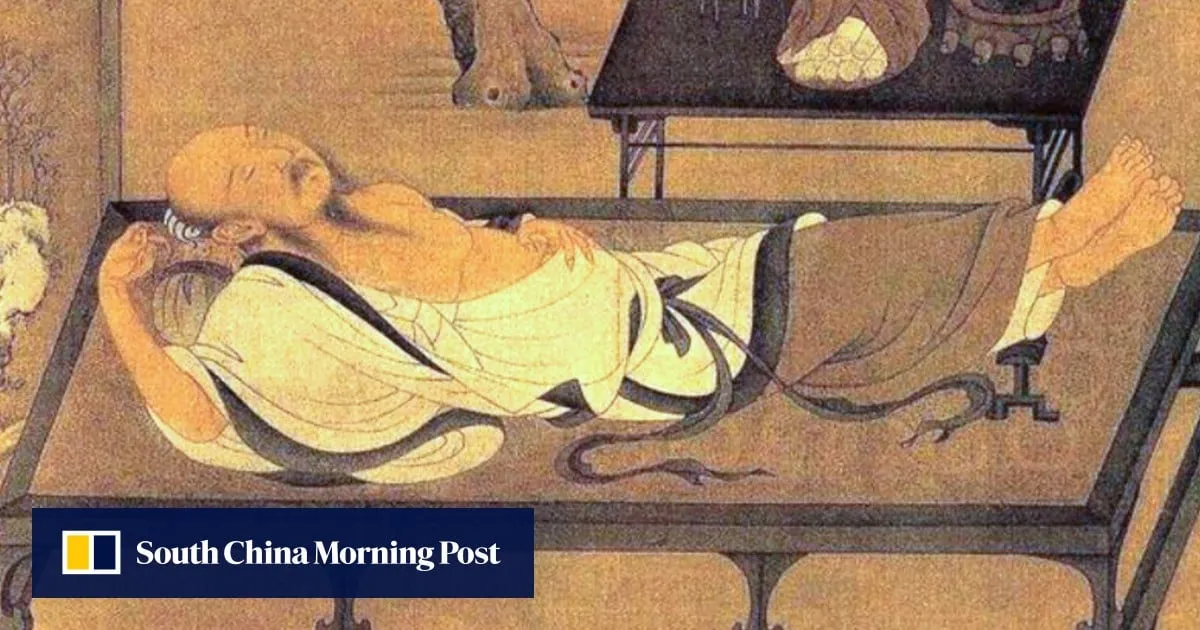
In ancient China, summer heat could be deadly long before the advent of air conditioning.To survive it, people resorted to remedies ranging from imperial ice sculptures and water-powered fans to the more carefree practice of dressing minimally.One of the most devastating examples occurred during the reign of Emperor Qianlong in the Qing dynasty (1644–1912), when an extreme heatwave swept across northern China.Lacking modern weather stations, officials documented the disaster through observable signs: parched fields, dead livestock, ruined crops, and rising death tolls.Modern researchers, utilising historical inscriptions and records, estimate that temperatures in many counties soared to 40 to 43 degrees Celsius.The invention of ice boxes, above, or their modern equivalents, marked a sophisticated response to summer heat, with devices dating back over 2,400 years. Photo: BaiduIn July 1743, records indicate that around 11,400 people perished in and around Beijing within just 10 days, with many being poor residents, labourers and craftsmen.Trees withered, household objects became too hot to touch, and reports of individuals collapsing from heatstroke spread panic across the city.Nevertheless, ancient Chinese people were remarkably innovative in their attempts to comprehend and cope with the weather.As early as the pre-Qin period, before 221 BC, people employed a simple water-filled vessel to monitor temperature changes.As air conditioning transitions from a luxury to a necessity, especially during prolonged heatwaves, ancient methods retain relevance. Photo: ShutterstockWhen the water froze, it signified deep winter; when the ice melted, it indicated a warming trend.Crude as it was, this device is considered an early precursor to the thermometer.By the Warring States period (475–221 BC), ancient China had something resembling a portable refrigerator.A bronze ice vessel discovered in the tomb of Marquis Yi of Zeng in Hubei province, central China, featured a double-layered structure: wine was placed inside an inner container, while ice was packed around it, allowing the elite to savour chilled drinks in summer.Further ReadingCooling technology became more sophisticated during the Han dynasty (206 BC–220 AD).Some ice boxes featured a double-layered design: wine was placed in an inner container surrounded by ice, allowing the elite to enjoy chilled beverages in the summer heat. Photo: BaiduAccording to the Miscellaneous Records of the Western Capital, the craftsman Ding Huan invented a mechanical fan consisting of seven enormous blades, each over two metres long, mounted on a rotating axle and powered by human effort.For emperors, summer comfort could be almost architectural.In the Tang dynasty (618–907), special summer halls were constructed for royalty beside water sources.Waterwheels lifted water to the roof, where it cascaded down like a curtain from the eaves, helping to block heat and cool the air. This system could also power fans, drawing cool, moist air indoors.For emperors, summer comfort was nearly architectural; during the Tang dynasty (618–907 AD), special halls were built beside water sources to enhance royal leisure. Photo: BaiduInside the palace, ice blocks carved into mountain shapes were displayed alongside fresh fruit.Imperial concubines enjoyed chilled watermelon while maids fanned them through the long summer days.Ice itself became a symbol of privilege.In the Qing dynasty, the Forbidden City contained five ice cellars capable of storing as many as 25,000 blocks of ice, according to the Collected Statutes of Qing.Empress Dowager Cixi later transformed imperial summer comfort into a spectacle.She spent the hottest months at retreats where she savoured lake views and opera from shaded pavilions.Palace anecdotes recount that eunuchs fanned her with peacock-feather fans and sprayed rose water to keep her cool.A modern interior reminiscent of an ancient ice house reflects the historical, often underground structures designed to store ice harvested in winter, enabling the preservation of food and drinks throughout the summer months. Photo: BaiduHer annual water route to the Summer Palace became known as the Cixi Waterway, later heralded as one of China’s oldest tourist routes.For ordinary people, relief came in simpler but often ingenious forms.Some folk homes were designed with openings leading to underground spaces, allowing cooler air to circulate indoors.During the Song dynasty (960–1279), people slept on bamboo pillows and clung to long woven bamboo bolsters known as “bamboo wives.” Hollow and breathable, these allowed air to flow around the body on humid nights.Urban life offered sweeter comforts.During the Song dynasty (960–1279), commoners slept on bamboo pillows and used long woven bamboo bolsters known as “bamboo wives” to stay cool. Photo: BaiduIn the Song dynasty, cold-drink stalls sold refreshments that may sound surprisingly modern: iced coconut wine, chilled milk curd, and iced mung bean soup, as noted in The Old Stories of Wulin.However, for the poorest, summer provided little respite.Farmers still toiled in the sweltering fields, wearing straw hats and sleeveless garments made from ramie or hemp – fabrics esteemed for their lightness and breathability.Others turned inward to meditation. The popular saying, “A calm mind naturally feels cool” remains familiar in China today, while writings from the Qing dynasty suggested that mental stillness could help the body endure summer heat.For poets, escape could be more carefree. They retreated to the mountains and wandered half-dressed through the forests.The Song dynasty poet Zhang Lun once wrote that city life was fraught with constraints, while the forests offered a deeper pleasure: “Loosen your hair, open your gown, and the summer heat would no longer trouble you.”
SRCSouth China Morning Post
LANGEN
LEANCenter-Right
WORDS864
ENT10
TUE · 2026-05-19 · 06:10 GMTBRIEF NSR-2026-0519-77450
NSR-2026-0519-77450News Report·EN·Human Interest
Ancient China elites used water fans, ice to cool down in summer; folks had bamboo pillows
Ancient Chinese elites and commoners employed various methods to combat deadly summer heat before air conditioning. Emperors utilized ice sculptures, water-powered fans, and architecturally designed cooling halls, while the elite enjoyed chilled drinks from bronze ice vessels.
Zoey ZhangSouth China Morning PostFiled 2026-05-19 · 06:10 GMTLean · Center-RightRead · 4 min
South China Morning PostFIG 01
Reading time
4min
Word count
864words
Sources cited
0cited
Entities identified
10entities
Quality score
100%
§ 01
Briefing Summary
AI-generatedNEWSAR · AI
Ancient Chinese elites and commoners employed various methods to combat deadly summer heat before air conditioning. Emperors utilized ice sculptures, water-powered fans, and architecturally designed cooling halls, while the elite enjoyed chilled drinks from bronze ice vessels. Ordinary people resorted to simpler solutions like bamboo pillows and underground living spaces. During a severe heatwave in the Qing dynasty, extreme temperatures led to thousands of deaths, highlighting the critical need for cooling strategies. Innovations like early thermometers and mechanical fans emerged, demonstrating ancient China's ingenuity in adapting to and mitigating the effects of intense summer weather.
Confidence 0.90Claims 5Entities 10
§ 02
Article analysis
Model · rule-basedFraming
Human Interest
Technology
Tone
Measured
AI-assessed
CalmNeutralAlarmist
Factuality
0.80 / 1.00
Factual
LowHigh
Sources cited
0
No named sources
FewMany
§ 03
Key claims
5 extracted01
A bronze ice vessel from the Warring States period (475–221 BC) was used to chill drinks with ice.
factual
Confidence
1.00
02
An extreme heatwave during Emperor Qianlong's reign in the Qing dynasty caused widespread crop failure and livestock death.
factual
Confidence
1.00
03
Ancient Chinese elites used ice boxes and water-powered fans to cool down during summer heatwaves.
factual
Confidence
1.00
04
Craftsman Ding Huan invented a large, human-powered mechanical fan during the Han dynasty.
factual
Confidence
0.90
05
In July 1743, approximately 11,400 people died in and around Beijing due to a heatwave.
statistic
Confidence
0.90
§ 04
Full report
4 min read · 864 words§ 05
Entities
10 identifiedKey playerOppositionContextPositiveNeutralNegative
Organizations1
Events3
§ 06
Keywords & salience
9 termsancient china
1.00
summer heat
0.90
cooling methods
0.80
ice boxes
0.70
water fans
0.60
historical records
0.50
qing dynasty
0.40
heatwave
0.40
thermometer precursor
0.40
§ 07
Topic connections
Interactive graph Network visualization showing 51 related topics
View Full Graph Person Organization Location Event|Click node to navigate|Edge numbers = shared articles