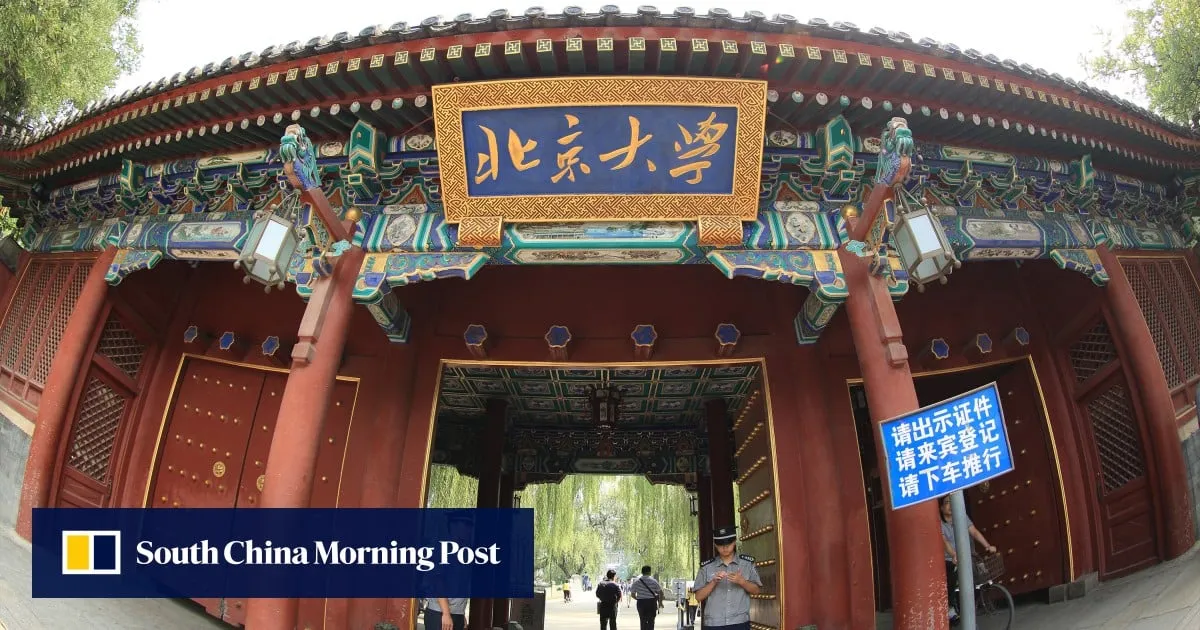
Prestigious universities in China carry a rich tradition of showcasing their names on entrance gates, inscribed in calligraphy by renowned political leaders, reflecting both political history and academic prestige.Calligraphy, the art of writing, is a revered traditional Chinese art form that was historically valued above all others.In ancient China, calligraphy was an elite art, its aesthetics meticulously regulated by imperial authority. For instance, during the Qin dynasty (221–206 BC), the small seal script, or xiaozhuan, was developed to standardise Chinese writing across the nation.Calligraphy, an esteemed art of writing, is a cherished traditional Chinese art form that has historically been valued above other artistic disciplines. Photo: ShutterstockThroughout history, numerous Chinese emperors were esteemed calligraphers. Emperor Huizong of the Song dynasty (960–1279) is particularly noted for creating the Slender Gold calligraphy style, which remains a popular choice in contemporary graphic design.Following the establishment of the People’s Republic of China in 1949, political leaders gained recognition for their calligraphy, with their artistic talents celebrated by universities across the nation.Of the more than 110 elite Chinese universities that are part of Project 211, over 70 per cent reportedly feature names inscribed in calligraphy by political leaders. Project 211, initiated by the Chinese government in 1995, aims to enhance research and educational standards at about 100 top-tier universities for the 21st century.About 40 universities boast names inscribed by Mao Zedong, whose distinct running script-style handwriting, known as “Mao style calligraphy,” is widely recognised.Chairman Mao Zedong (1893–1976) is depicted writing with a brush at his desk in a cave headquarters in northwest China during the Chinese Civil War in 1948. Photo: FPG/Hulton Archive/Getty ImagesIn the early 1950s, several institutions, including the prestigious Peking University and Tsinghua University, invited Mao to inscribe their titles. Interestingly, Mao once served as a library assistant at Peking University in 1918.Tsinghua University, founded in 1911, originally had its name inscribed by Qing dynasty official Natong. Mao produced six variations of “Tsinghua University” on rice paper, advising that “the cursive script on the lower right seems to be better.”Although Tsinghua selected the recommended version for its plaque and badge, the original paper was accidentally lost. The university now features a title composed of characters chosen from various versions, a practice known as ji zi, which is common in Chinese university title editing.Tsinghua University, above, established in 1911, originally had its name inscribed by Qing dynasty official Natong. Photo: ZhihuMany university titles featuring Mao’s handwriting were not directly inscribed by him but compiled and modified from his written documents. This includes China’s first modern university, Tianjin University, as well as Nanjing University and Zhejiang University.Further ReadingSome universities have also incorporated the writings of famed calligraphers and authors into their titles. For instance, Southeast University in Nanjing showcases the writing of Wang Xizhi, a celebrated calligrapher from the Jin dynasty (266–420), revered as the “Sage of Calligraphy.”Meanwhile, Xiamen University in Fujian province utilised an inscription by Lu Xun, which gained viral attention on Chinese social media after it was revealed to be sourced from a letter he wrote to his partner Xu Guangping, in which he humorously expressed his dissatisfaction with the university while teaching there.Other universities’ titles reflect their unique historical ties to various political leaders. For example, Sichuan University’s name was inscribed by Deng Xiaoping, who hailed from Sichuan province. Several universities have had their titles crafted by Deng or Jiang Zemin during their foundational restructures or renamings.The China Foreign Affairs University, linked to the Ministry of Foreign Affairs, uniquely features an inscription by China’s first premier, Zhou Enlai, who played a pivotal role in establishing the institution.The China Foreign Affairs University, affiliated with the Ministry of Foreign Affairs, features a unique inscription by China’s first premier, Zhou Enlai, who played a crucial role in founding the institution. Photo: HandoutIn 2012, the China University of Geosciences invited its alumnus, then-premier Wen Jiabao, to inscribe a new name to commemorate its 60th anniversary.In 2015, President Xi Jinping mandated that government officials resign from positions in artistic organisations, including calligraphy and painting associations, as part of his anti-corruption campaign.The Central Commission for Discipline Inspection (CCDI) launched efforts to combat “refined bribes,” prohibiting officials from commercialised inscriptions.Wang Qishan, then head of the CCDI, criticised officials who “cannot even write regular script properly” yet attempted to master running and cursive scripts.Inscriptions at universities sometimes also reflect political turmoil. For example, when China’s former security chief Zhou Yongkang was under investigation for corruption in 2014, his alma mater, China University of Petroleum, removed or painted over inscriptions by him to obscure traces and references to him on campus.
SRCSouth China Morning Post
LANGEN
LEANCenter-Right
WORDS762
ENT10
TUE · 2026-05-19 · 10:00 GMTBRIEF NSR-2026-0519-77505
NSR-2026-0519-77505News Report·EN·Human Interest
Legacy in ink: how calligraphy links China’s political heritage to academic institutions
Prestigious Chinese universities often display their names inscribed in calligraphy by renowned political leaders on their entrance gates, a tradition that links political history with academic prestige. Calligraphy, a highly valued traditional Chinese art form, was historically regulated by imperial authority and practiced by emperors.
Fran LuSouth China Morning PostFiled 2026-05-19 · 10:00 GMTLean · Center-RightRead · 4 min
South China Morning PostFIG 01
Reading time
4min
Word count
762words
Sources cited
0cited
Entities identified
10entities
Quality score
100%
§ 01
Briefing Summary
AI-generatedNEWSAR · AI
Prestigious Chinese universities often display their names inscribed in calligraphy by renowned political leaders on their entrance gates, a tradition that links political history with academic prestige. Calligraphy, a highly valued traditional Chinese art form, was historically regulated by imperial authority and practiced by emperors. Following the 1949 establishment of the People's Republic of China, political leaders' calligraphic talents were celebrated by universities, with over 70% of elite institutions featuring such inscriptions. Mao Zedong's distinct "Mao style calligraphy" is particularly prevalent, adorning the names of about 40 universities, including Peking and Tsinghua. Other leaders like Deng Xiaoping and Zhou Enlai have also inscribed university names, reflecting their provincial ties or institutional links. This practice, however, has seen shifts, with a 2015 mandate prohibiting officials from holding positions in artistic organizations as part of an anti-corruption campaign.
Confidence 0.90Claims 5Entities 10
§ 02
Article analysis
Model · rule-basedFraming
Human Interest
Political Strategy
Tone
Measured
AI-assessed
CalmNeutralAlarmist
Factuality
0.70 / 1.00
Factual
LowHigh
Sources cited
0
No named sources
FewMany
§ 03
Key claims
5 extracted01
About 40 universities have names inscribed by Mao Zedong, whose handwriting is known as 'Mao style calligraphy'.
factual
Confidence
0.90
02
Calligraphy was historically an elite art in China, regulated by imperial authority and valued above other arts.
factual
Confidence
0.90
03
Prestigious universities in China often feature their names inscribed in calligraphy by renowned political leaders.
factual
Confidence
0.90
04
Many university titles featuring Mao's handwriting were compiled and modified from his written documents, not directly inscribed by him.
factual
Confidence
0.80
05
Over 70% of elite Chinese universities in Project 211 reportedly feature names inscribed by political leaders.
statistic
Confidence
0.80
§ 04
Full report
4 min read · 762 words§ 05
Entities
10 identifiedKey playerOppositionContextPositiveNeutralNegative
People3
§ 06
Keywords & salience
10 termscalligraphy
1.00
political heritage
0.90
academic institutions
0.90
chinese art form
0.80
mao zedong
0.70
project 211
0.60
imperial authority
0.50
qin dynasty
0.40
song dynasty
0.40
people's republic of china
0.40
§ 07
Topic connections
Interactive graph No topic relationship data available yet. This graph will appear once topic relationships have been computed.