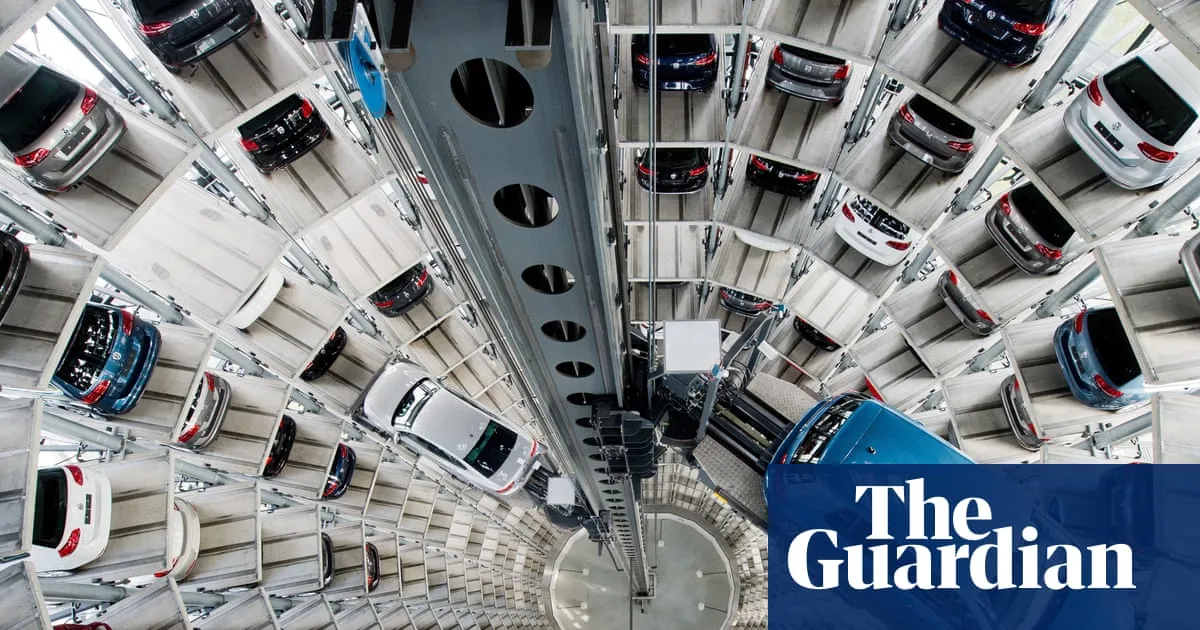
Germany must stop admiring China’s success in the EU or it will sleepwalk into the kind of deindustrialisation the US experienced 25 years ago, a leading Brussels thinktank has said.With China’s surplus with Germany having doubled between 2024 and 2025 from $12bn (£9bn) to $25bn, creating a $94bn trade imbalance, the Centre for European Reform (CER) said Europe’s largest economy risked a repeat of what happened in the US in 2001 when a sudden surge in imports permanently hollowed out towns in the American midwest.“China-shock-10" class="entity-link entity-topic" data-entity-id="130612" data-entity-type="topic">China Shock 1.0” not only led to losses of up to 2.5m jobs but was also marked by a rise in suicides, divorce and drug use in US towns that lost industries to the Chinese, according to the CER report.That fraying of the US social fabric, it said, was “an eerie warning shot for Germany’s car and machine-building cities like Wolfsburg and Stuttgart”, a reference to the homes of Volkswagen and Mercedes-Benz, two brands emblematic of German engineering and design success.“Germany remains hesitant, even as China has already eaten much of German industry’s lunch and is preparing to start on dinner,” said the CER.Entitled “China-shock-20" class="entity-link entity-event" data-entity-id="90614" data-entity-type="event">China Shock 2.0: the cost of Germany’s complacency”, the thinktank report concluded: “Berlin cannot keep admiring the problem,” adding that the risk for Berlin was acute, yet the German political leaders had “struggled to see the problem clearly”.China’s surplus with Germany doubled between 2024 and 2025 from $12bn (£9bn) to $25bn. Photograph: Fabian Bimmer/ReutersIt comes amid a growing consensus that the Chinese export boom, which is underscored by Xi Jinping’s laser-focused five-year policy cycles, has triggered a second China shock that is putting industry and jobs at risk all over the world.However, the CER said that in the EU, the shock was more consequential in Germany than any other country and was worsening.Its report pointed out that Beijing was running a policy project, named “10,000 little giants”, that was specifically targeting Germany’s Mittelstand, the country’s ecosystem of middle-sized, innovative industrial suppliers and firms. Germany was described as “frantically searching for culprits” for its economic woes with high energy prices and bureaucracy dominating the political conversation, instead of China.Germany’s failure to diagnose what was going on resembled the “phantom pain” of an amputee, the CER said, adding: “That missing limb is export demand, chopped off by China’s profound pressure on Germany’s industrial base.”The root of the problem was ballooning Chinese exports around the world as imports into China declined, with the country reporting a record $1.2tn surplus in 2025.The CER blamed the economic imbalance on issues including the yuan being potentially undervalued against the euro by 40%. Photograph: APThe CER blamed the economic imbalance on three issues: dampened domestic demand in China; an extremely unfavourable exchange rate, potentially undervaluing the yuan by 40% against the euro; and a Beijing policy that ruthlessly targeted Germany’s core industrial base.The thinktank said political leaders needed to wake up: “Waiting for the shock to correct itself is not prudence, but a decision to let deindustrialisation run its course.”It said the best option for Berlin was to go on the offensive “and support Paris in pushing the IMF and G7 to confront China’s currency undervaluation and one-sided trade model”.Industrial leaders in Europe and China have told the Guardian of their fears that European industry was being cannibalised, while one leading German industrial said Europe might as well become “a province of China” such was the endemic damage.
SRCThe Guardian - World News
LANGEN
LEANCenter-Left
WORDS569
ENT12
WED · 2026-05-20 · 09:25 GMTBRIEF NSR-2026-0520-77782
NSR-2026-0520-77782Analysis·EN·Economic Impact
Germany urged to stop admiring Beijing and wake up to ‘China Shock 2.0’
A Brussels thinktank, the Centre for European Reform (CER), warns Germany that it risks deindustrialization similar to the US experience in 2001 due to a growing trade imbalance with China. The CER highlights that China's surplus with Germany doubled between 2024 and 2025, reaching $25 billion and contributing to a $94 billion trade imbalance.
Lisa O’Carroll Senior correspondentThe Guardian - World NewsFiled 2026-05-20 · 09:25 GMTLean · Center-LeftRead · 3 min
The Guardian - World NewsFIG 01
Reading time
3min
Word count
569words
Sources cited
1cited
Entities identified
12entities
Quality score
100%
§ 01
Briefing Summary
AI-generatedNEWSAR · AI
A Brussels thinktank, the Centre for European Reform (CER), warns Germany that it risks deindustrialization similar to the US experience in 2001 due to a growing trade imbalance with China. The CER highlights that China's surplus with Germany doubled between 2024 and 2025, reaching $25 billion and contributing to a $94 billion trade imbalance. The thinktank argues that China's targeted industrial policies, particularly its "10,000 little giants" program, are pressuring Germany's core industries. The CER attributes the imbalance to dampened Chinese domestic demand, an undervalued yuan, and Beijing's trade strategy, urging Germany to confront these issues rather than admire China's success.
Confidence 0.90Sources 1Claims 5Entities 12
§ 02
Article analysis
Model · rule-basedFraming
Economic Impact
Diplomatic
Tone
Mixed Tone
AI-assessed
CalmNeutralAlarmist
Factuality
0.40 / 1.00
Mixed
LowHigh
Sources cited
1
Limited
FewMany
§ 03
Key claims
5 extracted01
China's trade surplus with Germany doubled from $12bn to $25bn between 2024 and 2025.
statisticCentre for European Reform (CER)
Confidence
0.90
02
China's "10,000 little giants" policy specifically targets Germany's Mittelstand.
factualCentre for European Reform (CER)
Confidence
0.85
03
Germany is struggling to clearly see the economic problem posed by China.
factualCentre for European Reform (CER)
Confidence
0.80
04
Germany risks deindustrialization similar to the US in 2001 due to China's economic practices.
predictionCentre for European Reform (CER)
Confidence
0.80
05
The yuan may be undervalued by 40% against the euro, contributing to economic imbalance.
factualCentre for European Reform (CER)
Confidence
0.70
§ 04
Full report
3 min read · 569 words§ 05
Entities
12 identifiedKey playerOppositionContextPositiveNeutralNegative
Organizations4
Locations4
§ 06
Keywords & salience
8 termschina shock 2.0
1.00
german industry
0.90
deindustrialisation
0.80
trade imbalance
0.70
economic complacency
0.60
mittelstand
0.50
china's surplus
0.50
export demand
0.40
§ 07
Topic connections
Interactive graph Network visualization showing 51 related topics
View Full Graph Person Organization Location Event|Click node to navigate|Edge numbers = shared articles