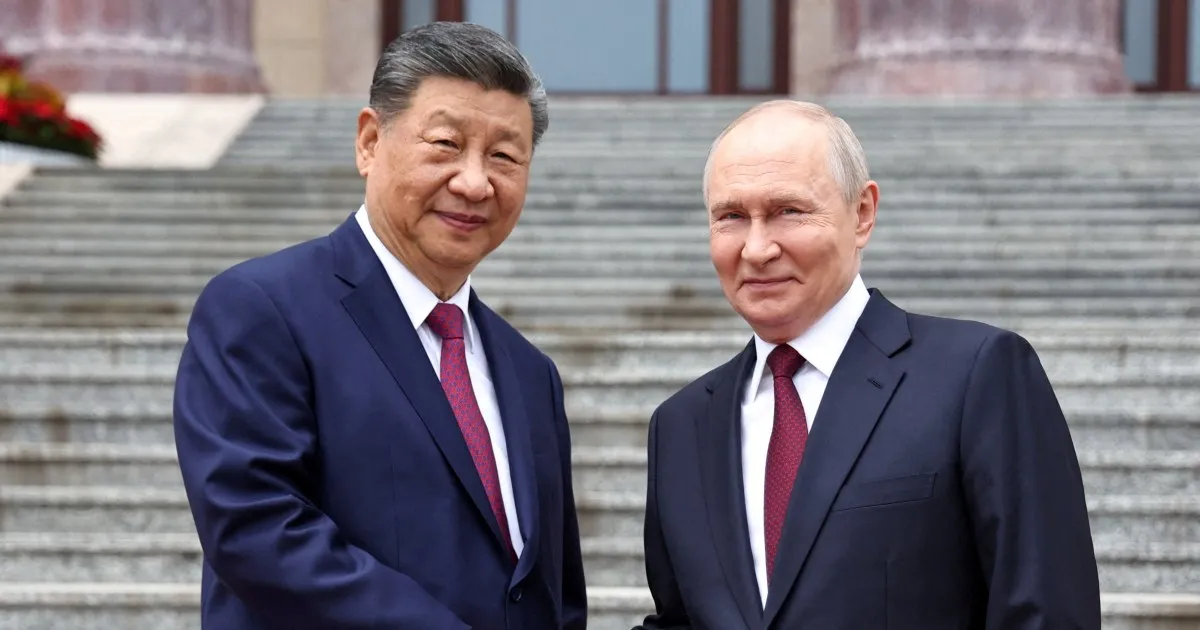
EXPLAINERAnalysts say Russia wants to replace lost gas revenue while China seeks to diversify and secure its energy supplies.Russian President Vladimir Putin and Chinese President Xi Jinping attend a meeting in the Great Hall of the People in Beijing on May 20, 2026 [Maxim Shemetov/Pool Photo via AP]Published On 20 May 2026On the agenda at this week’s Russia-China summit between Presidents Vladimir Putin and Xi Jinping is the long-delayed Power of Siberia 2 (POS-2) project, a proposed 2,600km (1,616-mile) natural gas pipeline that would carry Russian gas from western Siberia through Mongolia to China.On Wednesday, the two countries said they had reached an understanding about the route and construction of the pipeline, but other details have yet to be negotiated.Recommended Stories list of 3 itemslist 1 of 3Putin meets Xi: Why Russia and China need each otherlist 2 of 3Xi and Putin signal united front against US in Beijing talkslist 3 of 3Putin hails ‘unshakable foundations’ in meeting with China’s Xiend of listOnce built, the pipeline is expected to have a capacity of 50 billion cubic metres (1.77 trillion cubic feet) per year, equivalent to about 525 terawatt-hours of energy – nearly twice the United Kingdom’s annual electricity consumption.The pipeline would be nearly as large as Nord Stream 1, one of Russia’s most important former gas export routes to Europe, which had a design capacity of 55 billion cubic metres (1.94 trillion cubic feet) per year.Analysts said Russia wants to build the pipeline to replace revenue lost since European countries slashed their gas imports from Russia after Moscow’s full-scale invasion of Ukraine in February 2022.For China, pipeline gas from Russia could offer a more secure alternative to imported liquefied natural gas (LNG), which is cooled into liquid form and transported by ship.Most of China’s LNG imports must be shipped through strategic chokepoints, such as the Strait of Hormuz and the Strait of Malacca.The new pipeline may sound like a win-win, but analysts said significant hurdles remain before the project can become a reality.Here is what we know:Is the POS-2 pipeline feasible?The pipeline is logistically feasible as Russia’s state-owned Gazprom, the world’s largest producer of natural gas by reserves, has ample experience of building large-capacity, long-distance pipelines through challenging terrain, Jack Sharples, senior research fellow at the Oxford Institute for Energy Studies, told Al Jazeera.It takes several years to complete a pipeline, however. The first Power of Siberia (POS-1) pipeline carries gas from two eastern Siberian fields to the Russia-China border. Construction of that pipeline began after a 2014 agreement. Its first deliveries started in 2019, and it reached full capacity in 2024.Despite being slightly shorter than POS-1 and not requiring the development of new gas production, POS-2 is slated to cross a third country – Mongolia, he said.The timeline from the start of construction to launch is “unlikely” to be much shorter than that for POS-1 but reaching “the larger capacity may require a slightly longer ramp-up time than the five years,” he said, adding, “The project may take a decade from start of construction to full capacity.”Is the deal done?Not yet.After Putin met with Xi on Wednesday, Kremlin spokesman Dmitry Peskov told Russian media: “The president said during the talks that, overall, there is already a shared understanding of the main parameters for Power of Siberia 2.”“There is agreement on the route and on how the project will be built. Some details still need to be finalised, but in general, such an understanding is already in place,” he said.Peskov conceded there was no timetable for carrying out the project.POS-2 is “technically challenging” but the hold-up has “always been commercial terms”, Seb Kennedy, CEO and founder of the independent energy market analysis publication Energy Flux, told Al Jazeera.Wednesday’s discussions about “main parameters” are “diplomatic code” for a lack of agreement on price, he said.Analysts agreed this is the primary stumbling block, but unlike Russia, China is in no hurry to reach a deal.What’s in it for Russia?For Russia, POS-2 would provide a major new market for gas that was originally intended for Europe, helping state-controlled energy giant Gazprom recover part of the revenue it has lost since Moscow invaded Ukraine.Before the war, “Putin was very much turned towards Europe in terms of economic development,” said Remi Bourgeot, economist at the French Institute for International and Strategic Affairs in Paris and author of the analysis platform epistelem.org.For Russia, the reward will be revenues for Gazprom not only from gas sales, Sharples said, but also from “economic multiplier effects for Russian pipeline construction companies and Russian steel pipe producers and, therefore, also Russian steel producers”.However, Russia’s urgent need for revenue has given China the upper hand in negotiations.“The issue is that prices are clearly negotiated by the Chinese to be lower than what the European market offered, which makes sense, since Russia doesn’t have so much of a choice at the moment,” Bourgeot said.“Russia urgently needs long-term export demand to monetise stranded gas reserves, but China recognises Moscow’s weak negotiating position following the loss of Europe as a major buyer,” Go Katayama, principal insights analyst for LNG and natural gas at the analytics firm Kpler, told Al Jazeera.Beijing, therefore, is pushing for heavily discounted pricing linked to domestic benchmarks while Russia needs higher prices to justify the enormous infrastructure costs, he explained.“The negotiations ultimately reflect a balance between Russia’s need for revenue stability and China’s desire for secure, low-cost supply,” he said.“Beijing has reportedly pushed for prices linked to Russia’s highly subsidised domestic gas rates. Moscow wants terms closer to POS-1,” Kennedy said.“Every dollar shaved off the netback is a direct hit to Russian fiscal revenue at a time when gas-related tax receipts are already down,” he added.What is in it for China?China might not have the same immediate need as Russia, but POS-2 remains a strategically attractive prospect as the country seeks to diversify its energy supplies and reduce its reliance on seaborne LNG imports.Not only is Beijing wary of the immediate risks posed by maritime chokepoints such as the Strait of Hormuz, but LNG imports also rely on a complex global supply chain involving multiple suppliers, shipping routes and receiving terminals.This makes LNG imports in China’s case more vulnerable to geopolitical disruptions and price volatility than gas through a pipeline would be.In short, analysts said the arrangement offers China a potentially more secure supply route, requiring coordination primarily with Russia, which is eager to strengthen ties with its powerful neighbour.Mongolia, a landlocked nation between China and Russia, whose economy is roughly the size of that of the Maldives, would be unlikely to object to collecting hundreds of millions of dollars a year in transit fees.What are the risks?Analysts said the pipeline is about more than energy.It also reflects a broader effort by Russia and China to build closer economic ties and reduce their dependence on a Western-led international order that both countries increasingly view as fractured and unreliable.During Wednesday’s summit, the leaders echoed this sentiment.“Even against the backdrop of unfavourable external factors, our interaction and economic cooperation demonstrate strong momentum,” Russian media reported Putin as telling Xi.Xi, meanwhile, lauded the “unyielding relationship”, adding: “We have been able to continuously deepen our political mutual trust and strategic coordination with a resilience that remains unyielding despite trials and tribulations.”However, behind the show of a united front, both Beijing and Moscow will have reservations, analysts said.“Both sides may have a degree of caution. For Russia, it locks them into supplying a large volume to a single customer. For China, it increases the share of Russia in China’s total gas supply,” Sharples said.“The risk for China is overconcentration in a politically toxic supplier just as domestic output and renewables are scaling,” Kennedy said, adding: “The risk for Russia is becoming a price-taker to a single customer who knows it has nowhere else to go.”POS-2 would structurally reduce China’s future LNG import requirements by replacing part of its marginal spot LNG demand with pipeline gas from Russia, Katayama said.“This could ease competition for Atlantic Basin cargoes and soften global LNG prices over time, particularly during periods of weaker Asian demand,” he said.Every cubic metre China commits to buy via pipeline is one less cargo it might pull from the Atlantic basin, which puts structural pressure over the 2030s on the TTF, Europe’s main virtual marketplace for trading natural gas, amid anticipated LNG oversupply, Kennedy said.“More broadly, the project would accelerate the shift toward a more fragmented and regionalised global gas market centred around long-term geopolitical supply relationships rather than fully globalised LNG trade,” Katayama said.“POS-2 would diminish Moscow’s urgency to reopen pipeline flows to Europe although it would not restore Russia’s pre-2022 export volumes or revenues. POS-2 is a consolation prize, not a replacement,” he said.
SRCAl Jazeera
LANGEN
LEANCenter
WORDS1 451
ENT12
WED · 2026-05-20 · 15:30 GMTBRIEF NSR-2026-0520-77858
NSR-2026-0520-77858News Report·EN·Economic Impact
What is the Power of Siberia 2 pipeline that Russia, China are planning?
Russia and China are planning the Power of Siberia 2 (POS-2) pipeline, a proposed 2,600km project to transport Russian gas from western Siberia through Mongolia to China. The pipeline, expected to have a capacity of 50 billion cubic meters annually, is seen by analysts as a way for Russia to replace lost European gas revenue following the invasion of Ukraine.
Nils AdlerAl JazeeraFiled 2026-05-20 · 15:30 GMTLean · CenterRead · 6 min
Al JazeeraFIG 01
Reading time
6min
Word count
1 451words
Sources cited
1cited
Entities identified
12entities
Quality score
100%
§ 01
Briefing Summary
AI-generatedNEWSAR · AI
Russia and China are planning the Power of Siberia 2 (POS-2) pipeline, a proposed 2,600km project to transport Russian gas from western Siberia through Mongolia to China. The pipeline, expected to have a capacity of 50 billion cubic meters annually, is seen by analysts as a way for Russia to replace lost European gas revenue following the invasion of Ukraine. For China, it offers a more secure energy supply compared to imported liquefied natural gas, which faces transit risks. While an understanding on the route and construction has been reached, commercial terms, particularly pricing, remain a significant hurdle, giving China leverage. The project is logistically feasible but is expected to take around a decade to reach full capacity.
Confidence 0.90Sources 1Claims 5Entities 12
§ 02
Article analysis
Model · rule-basedFraming
Economic Impact
Diplomatic
Tone
Measured
AI-assessed
CalmNeutralAlarmist
Factuality
0.70 / 1.00
Factual
LowHigh
Sources cited
1
Limited
FewMany
§ 03
Key claims
5 extracted01
The pipeline is expected to have a capacity of 50 billion cubic metres per year.
statistic
Confidence
1.00
02
The Power of Siberia 2 (POS-2) is a proposed 2,600km natural gas pipeline to carry Russian gas from western Siberia through Mongolia to China.
factual
Confidence
1.00
03
The POS-2 pipeline is logistically feasible, and Russia's Gazprom has experience building large-capacity, long-distance pipelines.
quoteJack Sharples, Oxford Institute for Energy Studies
Confidence
0.95
04
For China, pipeline gas from Russia could offer a more secure alternative to imported liquefied natural gas (LNG).
quoteAnalysts
Confidence
0.90
05
Russia wants to build the pipeline to replace revenue lost since European countries slashed gas imports after the 2022 invasion of Ukraine.
quoteAnalysts
Confidence
0.90
§ 04
Full report
6 min read · 1 451 words§ 05
Entities
12 identifiedKey playerOppositionContextPositiveNeutralNegative
Locations6
§ 06
Keywords & salience
8 termspower of siberia 2
1.00
natural gas pipeline
0.90
russia-china relations
0.80
energy security
0.70
gas revenue
0.60
energy supplies
0.50
lng imports
0.40
gazprom
0.40
§ 07
Topic connections
Interactive graph Network visualization showing 3 related topics
View Full Graph Person Organization Location Event|Click node to navigate|Edge numbers = shared articles