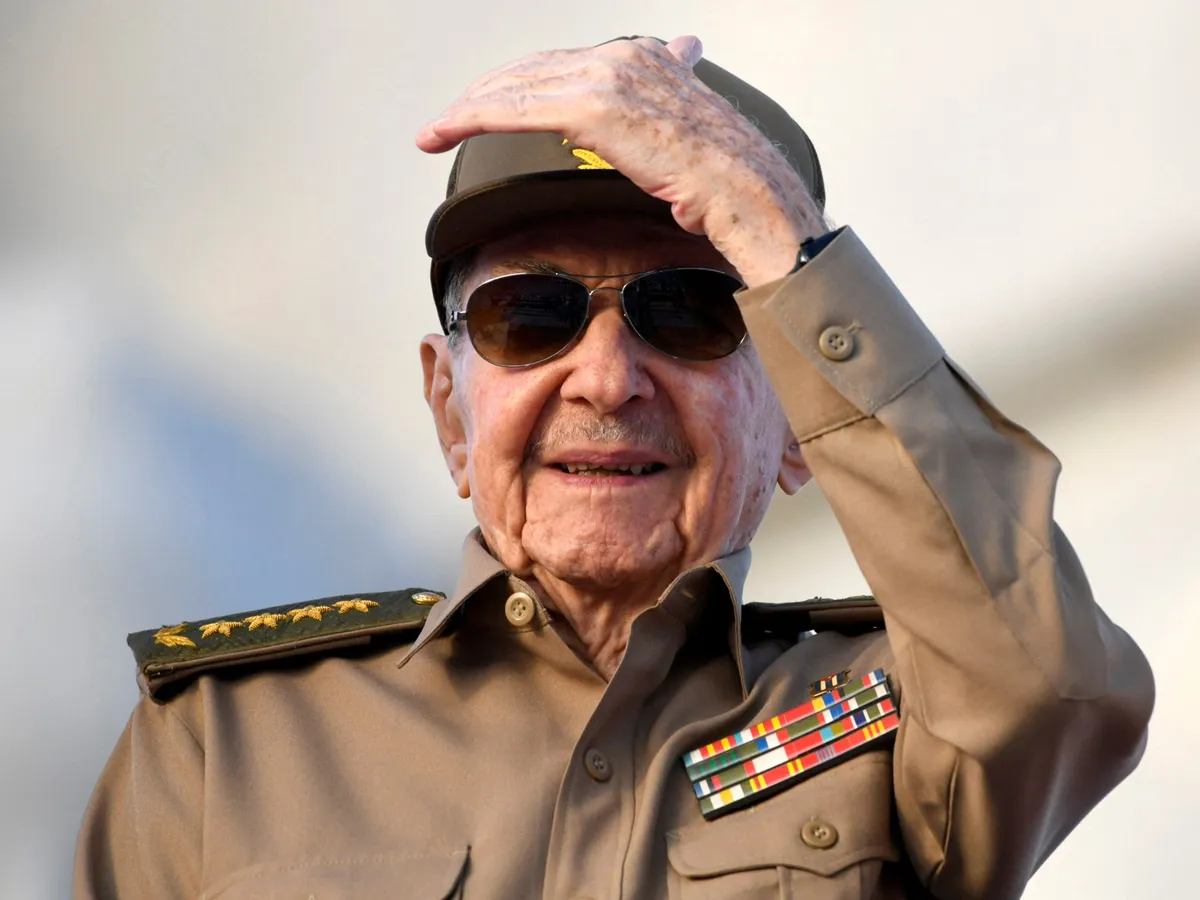
DEVELOPING STORY, The indictment marks one of the sharpest escalations in tensions between Washington and Havana.Former President Raul Castro is considered a key figure in Cuba's communist leadership [Norlys Perez/Reuters]Published On 20 May 2026United States federal prosecutors have indicted Cuba’s former President Raul Castro in connection with the 1996 downing of planes operated by the Miami-based exile group Brothers to the Rescue.The indictment, unsealed on Wednesday, marks one of the sharpest escalations in tensions between Washington and Havana in years.Recommended Stories list of 3 itemslist 1 of 3Photos: Cuba holds May Day celebrations amid US threatslist 2 of 3US seeks indictment of former Cuban leader Raul Castrolist 3 of 3Cuba’s Diaz-Canel open to US aid amid worsening fuel crisis, blackoutsend of listThe US Justice Department alleges that Castro, Cuba’s defence minister at the time, played a leading role in the decision to have Cuban fighter jets to shoot down two civilian aircraft on February 24, 1996.It has charged Castro with one count of conspiracy to kill US nationals, four counts of murder and two counts of destroying an aircraft. Five co-defendants were also named in the indictment.Four people were killed in the 1996 attack, which triggered international condemnation and deepened the strains between the US and Cuba.“ For nearly 30 years, the families of four murdered Americans have waited for justice,” acting Attorney General Todd Blanche said as he announced the charges at Miami’s Freedom Tower.“ My message today is clear: The United States and President Trump does not and will not forget its citizens.”He described the four men who were killed — Carlos Costa, Armando Alejandre Jr, Mario de la Pena, and Pablo Morales — as “unarmed civilians” engaged in “humanitarian missions for the rescue and protection of people fleeing oppression across the Florida Strait”.“Nations and their leaders cannot be permitted to target Americans, kill them, and not face accountability,” Blanche added. “If you kill Americans, we will pursue you, no matter who you are, no matter what title you hold, and in this case, no matter how much time has passed.”Kash Patel, the director of the Federal Bureau of Investigation, also called the indictment “a major step toward accountability”.Brothers to the Rescue began operating in 1991 during a wave of Cuban migration to the United States. Founded by Cuban exile Jose Basulto, the group aimed to help Cuban refugees crossing the Florida Straits by locating rafters at sea and alerting the US Coast Guard.US officials and international investigators said the planes were attacked over international waters, while Cuba maintained the aircraft had violated or approached Cuban airspace.Then-President Fidel Castro later denied that he or Raul Castro gave a direct order to shoot down the planes.After the indictment was unveiled, Cuba’s current leader, Miguel Diaz-Canel, dismissed the charges as an act of political theatre.He also accused the administration of US President Donald Trump of “lying and manipulating the events” of 1996 to make the case for military action against Cuba.“This is a political manoeuvre, devoid of any legal basis, aimed solely at padding the dossier they are fabricating to justify the folly of a military aggression against Cuba,” Diaz-Canel wrote on social media.Acting US Attorney General Todd Blanche announces the indictment against Raul Castro [Marco Bello/Reuters]Castro indictment raises pressure on HavanaOrlando Perez, a political science professor at the University of North Texas at Dallas, told Al Jazeera that the timing of the indictment appears linked to a broader US pressure campaign against Havana.“I think it’s important to look at the sequence of recent events,” Perez said.He pointed to a visit last week from the director of the US Central Intelligence Agency (CIA), John Ratcliffe, to Havana.That meeting came as part of ongoing negotiations between the island’s communist government and the administration of US President Donald Trump, which has pushed for leadership change in Cuba.There were also reports this month alleging Cuba had explored drone and asymmetric warfare capabilities, as Trump increases his pressure campaign against the island.According to the reports, Havana had considered possible drone attacks targeting the US naval base at Guantanamo Bay, US military vessels and the nearby island of Key West, Florida, which sits roughly 140 kilometres (90 miles) from the Cuban coast.“Washington appears to be running two simultaneous tracks: a backchannel with the Castro family network, and a public pressure campaign,” Perez said. “A Raul Castro indictment fits within that architecture.”Perez added that the move to indict Castro could backfire, stirring support among Cuba’s communist base rather than weakening it.“An indictment of Raul Castro strengthens those hardliners and hands them the siege narrative they’ve always relied on,” he said.“The Castro clan is not going to turn over Raul Castro. Raul Castro is the legitimacy anchor for the regime.”Searching for an ‘acceptable deal’But Perez indicated that the Trump administration might have another motive for unveiling the indictment now.Trump’s Republican Party is facing a heated midterm election in November, and Trump’s approval ratings continue to tumble.A poll from the news agency Reuters and the research firm Ipsos, published this month, showed Trump’s support at its lowest level since he returned to office. Only 34 percent of respondents approved of his job performance.Perez explained that Trump’s polling has suffered from public backlash to the US-Israeli war in Iran and other issues.If Wednesday’s indictment pushes Cuba’s government to some sort of compromise, the Trump administration could frame that outcome as a victory.“Under the circumstances that he is suffering now — in terms of his own approval ratings, which are very low, and the prospects of losing seats in the midterm elections, and the situation in Iran, which is still critical and unresolved — I think the pressure campaign is there and they’re hoping that it will lead to some sort of acceptable deal,” Perez said.But Perez added that such an outcome is likely a long shot. “I don’t know that that is possible.”Castro, 94, succeeded his brother Fidel Castro as Cuba’s president in 2008. Although he formally stepped down from Cuba’s Communist Party leadership in 2021, he is still widely seen as an influential figure within the country’s political system.Jason Reding Quinones, the US Attorney for the southern district of Florida, reflects on his family’s Cuban heritage at a ceremony at Freedom Tower in Miami [Marco Bello/Reuters]A symbolic dayThe indictment’s unsealing was announced on a heavily symbolic day. May 20, 1902, marks Cuba’s declaration of independence and the establishment of the Cuban republic, following the Spanish-American war and a period of US military occupation.The White House issued a statement marking the occasion and calling the island’s current communist leadership a “direct betrayal of the nation their founding patriots bled and died for”.Cuba’s Foreign Minister Bruno Rodriguez Parrilla responded on social media that the message was “superficial and ill-informed”.The Trump administration’s statement, he wrote, “is an affront to the people of #Cuba and a reflection of the neocolonial nostalgia that persists among influential elements within that government”.Deputy Foreign Minister Carlos de Cossio also accused the Trump administration of catering to Cuban exiles in South Florida with its actions.“The anti-Cuban fascist minority entrenched in Florida has finally found a government it can ride, pressure and attempt to bend to its will by blackmailing it with their votes,” he posted online.William Leogrande, a specialist in Latin American politics at American University’s School of Public Affairs, acknowledged that the Trump administration’s indictment against Castro would indeed be popular in South Florida, where exiled Cubans form a largely Republican base of support.“The indictment of Raul Castro is a political gift from Marco Rubio and Donald Trump to Cuban Americans in south Florida,” Leogrande said. “It is also likely to be the final nail in the coffin for any hope of a diplomatic agreement to end the ongoing confrontation.”Negotiations, he pointed out, had been stalled between the two governments.“It appears that the Trump administration is trying to lay the political groundwork for military action against Cuba,” he explained.The Trump administration itself acknowledged South Florida’s large Cuban community in its remarks on Wednesday, holding up their experiences as evidence of the Cuban government’s violence.“The community here — you all — understands the history of the Cuban regime better than anyone in America,” Blanche told his audience at the Freedom Tower. “Many families here know the cost of oppression.”
SRCAl Jazeera
LANGEN
LEANCenter
WORDS1 372
ENT12
WED · 2026-05-20 · 16:55 GMTBRIEF NSR-2026-0520-77891
NSR-2026-0520-77891News Report·EN·Legal & Judicial
Trump administration indicts Cuba’s Raul Castro over 1996 plane shootdown
The Trump administration has indicted former Cuban President Raul Castro in connection with the 1996 downing of two civilian aircraft operated by the Miami-based exile group Brothers to the Rescue. U.S.
Elizabeth MelimopoulosAl JazeeraFiled 2026-05-20 · 16:55 GMTLean · CenterRead · 6 min
Al JazeeraFIG 01
Reading time
6min
Word count
1 372words
Sources cited
4cited
Entities identified
12entities
Quality score
100%
§ 01
Briefing Summary
AI-generatedNEWSAR · AI
The Trump administration has indicted former Cuban President Raul Castro in connection with the 1996 downing of two civilian aircraft operated by the Miami-based exile group Brothers to the Rescue. U.S. federal prosecutors allege Castro, who was Cuba's defense minister at the time, played a leading role in the decision to have Cuban fighter jets shoot down the planes over international waters, resulting in the deaths of four Americans. The indictment, unsealed on Wednesday, charges Castro with conspiracy to kill U.S. nationals, murder, and destroying an aircraft. The Justice Department stated the indictment aims to hold leaders accountable for killing Americans. Cuba's current leader, Miguel Diaz-Canel, dismissed the charges as a political maneuver by the Trump administration.
Confidence 0.90Sources 4Claims 5Entities 12
§ 02
Article analysis
Model · rule-basedFraming
Legal & Judicial
Conflict
Tone
Mixed Tone
AI-assessed
CalmNeutralAlarmist
Factuality
0.70 / 1.00
Factual
LowHigh
Sources cited
4
Well sourced
FewMany
§ 03
Key claims
5 extracted01
Cuba’s current leader, Miguel Diaz-Canel, dismissed the charges as an act of political theatre.
quoteMiguel Diaz-Canel
Confidence
1.00
02
Four people were killed in the 1996 attack, which triggered international condemnation and deepened the strains between the US and Cuba.
factual
Confidence
1.00
03
The US Justice Department alleges that Castro, Cuba’s defence minister at the time, played a leading role in the decision to have Cuban fighter jets to shoot down two civilian aircraft on February 24, 1996.
factualUS Justice Department
Confidence
1.00
04
United States federal prosecutors have indicted Cuba’s former President Raul Castro in connection with the 1996 downing of planes operated by the Miami-based exile group Brothers to the Rescue.
factual
Confidence
1.00
05
US officials and international investigators said the planes were attacked over international waters, while Cuba maintained the aircraft had violated or approached Cuban airspace.
factual
Confidence
0.90
§ 04
Full report
6 min read · 1 372 words§ 05
Entities
12 identifiedKey playerOppositionContextPositiveNeutralNegative
People5
§ 06
Keywords & salience
8 termsraul castro indictment
1.00
plane shootdown
0.90
us-cuba relations
0.80
brothers to the rescue
0.70
conspiracy to kill
0.60
justice for victims
0.50
1996 attack
0.50
accountability
0.40
§ 07
Topic connections
Interactive graph Network visualization showing 51 related topics
View Full Graph Person Organization Location Event|Click node to navigate|Edge numbers = shared articles