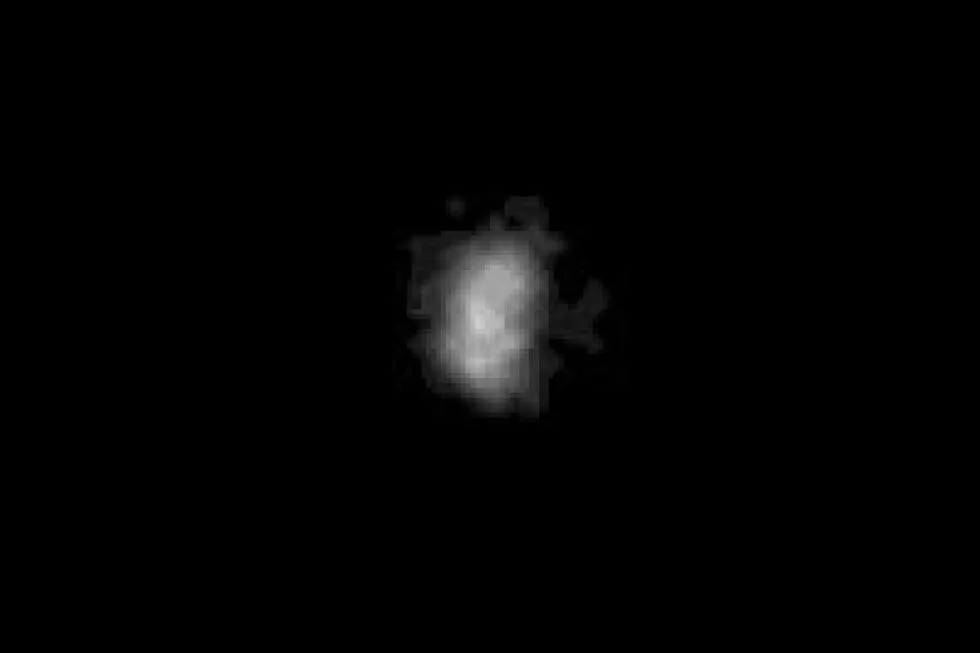
Neptune’s mysterious moon Nereid may be an original, study shows 1 of 2 | This image released by NASA shows the Voyager view of Nereid, a satellite of Neptune, obtained on Aug. 24, 1989. (NASA via AP) 2 of 2 | This August 1989 image provided by NASA shows the planet Neptune photographed by the Voyager 2 spacecraft, processed to enhance the visibility of small features. (NASA via AP) 1 of 2 | This image released by NASA shows the Voyager view of Nereid, a satellite of Neptune, obtained on Aug. 24, 1989. (NASA via AP) 1 of 2 This image released by NASA shows the Voyager view of Nereid, a satellite of Neptune, obtained on Aug. 24, 1989. (NASA via AP) Add AP News on Google Add AP News as your preferred source to see more of our stories on Google. Share 2 of 2 | This August 1989 image provided by NASA shows the planet Neptune photographed by the Voyager 2 spacecraft, processed to enhance the visibility of small features. (NASA via AP) 2 of 2 This August 1989 image provided by NASA shows the planet Neptune photographed by the Voyager 2 spacecraft, processed to enhance the visibility of small features. (NASA via AP) Add AP News on Google Add AP News as your preferred source to see more of our stories on Google. Share Updated [hour]:[minute] [AMPM] [timezone], [monthFull] [day], [year] CAPE CANAVERAL, Fla. (AP) — Neptune’s far-flung moon Nereid may be the last of the planet’s original companions that managed to survive a cosmic crash, scientists reported Wednesday. Sixteen known moons circle Neptune, our solar system’s eighth and most distant planet. Neptune’s biggest moon, Triton, barged in from the solar system’s frigid outskirts billions of years ago, scattering the planet’s original moons and putting them on destructive collision courses. A team led by the California Institute of Technology used NASA’s Webb Space Telescope to study Nereid. Their observations suggest that Nereid is no party crasher like Triton and likely survived by escaping into its extreme, elliptical orbit around Neptune.“What we know about Nereid is very limited. For its size, Nereid is extremely understudied,” said study author Matthew Belyakov, of Caltech. Neptune has only been visited by one spacecraft, NASA’s Voyager 2 in 1989. Nereid was discovered 40 years earlier by Dutch astronomer Gerard Kuiper, who named the moon after the sea nymphs in Greek mythology.Roughly 220 miles (350 kilometers) across, Nereid has an extremely eccentric orbit for a moon. It takes practically an entire Earth year for Nereid to orbit Neptune, with the moon passing less than 1 million miles (1.4 million kilometers) from the giant icy planet at one end of its egg-shaped loop and as far as 6 million miles (9.6 million kilometers) at the other end. 1 MIN READ 1 MIN READ 2 MIN READ Like so many other moons in the outer solar system, Nereid was long suspected of migrating to Neptune’s neighborhood from the frigid outlying expanse known as the Kuiper Belt. But using the Webb telescope, scientists determined that Nereid’s composition was inconsistent with Kuiper Belt objects — it had too much ice. That suggests it was part of Neptune’s system all along. “We don’t have all that much evidence left around Neptune — the system doesn’t have very many moons left,” Belyakov said in an email. But the latest observations “strongly rule out” that Nereid wandered by like so many others and got ensnared by planetary gravity. The findings appear in the journal Science Advances.This is “an exciting result,” said Carnegie Science planetary astronomer Scott Sheppard, who was not part of the study. The observations show for the first time that Nereid’s peculiar orbit matches “the history we might expect from a moon that originally formed close to Neptune and was later pushed outward from the capture of Triton,” Sheppard said in an email.Neptune’s innermost moons likely formed out of the shattered remains of the originals that were Triton’s casualties, according to Belyakov and his team. All three of the solar system’s other giant planets have more moons, with Saturn topping the charts at 292.A visiting spacecraft could clinch the Neptunian system’s origin story, according to scientists, although none are currently planned.___The Associated Press Health and Science Department receives support from the Howard Hughes Medical Institute’s Department of Science Education and the Robert Wood Johnson Foundation. The AP is solely responsible for all content.
SRCAssociated Press (AP)
LANGEN
LEANCenter
WORDS735
ENT10
WED · 2026-05-20 · 18:23 GMTBRIEF NSR-2026-0520-77935
NSR-2026-0520-77935News Report·EN·Human Interest
Neptune’s mysterious moon Nereid may be an original, study shows
Scientists using NASA's Webb Space Telescope have found evidence suggesting Neptune's moon Nereid may be one of the planet's original companions. Previously, it was thought Nereid might have migrated from the Kuiper Belt.
By
MARCIA DUNNAssociated Press (AP)Filed 2026-05-20 · 18:23 GMTLean · CenterRead · 3 min
Associated Press (AP)FIG 01
Reading time
3min
Word count
735words
Sources cited
2cited
Entities identified
10entities
Quality score
100%
§ 01
Briefing Summary
AI-generatedNEWSAR · AI
Scientists using NASA's Webb Space Telescope have found evidence suggesting Neptune's moon Nereid may be one of the planet's original companions. Previously, it was thought Nereid might have migrated from the Kuiper Belt. However, the telescope's observations revealed Nereid's composition, with its high ice content, is inconsistent with Kuiper Belt objects, indicating it was part of Neptune's system from the beginning. Researchers propose that Nereid likely survived a cosmic collision caused by the capture of Neptune's largest moon, Triton, by escaping into its extreme, elliptical orbit. This finding, published in Science Advances, suggests Nereid could be the last surviving original moon of Neptune.
Confidence 0.90Sources 2Claims 5Entities 10
§ 02
Article analysis
Model · rule-basedFraming
Human Interest
Technology
Tone
Measured
AI-assessed
CalmNeutralAlarmist
Factuality
0.80 / 1.00
Factual
LowHigh
Sources cited
2
Limited
FewMany
§ 03
Key claims
5 extracted01
What we know about Nereid is very limited.
quoteMatthew Belyakov
Confidence
1.00
02
Nereid has an extremely eccentric orbit, taking nearly an Earth year to orbit Neptune.
factualarticle
Confidence
0.90
03
Neptune's biggest moon, Triton, barged in from the solar system's frigid outskirts billions of years ago, scattering original moons.
factualscientists
Confidence
0.80
04
Nereid likely survived by escaping into its extreme, elliptical orbit around Neptune.
factualscientists
Confidence
0.70
05
Neptune's moon Nereid may be an original moon that survived a cosmic crash.
factualscientists
Confidence
0.70
§ 04
Full report
3 min read · 735 words§ 05
Entities
10 identifiedKey playerOppositionContextPositiveNeutralNegative
Organizations4
Locations1
§ 06
Keywords & salience
9 termsnereid
1.00
neptune
0.90
moon
0.80
original moon
0.70
triton
0.60
cosmic crash
0.50
orbit
0.50
webb space telescope
0.40
voyager 2
0.40
§ 07
Topic connections
Interactive graph No topic relationship data available yet. This graph will appear once topic relationships have been computed.