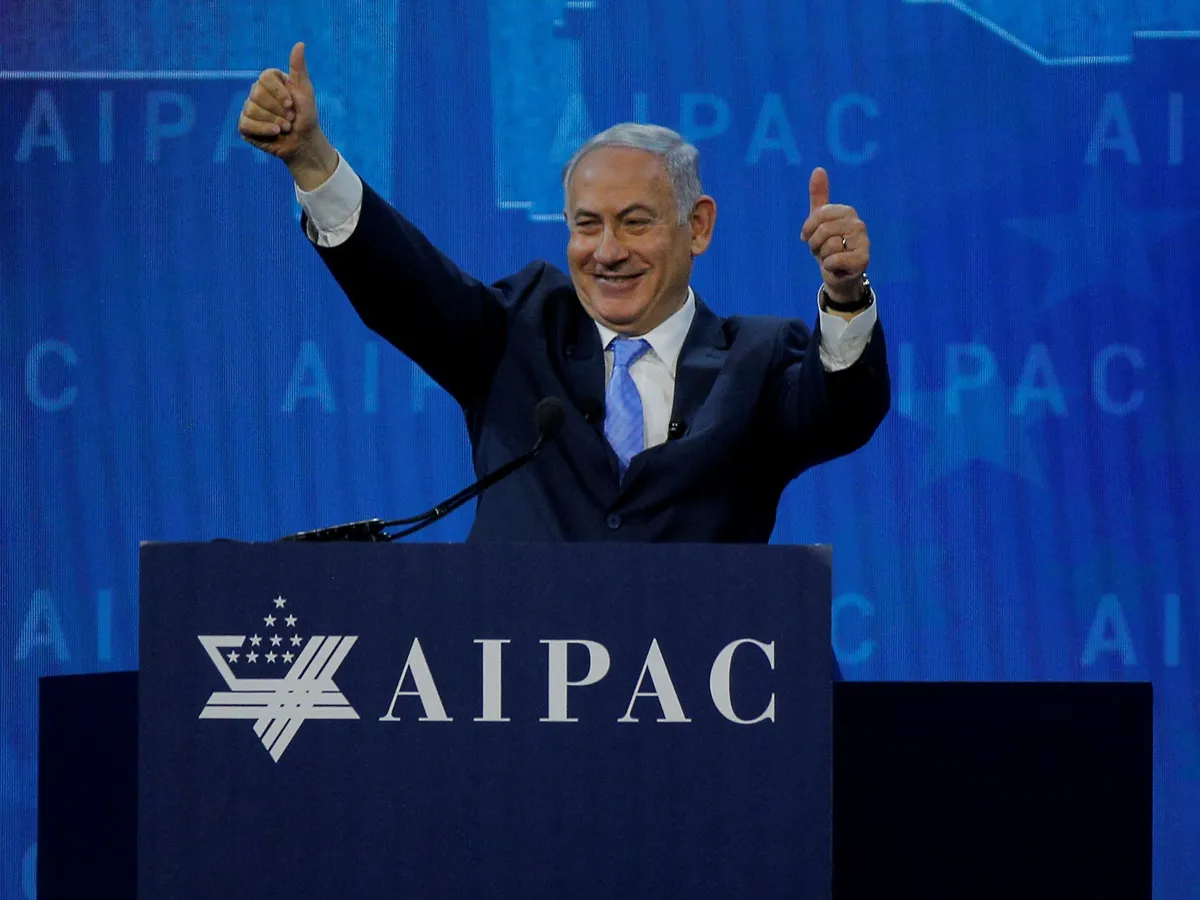
ANALYSISHow AIPAC channels millions through shell PACs ahead of US midtermsAl Jazeera analyses how the pro-Israel lobby group has relied on shell political action groups with deceptive names to defeat Israel critics.Israeli Prime Minister Benjamin Netanyahu speaks at the AIPAC policy conference in Washington, DC, in 2018 [File: Brian Snyder/Reuters]Published On 20 May 2026Washington, DC – For many voters in Illinois, nothing appeared overtly suspicious in the 30-second election that aired in mid-March.The video starts with a burst of cheerful music, and a narrator praises congressional candidate Bushra Amiwala as a fighter for “real economic justice” and “the real deal”.Recommended Stories list of 3 itemslist 1 of 3Iran claims it coordinated passage of 26 vessels out of Hormuz in 24 hourslist 2 of 3Trump critic Massie defeated: Takeaways from US primary election resultslist 3 of 3Chris Rabb win in Pennsylvania energises Democrats’ progressive flankend of listBut the video was not part of a genuine effort to get Amiwala elected to the United States House of Representatives. And the candidate quickly disavowed it.Instead, public records reviewed by Al Jazeera now show the commercial was paid for by a political action committee (PAC) associated with the largest pro-Israel lobby group in the US.Funding for the came from the American Israel Public Affairs Committee (AIPAC), which has been pumping tens of millions of dollars into election campaigns in a push to sink candidates critical of Israel.With the midterm primary season in full swing, advocates say AIPAC is placing its thumb on the scale in many congressional races. Its tactics, they argue, undermine election transparency.“Every cycle, AIPAC shows just how broken our democracy is and how corrupt our political finance system is,” said Usamah Andrabi, a spokesperson at Justice Democrats, a progressive group.“Every cycle, they are at the forefront of exploiting those gaps for their right-wing donors and at the expense of voters.”Shell PACsIn Illinois, the aimed to boost Amiwala in order to syphon off votes from more viable progressive candidates — namely, Palestinian American activist Kat Abughazaleh, who ended up losing the race narrowly.While the Chicago Progressive Partnership — the group whose name appeared on the Amiwala — was widely believed to be linked to AIPAC, it did not have to reveal the source of its funding until after the elections, which took place in March.Now that the vote is over, Federal Election Commission receipts show that the sole funder of Chicago Progressive Partnership was Elect Chicago Women (ECW), another PAC. It contributed $1m to the partnership.In turn, ECW had raised more than $4m from United Democracy Project (UDP), the election arm of AIPAC, and another $1m from investor Blair Frank, one of UDP’s largest donors.AIPAC also contributed $1.3m to a third PAC, Affordable Chicago Now, in what critics call an effort to conceal its spending in Illinois.Palestinian rights advocates say this use of “shell PACs” is evidence of how the pro-Israel group has become “toxic” among the US electorate. They argue AIPAC has taken a Russian doll approach — hiding its spending by funnelling funds from one PAC to another — to hide its involvement in primary races.“They are so unpopular amongst the Democratic Party that they have to hide themselves,” Andrabi told Al Jazeera. “We have to keep exposing them and looking under every rock to see whether or not this shell PAC or that shell PAC is funded by AIPAC.”Part of the backlash has come from broader public disillusionment with Israel-backed policies, including the joint US-Israeli war against Iran and the genocidal assault on Gaza, which AIPAC supports.As a result, Israel has been rapidly losing support among the US public.Just this week, The New York Times and Siena College released a survey showing that 37 percent of US voters now sympathise with Palestinians, while 35 percent sympathise with Israelis.That number was even higher among Democratic respondents, 57 percent of whom felt greater sympathy for the Palestinians.The Pew Research Center suggested an even stronger left-wing backlash. Its survey earlier this year found 80 percent of Democratic respondents said they have unfavourable views of Israel.For many voters, AIPAC has come to symbolise the oversized influence of campaign spending in US politics, turning the group into a pariah — especially among Democrats.Some politicians who previously received support from the group are now disavowing it.Omar Shakir, the executive director of the US-based rights group DAWN, said AIPAC’s use of shell groups is a reflection of that growing repudiation.Routing funds “through layered PAC structures designed to obscure where the money originates reflects weakness, not strength”, he told Al Jazeera.“They can’t defend Israel’s genocide, apartheid and ethnic cleansing, so they’re rigging the system outside of public view.”Secretary of State Marco Rubio, who was a senator at that time, attends the AIPAC policy conference in Washington, DC, in 2018 [File: Brian Snyder/Reuters]Lack of transparencyA 2010 US Supreme Court ruling has allowed corporations and advocacy groups to spend unlimited amounts of money in elections, as long as they do not directly coordinate with the campaigns they are backing.In many cases, PACs do not have to list all of their donors until after the elections. Some nonprofits that influence elections — known as dark money groups — do not have to reveal their donors at all. And there are few rules about messaging.Experts say AIPAC has exploited these loopholes to advance its goals. But the lack of transparency is causing confusion in many races.For example, in a competitive Democratic primary in Pennsylvania, candidate Ala Stanford insisted that she did not receive AIPAC money.But the largest spender in the race was 314 Action Fund, a PAC that backs Democratic scientists, which supported Stanford, who is a paediatric surgeon.AIPAC transferred $1m to 314 Action Fund in the last election cycle in 2024, but the extent of the group’s involvement in the Pennsylvania race remains unclear.Progressive state legislator Chris Rabb, who has condemned Israel’s atrocities in Gaza as a genocide, ended up winning that primary on Tuesday.In Kentucky, meanwhile, AIPAC and other pro-Israel groups helped defeat Congressman Thomas Massie, a rare Republican critic of President Donald Trump.It was the most expensive House primary in US history, but the names of the donors of the PAC that spent the most money in that race have not been fully made public.While it may be difficult to prove AIPAC’s spending in some races, Andrabi said it is not enough for candidates to merely distance themselves from the pro-Israel group.“We know that AIPAC does not throw money at candidates unless those candidates will rubber-stamp their agenda in Washington,” he said.“So it’s not just about what they say and whether or not they deny they have AIPAC support. Let’s ask them what policies they will support in Congress. Will they support an arms embargo against Israel? Will they call a genocide a genocide? Will they stop all funding to the Israeli government and military? That’s a good litmus test for us to do.”AIPAC’s connectionsBeyond its work with UDP and associated PACs, AIPAC has encouraged individual donors to contribute to the campaigns of 361 legislators, including Republican House Speaker Mike Johnson and Democratic Minority Leader Hakeem Jeffries.The contingency of AIPAC-backed members of Congress spans the ideological spectrum, from prominent liberals like Ted Lieu to far-right, anti-Muslim figures, including Randy Fine.In his 2020 memoir, former President Barack Obama acknowledged AIPAC’s influence in Washington, saying that politicians were worried about “crossing” the lobby group.
SRCAl Jazeera
LANGEN
LEANCenter
WORDS1 224
ENT12
WED · 2026-05-20 · 20:50 GMTBRIEF NSR-2026-0520-77950
NSR-2026-0520-77950Analysis·EN·Political Strategy
As AIPAC becomes ‘toxic’, it is trying to conceal spending in US elections
The pro-Israel lobby group AIPAC is reportedly using shell Political Action Committees (PACs) with deceptive names to channel millions of dollars into US elections, aiming to defeat critics of Israel. Al Jazeera's analysis reveals that AIPAC's election arm, United Democracy Project (UDP), funded PACs like Elect Chicago Women (ECW) and Affordable Chicago Now, which in turn supported other groups that aired campaign advertisements.
Ali HarbAl JazeeraFiled 2026-05-20 · 20:50 GMTLean · CenterRead · 5 min
Al JazeeraFIG 01
Reading time
5min
Word count
1 224words
Sources cited
2cited
Entities identified
12entities
Quality score
100%
§ 01
Briefing Summary
AI-generatedNEWSAR · AI
The pro-Israel lobby group AIPAC is reportedly using shell Political Action Committees (PACs) with deceptive names to channel millions of dollars into US elections, aiming to defeat critics of Israel. Al Jazeera's analysis reveals that AIPAC's election arm, United Democracy Project (UDP), funded PACs like Elect Chicago Women (ECW) and Affordable Chicago Now, which in turn supported other groups that aired campaign advertisements. This "Russian doll" tactic is described by critics as an effort to conceal AIPAC's spending and involvement in primary races, particularly as public sympathy for Palestinians grows among US voters, especially Democrats. Advocates argue this practice exploits loopholes in campaign finance laws and undermines election transparency.
Confidence 0.90Sources 2Claims 5Entities 12
§ 02
Article analysis
Model · rule-basedFraming
Political Strategy
Social Justice
Tone
Mixed Tone
AI-assessed
CalmNeutralAlarmist
Factuality
0.70 / 1.00
Factual
LowHigh
Sources cited
2
Limited
FewMany
§ 03
Key claims
5 extracted01
ECW received over $4m from United Democracy Project (UDP), the election arm of AIPAC.
factualFederal Election Commission receipts reviewed by Al Jazeera
Confidence
0.95
02
The Chicago Progressive Partnership, which aired a deceptive ad for a candidate, was funded solely by Elect Chicago Women (ECW).
factualFederal Election Commission receipts reviewed by Al Jazeera
Confidence
0.95
03
AIPAC is channeling millions of dollars through shell PACs with deceptive names to defeat Israel critics in US elections.
factualAl Jazeera
Confidence
0.90
04
AIPAC contributed $1.3m to a third PAC, Affordable Chicago Now, in an effort to conceal its spending in Illinois.
factualCritics cited by Al Jazeera
Confidence
0.85
05
AIPAC's tactics undermine election transparency and exploit gaps in the political finance system.
quoteUsamah Andrabi (Justice Democrats)
Confidence
0.80
§ 04
Full report
5 min read · 1 224 words§ 05
Entities
12 identifiedKey playerOppositionContextPositiveNeutralNegative
People4
Organizations3
§ 06
Keywords & salience
9 termsaipac
1.00
us elections
0.90
shell pacs
0.80
election spending
0.70
pro-israel lobby
0.70
political finance
0.60
campaign finance
0.50
transparency
0.50
benjamin netanyahu
0.40
§ 07
Topic connections
Interactive graph No topic relationship data available yet. This graph will appear once topic relationships have been computed.