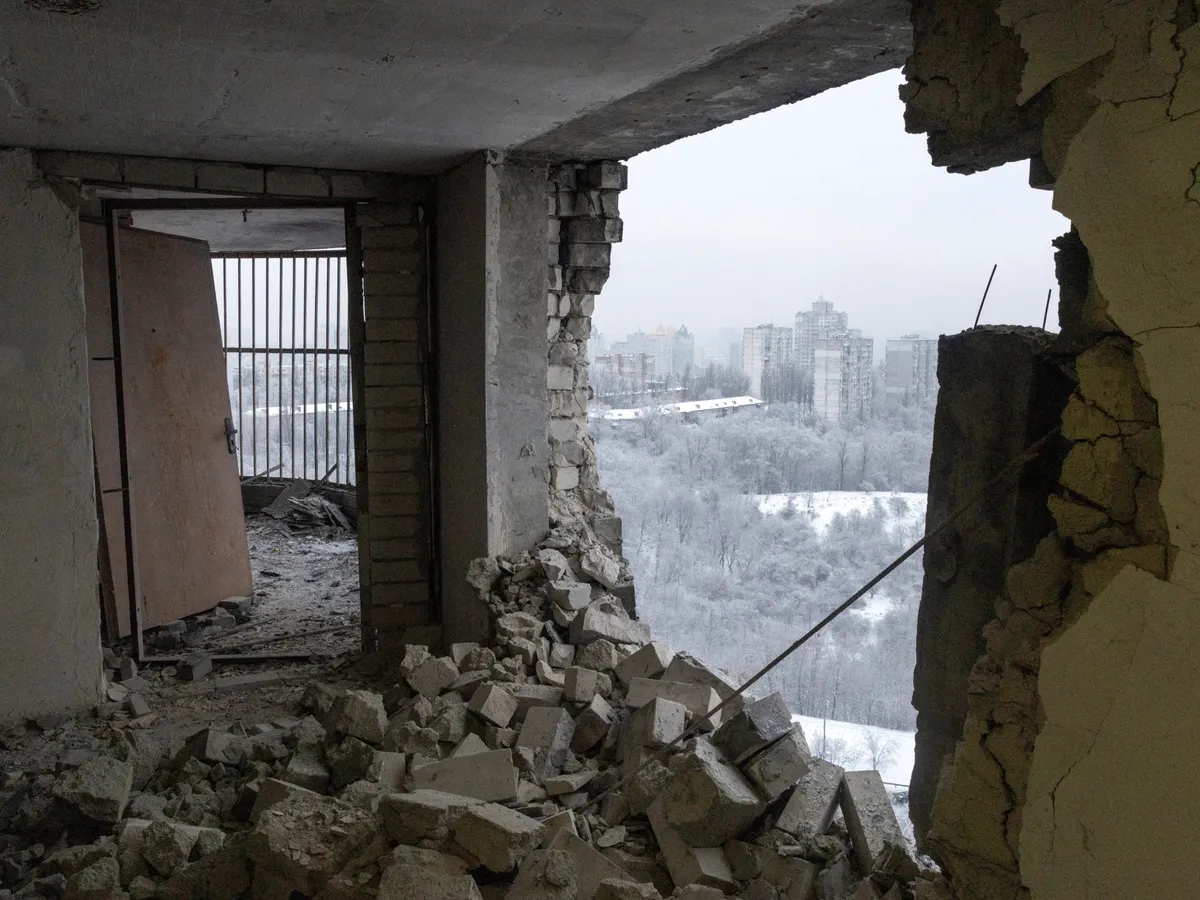
These are the key developments from day 1,422 of Russia’s war on Ukraine.Ukraine's snow-covered capital is seen through the impact hole of a Russian drone that hit the top floor of an apartment building in Kyiv, Ukraine, on Thursday [Thomas Peter/Reuters]Published On 16 Jan 2026Here is where things stand on Friday, January 16:Fighting A Ukrainian drone attack killed two workers from a state-owned pharmacy as they were transporting medicines to Polohy in a Russian-occupied area of Ukraine’s Zaporizhia region, Russia’s state news agency TASS reports. A Ukrainian drone strike injured three people in Russia’s front-line Belgorod region, the regional task force reported, according to TASS. Russian forces dropped a guided bomb on Bilopillia, in Ukraine’s Sumy region, killing one person and injuring at least four others, the regional prosecutor’s office said on the Telegram messaging app. Ukraine’s Ministry of Energy said that new power outages were affecting customers in the Zhytomyr and Kharkiv regions following an overnight Russian attack. Network restrictions remained in place in the capital Kyiv, the Kyiv region, and the Odesa region, the ministry added in a statement. Ihor Terekhov, the mayor of Ukraine’s second-biggest city, Kharkiv, said on Telegram that Russian forces destroyed a large facility of “critical energy infrastructure”, without specifying which type of facility was struck. Kateryna Pop, spokeswoman for the Kyiv City Military Administration, said that 287 residential buildings remain without heating in Kyiv more than a week after a massive Russian attack damaged infrastructure there, and as temperatures continue to fall to -17 degrees Celsius (1.4 Fahrenheit) overnight. Ukrainian President Volodymyr Zelenskyy said that the national government would take over responsibility for Kyiv’s energy as the city had not responded quickly enough to the current crisis, according to the Ukrinform news site. A Ukrainian attack left close to 87,000 people without electricity in Russian-occupied Zaporizhia, Russian-appointed official Yevhen Balitsky wrote on Telegram. Oleksandr Kovalenko, the spokesman for the Zaporizhia Regional Military Administration, said that more than 500 people will need to be evacuated from two districts of Ukraine’s embattled Zaporizhia region by early February, according to Ukrinform. More than 700 people have already been evacuated since the beginning of January, including 480 children, he added. Politics and diplomacy President Zelenskyy said in his nightly video address that “Ukraine has never been and will never be a stumbling block to peace”, appearing to refute comments made by United States President Donald Trump a day earlier. “When Russian strikes are aimed at breaking our energy system and our people, it is Russia that must be put under pressure,” Zelenskyy added. Trump told the Reuters news agency on Wednesday that he believed Russian President Vladimir Putin was “ready to make a deal. I think Ukraine is less ready to make a deal”. International Monetary Fund (IMF) chief Kristalina Georgieva told the Reuters news agency during a visit to Kyiv that she expects to ask the fund’s executive board to approve a new $8.1bn lending programme for Ukraine within weeks. NATO Secretary-General Mark Rutte said in a post on X that he had spoken to Zelenskyy “about the energy situation in Ukraine, with Russia’s attacks causing terrible human suffering, as well as on the ongoing efforts to bring an end to the war”. “We’re committed to ensuring that Ukraine continues to get the crucial support needed to defend today and ultimately secure a lasting peace,” Rutte said. French President Emmanuel Macron said that France is now providing two-thirds of intelligence information to Ukraine, largely replacing the US, which until last year had delivered the majority of those services. Oil and gas Greece’s shipping ministry warned its ships to “take the highest possible security measures” in the Black Sea region, following recent drone attacks on oil tankers there, which Russia has blamed on Ukraine, according to Reuters. Russia’s federal budget revenues from oil and gas dropped by 24 percent in 2025 to the lowest level since 2020, according to Finance Ministry data, as oil prices fell while the rouble appreciated.
SRCAl Jazeera
LANGEN
LEANCenter
WORDS663
ENT12
FRI · 2026-01-16 · 00:37 GMTBRIEF NSR-2026-0116-7802
NSR-2026-0116-7802News Report·EN·Conflict
Russia-Ukraine war: List of key events, day 1,422
On January 16, 2026, day 1,422 of the Russia-Ukraine war saw continued fighting and infrastructure damage. A Ukrainian drone strike in Russian-occupied Zaporizhia killed two pharmacy workers, while another injured three in Russia's Belgorod region.
Lyndal RowlandsAl JazeeraFiled 2026-01-16 · 00:37 GMTLean · CenterRead · 3 min
Al JazeeraFIG 01
Reading time
3min
Word count
663words
Sources cited
11cited
Entities identified
12entities
Quality score
100%
§ 01
Briefing Summary
AI-generatedNEWSAR · AI
On January 16, 2026, day 1,422 of the Russia-Ukraine war saw continued fighting and infrastructure damage. A Ukrainian drone strike in Russian-occupied Zaporizhia killed two pharmacy workers, while another injured three in Russia's Belgorod region. Russian forces struck Bilopillia in the Sumy region, killing one and injuring at least four. Overnight Russian attacks caused power outages in the Zhytomyr and Kharkiv regions, with restrictions in Kyiv and Odesa. Kharkiv's mayor reported the destruction of a critical energy facility. In Kyiv, many residential buildings remain without heating after a previous Russian attack, prompting President Zelenskyy to announce the national government would take over energy responsibilities for the city. A Ukrainian attack left thousands without electricity in Russian-occupied Zaporizhia, where hundreds are being evacuated due to the ongoing conflict.
Confidence 0.90Sources 11Claims 5Entities 12
§ 02
Article analysis
Model · rule-basedFraming
Conflict
Human Interest
Tone
Measured
AI-assessed
CalmNeutralAlarmist
Factuality
0.80 / 1.00
Factual
LowHigh
Sources cited
11
Well sourced
FewMany
§ 03
Key claims
5 extracted01
Ukraine has never been and will never be a stumbling block to peace.
quotePresident Zelenskyy
Confidence
1.00
02
287 residential buildings remain without heating in Kyiv more than a week after a Russian attack.
factualKateryna Pop, spokeswoman for the Kyiv City Military Administration
Confidence
0.90
03
New power outages were affecting customers in the Zhytomyr and Kharkiv regions following an overnight Russian attack.
factualUkraine’s Ministry of Energy
Confidence
0.90
04
Russian forces dropped a guided bomb on Bilopillia, killing one person and injuring at least four others.
factualregional prosecutor’s office
Confidence
0.90
05
A Ukrainian drone attack killed two workers in Russian-occupied Zaporizhia as they transported medicines.
factualRussia’s state news agency TASS
Confidence
0.90
§ 04
Full report
3 min read · 663 words§ 05
Entities
12 identifiedKey playerOppositionContextPositiveNeutralNegative
People3
Organizations1
§ 06
Keywords & salience
10 termsrussia-ukraine war
1.00
drone attack
0.80
energy infrastructure
0.70
power outages
0.70
russian-occupied
0.60
zaporizhia region
0.60
kharkiv
0.50
evacuation
0.50
kyiv
0.50
belgorod region
0.40
§ 07
Topic connections
Interactive graph Network visualization showing 51 related topics
View Full Graph Person Organization Location Event|Click node to navigate|Edge numbers = shared articles