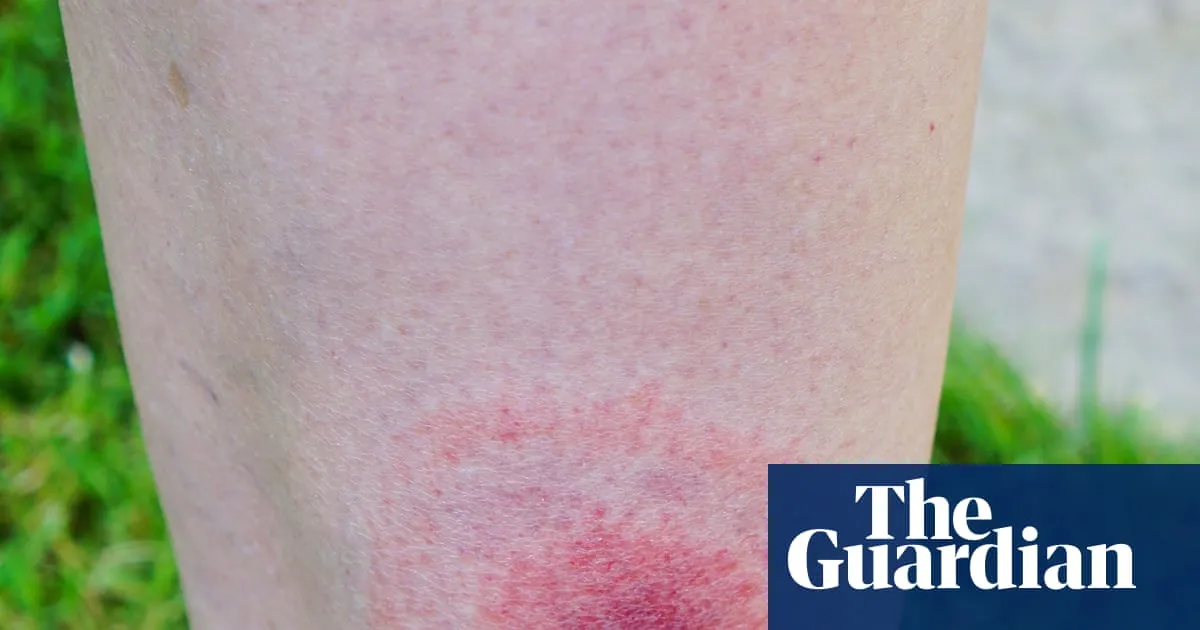
Cases of Lyme disease have risen more than 20% in England in the past year, public health experts have revealed, as pharmaceutical companies work to create new vaccines and drugs to tackle the tick-borne illness.According to data from the UK Health Security Agency (UKHSA), published as part of its One Health vector-borne disease surveillance report, there were 1,168 laboratory-confirmed cases of Lyme disease in 2025, up from 959 in 2024 – an increase of 22%. However, the figure is similar to that recorded in 2023, when there were 1,151 confirmed cases.Two probable cases of tick-borne encephalitis complex were also identified in 2025, bringing the total number of locally acquired cases to six since 2019, when the virus was first identified in the UK.Dr Claire Gordon, the head of the rare and imported pathogens laboratory at UKHSA, said: “While the number of laboratory-confirmed acute cases of Lyme disease in 2025 is an increase on numbers reported in 2024, we expect overall case rates to vary year to year depending on awareness, testing rates and factors that impact outdoor activities such as weather. Broader trends in 2025 remain consistent.”Lyme disease is caused by a type of bacteria called Borrelia burgdorferi, which lives in the gut of ticks – tiny spider-like creatures found in grassy and wooded areas that feed on the blood of birds and mammals, including humans.“In recent years, we have seen an increasing geographical distribution of ticks across the UK,” Gordon said. “But tick numbers continue to vary due to changes in weather conditions, climate trends, habitat changes and shifting host populations.”Symptoms of Lyme can include a bullseye-like rash, fever, muscle and joint pain, and lethargy. Left untreated, the condition can become chronic and, even among those who receive antibiotics, some report ongoing symptoms.Not all ticks carry Lyme bacteria, and it is thought rapid removal of ticks reduces the risk of infection after a bite. But while there are various medications available to protect pets from Lyme disease – including monthly oral tablets and vaccinations – advice for humans centres on prevention, such as using repellants, covering exposed skin outdoors and wearing light-coloured clothing to make ticks easier to spot.Linden Hu, a professor of immunology at Tufts medical school, said there were a number of reasons veterinary and human approaches differed, noting that pet owners were often more willing to medicate their dogs than themselves or family members, while clinical trials in humans were harder to conduct.“It’s easier to do studies in animals because you can control the situation. You can put infected ticks on them to test if it’s going to work, which you really can’t do with humans,” he said, adding real-world studies, or “field trials”, were expensive and risky, given that it was unclear how many cases of Lyme would occur.A vaccine against Lyme for humans, known as LYMErix, was previously available in the US, with trials suggesting it had an efficacy of 76% after a third dose. However, it was withdrawn from the market in 2002 after poor uptake.“There were a couple of things that coalesced to cause the low sales,” Hu said, noting this included the US Centers for Disease Control and Prevention recommending it only for people at high risk of Lyme disease. There were also concerns the vaccine may be linked to arthritis. While evidence remained lacking, the negative media coverage and lack of trust in the vaccine contributed to low demand.Several new treatments are in the works, including an mRNA vaccine from Moderna – a jab Hu has worked on that is in phase 2 of its clinical development – as well as a different vaccine from Pfizer and Valneva.Crucially, Hu said, both approaches aimed to avoid activating the immune pathway some researchers suspected caused arthritis in certain recipients of LYMErix.Not that it has been plain sailing. In the case of the Pfizer/Valneva vaccine, there were fewer-than-expected cases of Lyme among participants in a phase 3 trial, meaning that while the vaccine appeared to have an efficacy of more than 70%, the results were not as statistically robust as hoped. Despite this, the vaccine is to be submitted to regulatory authorities.Other approaches are also being explored. Among them is monoclonal antibody from Tonix Pharmaceuticals that could be given before exposure to ticks, while Hu is working on a drug with Tarsus Pharmaceuticals that is already used to protect dogs and cats. Unlike the vaccines, this drug – known as lotilaner – kills the ticks, rather than the bacteria they carry.According to Hu, lotilaner works rapidly by killing the ticks before they have a chance to transmit Lyme or, potentially, other diseases.Julia Knight, of the charity Lyme disease UK, said it was unclear whether a vaccine would be adopted in the UK, given that figures for Lyme disease appeared to be low, although were likely higher – not least because they do not include the roughly 70% of people with Lyme who develop the telltale rash, as these patients are treated immediately without laboratory tests, and Lyme disease can be missed or misdiagnosed.“Obviously any advances in science that prevents Lyme disease is always welcome, but whether people will welcome a vaccine or not in the current climate of vaccine hesitancy remains to be seen,” she said.
SRCThe Guardian - World News
LANGEN
LEANCenter-Left
WORDS873
ENT8
THU · 2026-05-21 · 09:13 GMTBRIEF NSR-2026-0521-78058
NSR-2026-0521-78058News Report·EN·Public Health
Lyme disease cases in England rise by more than 20% in a year
Cases of Lyme disease in England increased by 22% in 2025 compared to 2024, with 1,168 laboratory-confirmed cases reported by the UK Health Security Agency. This rise has prompted pharmaceutical companies to develop new vaccines and anti-tick treatments.
Nicola Davis Science correspondentThe Guardian - World NewsFiled 2026-05-21 · 09:13 GMTLean · Center-LeftRead · 4 min
The Guardian - World NewsFIG 01
Reading time
4min
Word count
873words
Sources cited
2cited
Entities identified
8entities
Quality score
100%
§ 01
Briefing Summary
AI-generatedNEWSAR · AI
Cases of Lyme disease in England increased by 22% in 2025 compared to 2024, with 1,168 laboratory-confirmed cases reported by the UK Health Security Agency. This rise has prompted pharmaceutical companies to develop new vaccines and anti-tick treatments. Scientists are working on several promising approaches, including mRNA vaccines from Moderna and Pfizer/Valneva, and a monoclonal antibody treatment. Additionally, a drug called lotilaner, which kills ticks, is being explored. These efforts aim to combat the growing geographical distribution of ticks and the potential for chronic illness if Lyme disease is left untreated.
Confidence 0.90Sources 2Claims 5Entities 8
§ 02
Article analysis
Model · rule-basedFraming
Public Health
Human Interest
Tone
Measured
AI-assessed
CalmNeutralAlarmist
Factuality
0.80 / 1.00
Factual
LowHigh
Sources cited
2
Limited
FewMany
§ 03
Key claims
5 extracted01
Lyme disease is caused by Borrelia burgdorferi bacteria, transmitted by ticks found in grassy and wooded areas.
factual
Confidence
1.00
02
The number of Lyme disease cases in 2025 is similar to the 1,151 confirmed cases recorded in 2023.
statisticUK Health Security Agency (UKHSA)
Confidence
1.00
03
Cases of Lyme disease in England rose by 22% in 2025 compared to 2024, with 1,168 laboratory-confirmed cases.
statisticUK Health Security Agency (UKHSA)
Confidence
1.00
04
Clinical trials for human Lyme disease vaccines are harder to conduct than for animals due to ethical and logistical challenges.
quoteLinden Hu
Confidence
0.90
05
Pet owners are often more willing to medicate their dogs for Lyme disease than humans are for themselves or family members.
quoteLinden Hu
Confidence
0.90
§ 04
Full report
4 min read · 873 words§ 05
Entities
8 identifiedKey playerOppositionContextPositiveNeutralNegative
Organizations2
Locations1
§ 06
Keywords & salience
10 termslyme disease
1.00
tick-borne illness
0.90
uk health security agency
0.70
disease surveillance
0.60
lyme disease prevention
0.50
borrelia burgdorferi
0.50
tick distribution
0.50
antibiotics
0.40
tick-borne encephalitis
0.40
vaccines
0.40
§ 07
Topic connections
Interactive graph No topic relationship data available yet. This graph will appear once topic relationships have been computed.