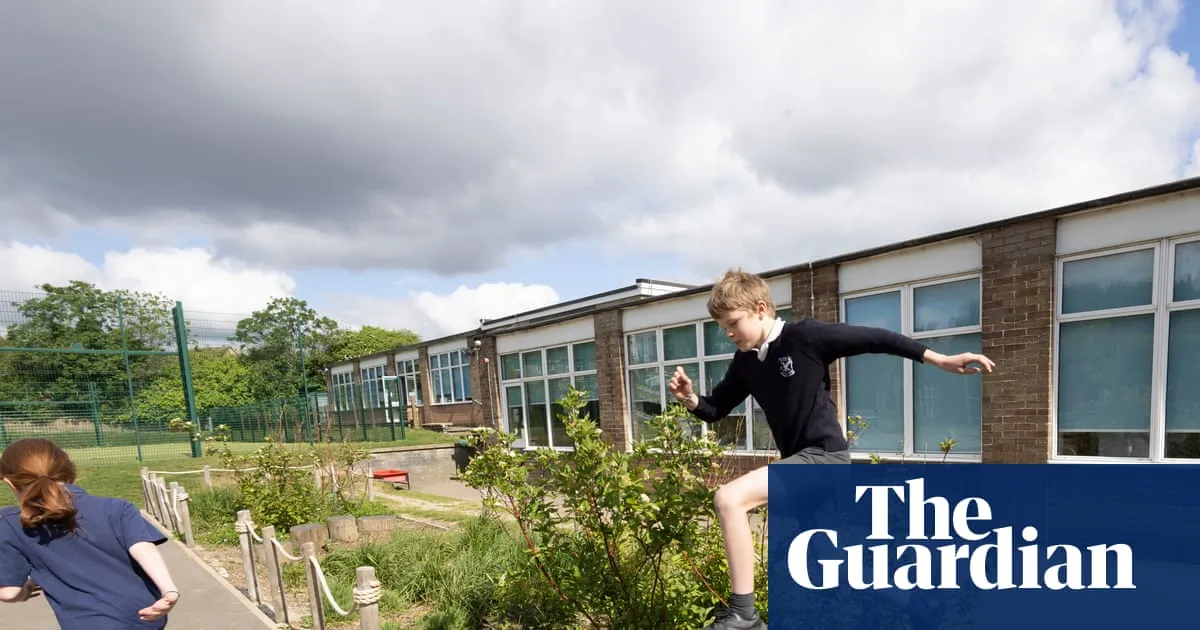
The play area at St John’s Church of England primary in Barnet, north London, used to flood so severely it was often unusable. “It would get so bad that the children couldn’t be dismissed from the playground,” says Macci Dobie, the school’s headteacher. “We had to dismiss them from different parts of the school or, literally, parents were stepping into puddles to lift their children out of the classroom.”Because the school sits in a basin with clay foundations, rain would pool on the grey tarmac and just sit there, often denying the children a proper break for play outside.Macci Dobie, headteacher at St John’s CofE primary. Photograph: Graeme Robertson/The GuardianBut that started to change when one of the parent governors, Sarah Taggart, spearheaded St John’s climate action plan. “This school is in a high flood-risk area, so we were able to get [Department for Education] funding for a bigger project and take up some of the tarmac,” says Taggart, who enlisted the help of Trees for Cities, a charity whose work includes planting green spaces in urban playgrounds to assist their adaptation to the climate crisis.“You’re taking space away from the kids, but kids are kids, it’s got to be functional,” says Alfie Davies, a landscape architect at Trees for Cities who led the design work and consultation at St John’s. “They have to be able to use it or otherwise they won’t be interested or won’t want to look after it.” Sarah Taggart spearheaded the climate action plan. Photograph: Graeme Robertson/The GuardianWith that in mind, Davies installed stepping logs to run through the new rain gardens. Now the children can enjoy jumping over a soil bed containing ornamental grasses, shrubs and perennial flowers that also functions as a sustainable drainage system. “It’s transformed our area outside,” says Dobie. “There is still some excess water when it rains heavily, but it clears up in 10 minutes.”The project responded to the topography of the site, but also the wider challenge of heavier rainfall and much hotter summers due to the climate crisis. “We put a bird cherry tree in the rain garden beds, a native species, really great for pollinators. They naturally tolerate the boggy ground but are quite drought resistant too,” says Davies, who emphasises that mitigating the heat island effect that intensifies summer heatwaves in urban areas is an integral part of their work.In 2024, the UN published a call to action on extreme heat that included a demand for children to be protected from heat stress. In recent years, Paris launched its Oasis Schoolyards scheme to incorporate structures such as canopies and pergolas into play areas, creating all-important shade for young children whose bodies cannot regulate heat in the same way as adults. In 2020, the Standards Council of Canada published a report on thermally comfortable playgrounds urging planners to put a greater focus on climate-responsive design.Trees for Cities believes that educating children about nature is a core part of how such challenges can be addressed. It runs a year-long engagement programme with the schools once the play area has been remodelled, putting on workshops for the children that links their science lessons back to the new plant life that greets them outdoors.The new playground at St John’s primary school. Photograph: Graeme Robertson/The Guardian“They [the children] will look at everything from the water cycle, how it supports the plants and infiltration of the soil itself to the actual implementation of why we’ve done things on these sites,” says Grace Walker, a senior landscape architect at Trees for Cities. The children at St John’s have been helping to water the rain gardens in the warmer months as well as going on tree identification walks in a nearby park.“Engaging the kids is probably the most valuable thing we do,” says Davies. “The kids love it. They want to be outside, looking at plants. They might be a bit weirded out looking at worms, at first, but they love it.”For Taggart, whose four children have all gone to St John’s, the legacy aspect of the work has been special. “The year 5s have been doing a project about pollinators and bees this term and it’s great because they can see it happening in their playground,” she says, adding that the children are thrilled by the extra greenery and love exploring the new plants.Two students in the garden at St John’s. Photograph: Graeme Robertson/The Guardian“It’s put the joy levels up of the school,” says Ronnie, one of St John’s pupils. “It’s prettier and calmer; the nature environment, that’s what you feel around it.”“We used to have wet breaks where we had to sit inside the classroom and just draw,” says Juliet, another pupil, “but now because of the rain gardens, you get to have more play. It affected our learning as well because when you’re stuck inside, your brain gets all wrong, but when you go outside it makes you feel better.”
SRCThe Guardian - World News
LANGEN
LEANCenter-Left
WORDS820
ENT10
THU · 2026-05-21 · 14:00 GMTBRIEF NSR-2026-0521-78169
NSR-2026-0521-78169News Report·EN·Environmental
‘It’s put the joy levels up’: the flood-prone London school with a climate-adapted playground
St John's Church of England primary school in Barnet, London, has transformed its flood-prone playground into a climate-adapted space. Previously, severe flooding made the playground unusable, forcing the school to dismiss children from classrooms or have parents lift them over puddles.
Tom DugginsThe Guardian - World NewsFiled 2026-05-21 · 14:00 GMTLean · Center-LeftRead · 4 min
The Guardian - World NewsFIG 01
Reading time
4min
Word count
820words
Sources cited
3cited
Entities identified
10entities
Quality score
100%
§ 01
Briefing Summary
AI-generatedNEWSAR · AI
St John's Church of England primary school in Barnet, London, has transformed its flood-prone playground into a climate-adapted space. Previously, severe flooding made the playground unusable, forcing the school to dismiss children from classrooms or have parents lift them over puddles. Spearheaded by a parent governor and in partnership with the charity Trees for Cities, the school received funding to remove tarmac and install rain gardens with stepping logs. This sustainable drainage system now allows water to clear within minutes, even after heavy rain. The project also addresses climate crisis challenges like increased rainfall and hotter summers by incorporating native, resilient plants. Trees for Cities provides a year-long engagement program, educating pupils about nature and the functionality of the new space, which has reportedly increased children's joy and opportunities for outdoor play.
Confidence 0.90Sources 3Claims 5Entities 10
§ 02
Article analysis
Model · rule-basedFraming
Environmental
Human Interest
Tone
Measured
AI-assessed
CalmNeutralAlarmist
Factuality
0.70 / 1.00
Factual
LowHigh
Sources cited
3
Well sourced
FewMany
§ 03
Key claims
5 extracted01
International bodies like the UN and organizations like Standards Council of Canada have highlighted the need to protect children from heat stress and focus on climate-responsive playground design.
factualarticle
Confidence
1.00
02
The transformed playground area now clears excess water within 10 minutes after heavy rain.
factualMacci Dobie
Confidence
1.00
03
The new playground design includes rain gardens with stepping logs and native plants that help with drainage and mitigate the urban heat island effect.
factualAlfie Davies
Confidence
1.00
04
St John’s school received Department for Education funding for a climate adaptation project for its playground.
factualSarah Taggart
Confidence
1.00
05
The playground at St John’s primary school used to flood severely, making it unusable for children.
factualMacci Dobie
Confidence
1.00
§ 04
Full report
4 min read · 820 words§ 05
Entities
10 identifiedKey playerOppositionContextPositiveNeutralNegative
People3
Organizations4
Locations2
§ 06
Keywords & salience
9 termsclimate-adapted playground
1.00
flood-prone school
0.90
climate crisis
0.80
sustainable drainage
0.70
urban playgrounds
0.60
heat island effect
0.50
climate action plan
0.50
rain gardens
0.40
trees for cities
0.40
§ 07
Topic connections
Interactive graph No topic relationship data available yet. This graph will appear once topic relationships have been computed.