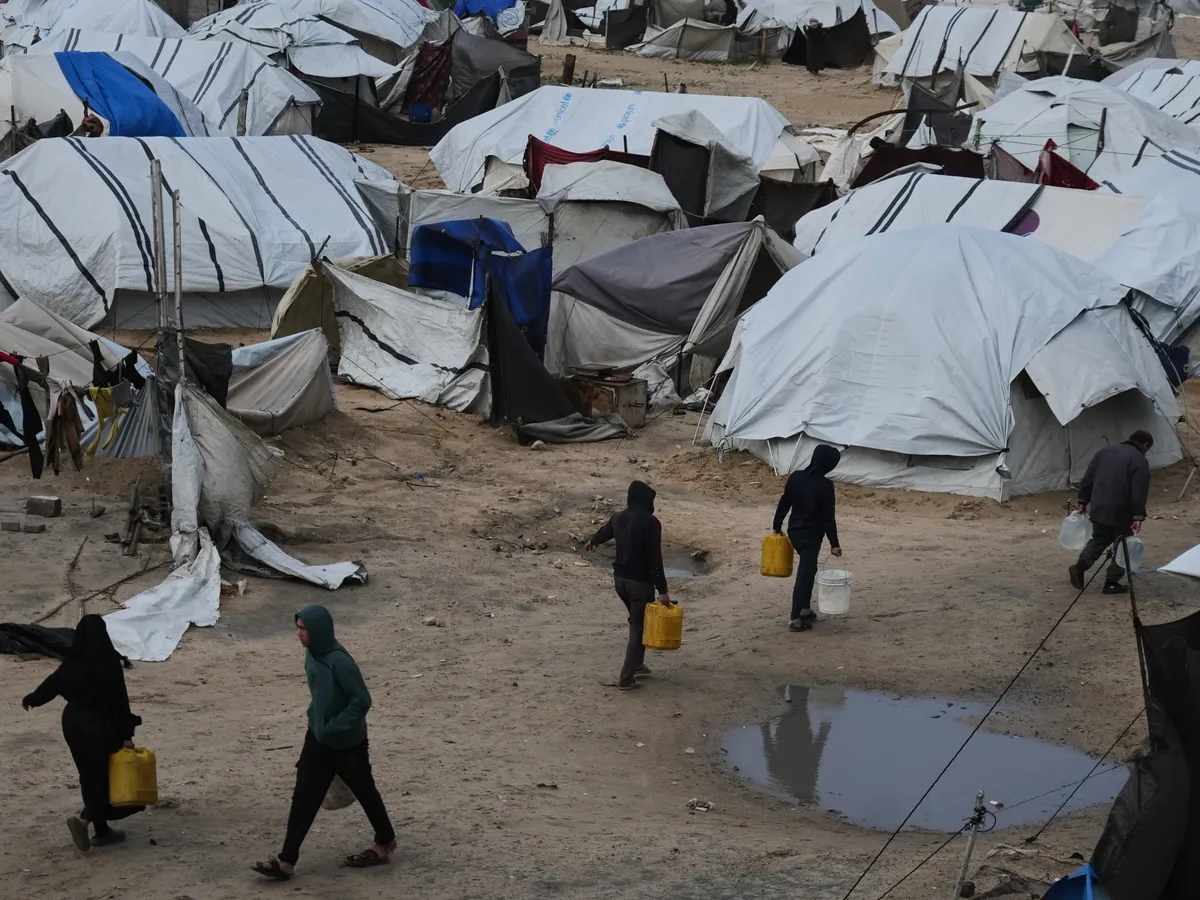
Palestinians fear decisions imposed from outside fail to address justice, freedom, and lived realities in Gaza.Palestinians carry plastic jerrycans filled with water amid stormy weather at a displacement camp in Gaza City, Tuesday, January 13, 2026 [Jehad Alshrafi/AP Photo]Published On 16 Jan 2026Gaza City – Peace, in both the physical and mental sense, feels far away in Gaza.A ceasefire may have officially been in place since October 10, but Israel continues to conduct occasional attacks, with more than 442 Palestinians killed in the three months since.Recommended Stories list of 3 itemslist 1 of 3UN chief’s last annual speech slams world leaders for lack of cooperationlist 2 of 3The UK is taking political prisoners to evade accountability for genocidelist 3 of 3Israel carries out raids and demolitions, arrests dozens across West Bankend of listIt is not just the attacks – daily life in Gaza is also shaped by siege and displacement, and a sense that living conditions will not improve any time soon.Amid this exhaustion came the announcement on Wednesday by the United States of the beginning of the ceasefire’s “second phase”. This phase is about “moving from ceasefire to demilitarization, technocratic governance, and reconstruction”, said US Special Envoy Steve Witkoff in a social media post.The new phase includes a new Palestinian technocratic administration, overseen by an international “Board of Peace”, chaired by US President Donald Trump.But while everything may sound workable on paper, the reaction from Palestinians in Gaza – one that mixes cautious hope and deep scepticism – is shaped by their lived experience since the beginning of Israel’s genocidal war on Gaza in October 2023.“A lot of political decisions are distant from the reality faced in Gaza… our daily life that is filled with blockades, fear, loss, tents, and a terrible humanitarian situation,” said Arwa Ashour, a freelance journalist and writer based in Gaza City. “Even when decisions are made to ease the suffering, they are obstructed by the Israeli occupation authorities.”“People want everything back like it was before the war: schools, hospitals, travel,” Ashour said. “If the Board of Peace is going to resolve all these crises, then we welcome it. But if it’s unable to do so, then what is its benefit?”Palestinians excluded?Ashour explained that after two years of war and more than 18 years of governance in the Palestinian enclave by Hamas, there is a desire for change in Gaza.“People want to be part of the process of creating the future, not only to accept the implementation of decisions that have already been made,” she said.The governance model envisaged in the second phase of the ceasefire plan does have a Palestinian component.Ali Shaath, a former Palestinian Authority (PA) deputy minister, will head the Palestinian technocratic committee that will manage daily life. But that committee will be overseen by the Board of Peace, to be led by Bulgaria’s former foreign and defence minister, Nickolay Mladenov.Mladenov – who has worked as a United Nations diplomat in the Middle East – is seen as an administrator, but one who may not be capable of pushing back against Israel and representing Palestinians in Gaza.“Decisions made without the meaningful participation of those most affected reproduce the same power structures that enabled this occupation and genocide,” Maha Hussaini, head of media and public engagement at Euro-Med Human Rights Monitor, told Al Jazeera. “Excluding Palestinians in Gaza from shaping their future strips them of agency and turns reconstruction and governance into tools of control rather than recovery.”For Hussaini, justice after a war in which Israel has killed at least 71,400 Palestinians and destroyed vast swathes of the territory cannot be ignored.“Peace does not mean silence after bombardment, nor a pause between wars,” she said. “For Gaza, peace means safety, dignity, and freedom from collective punishment. It also means justice: recognising the harm suffered, restoring the rights of victims, and holding perpetrators accountable. Without justice, what is called ‘peace’ becomes only a temporary arrangement that leaves the genocide intact.”Palestinian political analyst Ahmed Fayyad said that ultimately, Palestinians have little choice but to go along with Mladenov and the Board of Peace model, even if there is a sense that they are handing over the administration of Gaza to foreigners.“Palestinians don’t have the luxury of choice to accept or refuse Mladenov,” Fayyad said. “No one – the Palestinian Authority and the Arab [countries] – wants to disrupt the agreement.”But Fayyad described several potential stumbling blocks, including internal Palestinian divisions between the Palestinian Authority, based in Ramallah, and its longtime rival Hamas.The analyst also believes that the demilitarisation of Hamas – which the US and Israel insist upon, but which Hamas says is an internal Palestinian matter – will also likely cause problems.“Israel might attach the demilitarisation to the reconstruction or the opening of [border] crossings, and investments in the education and health sectors,” Fayyad said.“It is complicated, and it is all subject to Israeli security conditions,” he continued, adding that the formation of a new Palestinian security force that met Israel’s onerous requirements would take a long time because the process was not spelled out in Trump’s ceasefire plan.“This will reflect negatively on the civilians who yearn for an improvement to their daily harsh reality and suffering in tents, amid outbreaks of disease and the collapse of all economic and social life,” Fayyad said.Israeli spoilerThe announcement of the second phase of the ceasefire – a move that should have been seen as a sign of positive improvement – seems disconnected to the reality on the ground for Palestinians in Gaza.“There is more fear than hope,” said Hussaini, from the Euro-Med Human Rights Monitor. “Not because people in Gaza lack resilience or imagination, but because experience has taught them that moments labelled as ‘turning points’ rarely translate into real protection or accountability. Hope exists, but it is fragile and constantly undermined by the absence of justice and by decisions imposed from outside.”And the most influential outside force is Israel – the power that has bombarded Gaza not just in the last two years but in several previous wars, and controls access to Gaza, and the air and sea that surrounds it.“I think Israel tries its best to distance Gaza from any political solutions, which would end with Palestine’s right to self-determination,” said the analyst Fayyad. “Israel wants Gaza to be a disarmed zone; its people’s biggest concerns are the daily struggles of life, without caring about any political solutions.”“Israel doesn’t want any future political solutions for Gaza. These are the concerns of the Authority and the Palestinians. Israel doesn’t want independence in decision-making in Palestine,” he concluded.Reality of life in GazaThe daily struggle of life is all Sami Balousha, a 30-year-old computer programmer from Gaza City, can think about.Balousha described peace not as a political agreement, conducted in far-off meeting rooms, but as physical safety and a routine.“It is simply to sleep at night assured that I wake up the next morning, not dead, or I won’t get up in the middle of the night because of the sound of bombing,” Balousha said. “It is getting up the next morning and going to work, and being sure that I will be able to get home safely, not suspiciously turning around all the time, afraid of a strike.”Balousha said that he had been displaced with his family 17 times – moving from place to place to escape Israeli attacks. The mental turmoil of the past two years means he no longer looks to the future, and instead focuses on the here and now.“Tomorrow is far away, and I have no control over it,” Balousha said. “We can’t imagine the near future and plan it. We’ve been stuck in this loop for two years. The reality has always been strangely hard and unexpected.”
SRCAl Jazeera
LANGEN
LEANCenter
WORDS1 286
ENT6
FRI · 2026-01-16 · 06:23 GMTBRIEF NSR-2026-0116-7825
NSR-2026-0116-7825News Report·EN·Political Strategy
Scepticism and hope: Gaza reacts to Trump’s ‘Board of Peace’
Following a ceasefire in Gaza, the U.S. announced a "second phase" involving demilitarization, technocratic governance, and reconstruction overseen by an international "Board of Peace" chaired by President Trump.
Ola Al-AsiAl JazeeraFiled 2026-01-16 · 06:23 GMTLean · CenterRead · 6 min
Al JazeeraFIG 01
Reading time
6min
Word count
1 286words
Sources cited
3cited
Entities identified
6entities
Quality score
100%
§ 01
Briefing Summary
AI-generatedNEWSAR · AI
Following a ceasefire in Gaza, the U.S. announced a "second phase" involving demilitarization, technocratic governance, and reconstruction overseen by an international "Board of Peace" chaired by President Trump. The initiative aims to establish a new Palestinian administration. However, Palestinians in Gaza express skepticism, citing past experiences where external decisions failed to address their realities. They worry that the board will be unable to resolve the ongoing crises stemming from the war, blockade, and occupation, including displacement and limited access to essential services. Gazans desire a return to pre-war conditions but question whether the new board can deliver tangible improvements to their daily lives.
Confidence 0.90Sources 3Claims 5Entities 6
§ 02
Article analysis
Model · rule-basedFraming
Political Strategy
Human Interest
Tone
Mixed Tone
AI-assessed
CalmNeutralAlarmist
Factuality
0.60 / 1.00
Mixed
LowHigh
Sources cited
3
Well sourced
FewMany
§ 03
Key claims
5 extracted01
Ali Shaath will head the Palestinian technocratic committee that will manage daily life.
factualArticle
Confidence
1.00
02
The new phase is about moving from ceasefire to demilitarization, technocratic governance, and reconstruction.
quoteUS Special Envoy Steve Witkoff
Confidence
1.00
03
People want to be part of the process of creating the future, not only to accept the implementation of decisions that have already been made.
quoteArwa Ashour
Confidence
0.90
04
A lot of political decisions are distant from the reality faced in Gaza.
quoteArwa Ashour
Confidence
0.90
05
Israel continues to conduct occasional attacks, with more than 442 Palestinians killed in the three months since October 10.
factualArticle
Confidence
0.80
§ 04
Full report
6 min read · 1 286 words§ 05
Entities
6 identifiedKey playerOppositionContextPositiveNeutralNegative
Organizations1
§ 06
Keywords & salience
9 termsgaza
1.00
board of peace
0.90
palestinians
0.80
ceasefire
0.70
humanitarian situation
0.60
reconstruction
0.60
demilitarization
0.50
israeli occupation
0.50
trump
0.40
§ 07
Topic connections
Interactive graph Network visualization showing 51 related topics
View Full Graph Person Organization Location Event|Click node to navigate|Edge numbers = shared articles