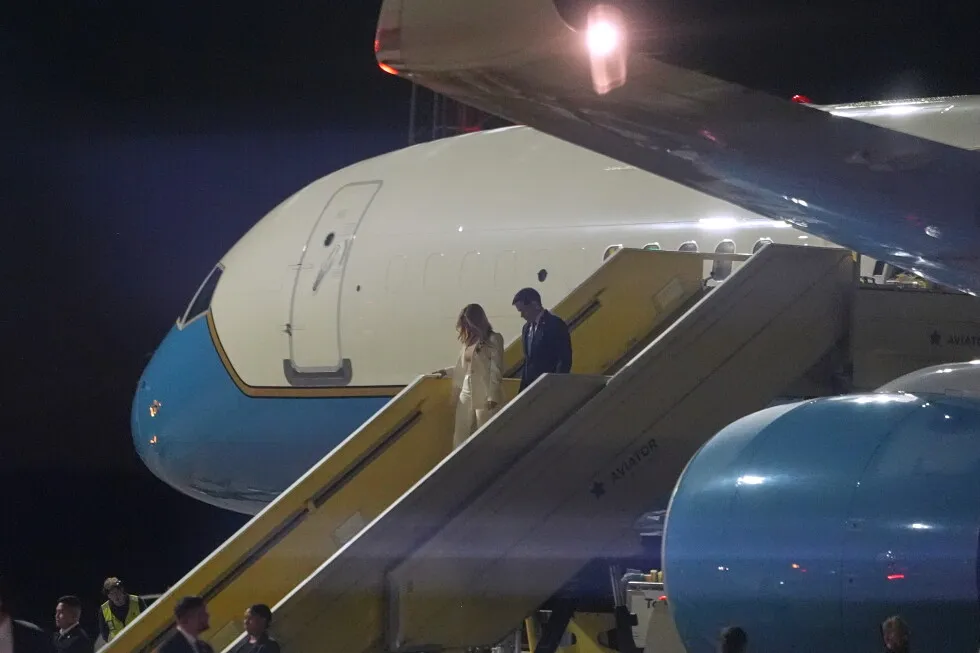
Rubio embarks on another mission to ease tensions with allies during NATO meeting 1 of 6 | Secretary of State Marco Rubio is on his latest mission to assuage nervous U.S. allies in Europe about the Trump administration’s intentions with NATO or at least put a friendlier face on whipsawing changes and uncertainty about American troop reductions. 2 of 6 | Secretary of State Marco Rubio arrives with his wife Jeanette at Malmo Airport, Friday, May 22, 2026, in Malmo-Sturup, Sweden, ahead of a NATO foreign ministers meeting. (AP Photo/Julia Demaree Nikhinson, Pool) 3 of 6 | Secretary of State Marco Rubio speaks to the press before boarding his plane at Homestead Air Reserve Base, Thursday, May 21, 2026. Rubio is traveling to a NATO foreign ministers meeting in Sweden. (AP Photo/Julia Demaree Nikhinson, Pool) 4 of 6 | Secretary of State Marco Rubio speaks to the press before boarding his plane at Homestead Air Reserve Base, Thursday, May 21, 2026. Rubio is traveling to a NATO foreign ministers meeting in Sweden. (AP Photo/Julia Demaree Nikhinson, Pool) 5 of 6 | Secretary of State Marco Rubio speaks to the press before boarding his plane at Homestead Air Reserve Base, Thursday, May 21, 2026. Rubio is traveling to a NATO foreign ministers meeting in Sweden. (AP Photo/Julia Demaree Nikhinson, Pool) 6 of 6 | Secretary of State Marco Rubio speaks to the press before boarding his plane at Homestead Air Reserve Base, Thursday, May 21, 2026. Rubio is traveling to a NATO foreign ministers meeting in Sweden. (AP Photo/Julia Demaree Nikhinson, Pool) 1 of 6 Secretary of State Marco Rubio is on his latest mission to assuage nervous U.S. allies in Europe about the Trump administration’s intentions with NATO or at least put a friendlier face on whipsawing changes and uncertainty about American troop reductions. Add AP News on Google Add AP News as your preferred source to see more of our stories on Google. Share 2 of 6 | Secretary of State Marco Rubio arrives with his wife Jeanette at Malmo Airport, Friday, May 22, 2026, in Malmo-Sturup, Sweden, ahead of a NATO foreign ministers meeting. (AP Photo/Julia Demaree Nikhinson, Pool) 2 of 6 Secretary of State Marco Rubio arrives with his wife Jeanette at Malmo Airport, Friday, May 22, 2026, in Malmo-Sturup, Sweden, ahead of a NATO foreign ministers meeting. (AP Photo/Julia Demaree Nikhinson, Pool) Add AP News on Google Add AP News as your preferred source to see more of our stories on Google. Share 3 of 6 | Secretary of State Marco Rubio speaks to the press before boarding his plane at Homestead Air Reserve Base, Thursday, May 21, 2026. Rubio is traveling to a NATO foreign ministers meeting in Sweden. (AP Photo/Julia Demaree Nikhinson, Pool) 3 of 6 Secretary of State Marco Rubio speaks to the press before boarding his plane at Homestead Air Reserve Base, Thursday, May 21, 2026. Rubio is traveling to a NATO foreign ministers meeting in Sweden. (AP Photo/Julia Demaree Nikhinson, Pool) Add AP News on Google Add AP News as your preferred source to see more of our stories on Google. Share 4 of 6 | Secretary of State Marco Rubio speaks to the press before boarding his plane at Homestead Air Reserve Base, Thursday, May 21, 2026. Rubio is traveling to a NATO foreign ministers meeting in Sweden. (AP Photo/Julia Demaree Nikhinson, Pool) 4 of 6 Secretary of State Marco Rubio speaks to the press before boarding his plane at Homestead Air Reserve Base, Thursday, May 21, 2026. Rubio is traveling to a NATO foreign ministers meeting in Sweden. (AP Photo/Julia Demaree Nikhinson, Pool) Add AP News on Google Add AP News as your preferred source to see more of our stories on Google. Share 5 of 6 | Secretary of State Marco Rubio speaks to the press before boarding his plane at Homestead Air Reserve Base, Thursday, May 21, 2026. Rubio is traveling to a NATO foreign ministers meeting in Sweden. (AP Photo/Julia Demaree Nikhinson, Pool) 5 of 6 Secretary of State Marco Rubio speaks to the press before boarding his plane at Homestead Air Reserve Base, Thursday, May 21, 2026. Rubio is traveling to a NATO foreign ministers meeting in Sweden. (AP Photo/Julia Demaree Nikhinson, Pool) Add AP News on Google Add AP News as your preferred source to see more of our stories on Google. Share 6 of 6 | Secretary of State Marco Rubio speaks to the press before boarding his plane at Homestead Air Reserve Base, Thursday, May 21, 2026. Rubio is traveling to a NATO foreign ministers meeting in Sweden. (AP Photo/Julia Demaree Nikhinson, Pool) 6 of 6 Secretary of State Marco Rubio speaks to the press before boarding his plane at Homestead Air Reserve Base, Thursday, May 21, 2026. Rubio is traveling to a NATO foreign ministers meeting in Sweden. (AP Photo/Julia Demaree Nikhinson, Pool) Add AP News on Google Add AP News as your preferred source to see more of our stories on Google. Share Updated [hour]:[minute] [AMPM] [timezone], [monthFull] [day], [year] WASHINGTON (AP) — Secretary of State Marco Rubio is on his latest mission to assuage nervous U.S. allies in Europe about the Trump administration’s intentions with NATO or at least put a friendlier face on whipsawing changes and uncertainty about American troop reductions.Rubio will attend a NATO foreign ministers’ meeting in Sweden on Friday — the same day senior Pentagon officials are expected to brief the 32-nation alliance on plans for the U.S. military’s commitment to European defense at the alliance’s headquarters in Brussels. The meeting of diplomats, which precedes a NATO leaders’ summit in Turkey in July, comes amid great uncertainty over how the war in Iran will play out and whether stalled U.S. efforts to broker an end to the Russia-Ukraine conflict will resume. Resentment also still simmers on the continent over President Donald Trump’s criticism of allies and his interest in taking over Greenland, a territory of NATO ally Denmark. Rubio has often been called on to offer a calmer, less antagonistic presence from the Trump administration at meetings like these. He has been dispatched on several such missions this year, including the Munich Security Conference in February and, more recently, to Italy, where he met with Italian officials and Pope Leo XIV after Trump criticized the American pontiff for his stances on crime and the Iran war. 2 MIN READ 3 MIN READ 2 MIN READ Lack of clarity about US troop drawdowns in EuropeOn his departure to the meeting in Helsingborg, Sweden, Rubio declined to discuss any further changes to the American military presence in Europe, including a possible reduction in the number of troops that the U.S. will commit under the NATO Force Model, which is a contingency plan for European defense in the event of serious security concerns. The Trump administration had decided to cancel the deployment of thousands of U.S. troops to Poland and Germany, but then the president posted on social media Thursday that “the United States will be sending an additional 5,000 Troops to Poland.” It was not clear whether that meant the brigade that had been stopped from going to Poland would be back on its way, whether additional troops beyond that rotational deployment could be added, or whether there would still be a drawdown of U.S. troops in Europe, but from a different country. The Pentagon referred requests for comment to the White House, which did not immediately respond to messages seeking clarity. Earlier, Rubio did repeat that Trump and others in the administration, including him, are “very disappointed” in NATO, especially in its response to the Iran war.“I don’t think anyone is shocked to know that the United States, and the president in particular, is very disappointed at NATO right now,” he told reporters in Miami before boarding his plane. Rubio reiterates criticism of NATO over the Iran warRubio said he was a “strong supporter” of the transatlantic military alliance and called it important. But he reiterated complaints that some NATO allies, notably Spain, had refused to allow access to U.S. bases for the Iran conflict and others had been reluctant, if not resistant, to join a coalition to reopen and protect the Strait of Hormuz, a crucial oil shipping route that Iran largely has closed.“I know why NATO is good for Europe, but why is NATO good for America?” Rubio asked rhetorically, answering his own question by referring to bases that allow the U.S. and others to project power globally. “So, when that is the key rationale for why you’re in NATO, and then you have countries like Spain denying us the use of these bases, well, then, why are you in NATO?” Rubio noted that nearly all NATO allies agree that Iran should not be allowed to develop nuclear weapons, but few, if any, stepped up when Trump said he would take action to prevent it.“He’s not asking them to commit troops. He’s not asking them to send their fighter jets in. But they refuse to do anything, and so I think the president looks at that and says, ‘Hold on a second,’” Rubio said. “I think we were very upset about that. The president has made that very clear.”NATO officials have downplayed the changes to U.S. troop levels in Europe, saying they have been long planned and do not come as a surprise. Yet the announcements have blindsided some allies and came despite U.S. promises to coordinate military moves to avoid creating security gaps. Similarly, Trump’s apparent change on Poland came as another surprise.NATO Secretary-General Mark Rutte said Wednesday that U.S. allies have known for a year that the Trump administration would be withdrawing some troops from Europe, and it expects “rightly, for Europe and Canada to take a bigger responsibility for the conventional defense of NATO and particularly, of course, the European part of NATO.”Rutte said the U.S. “will stay involved” but over time could pivot resources elsewhere in the world. U.S. Gen. Alexus Grynkewich, commander of both American and NATO forces in Europe, said this week that security in Europe would not be compromised but warned that allies should expect more drawdowns in the coming years. The Trump administration has warned that Europe would have to look after its own security, including Ukraine’s, in the future.___Associated Press writer Lorne Cook in Brussels contributed to this report.
SRCAssociated Press (AP)
LANGEN
LEANCenter
WORDS1 724
ENT11
FRI · 2026-05-22 · 07:23 GMTBRIEF NSR-2026-0522-78337
NSR-2026-0522-78337News Report·EN·Diplomatic
Rubio embarks on another mission to ease tensions with allies during NATO meeting
Secretary of State Marco Rubio is attending a NATO foreign ministers' meeting in Sweden to address European allies' concerns regarding the Trump administration's intentions with the alliance and uncertainty surrounding U.S. troop reductions.
By
MATTHEW LEEAssociated Press (AP)Filed 2026-05-22 · 07:23 GMTLean · CenterRead · 7 min
Associated Press (AP)FIG 01
Reading time
7min
Word count
1 724words
Sources cited
0cited
Entities identified
11entities
Quality score
100%
§ 01
Briefing Summary
AI-generatedNEWSAR · AI
Secretary of State Marco Rubio is attending a NATO foreign ministers' meeting in Sweden to address European allies' concerns regarding the Trump administration's intentions with the alliance and uncertainty surrounding U.S. troop reductions. This mission comes amid ongoing global conflicts and lingering resentment over President Trump's past criticisms of NATO members. Rubio has been tasked with presenting a more conciliatory stance from the administration, having undertaken similar diplomatic efforts previously. The meeting precedes a NATO leaders' summit and occurs as Pentagon officials brief the alliance on U.S. military commitments to European defense. Rubio reiterated U.S. disappointment with some allies' responses to the Iran war and their reluctance to support efforts to protect the Strait of Hormuz.
Confidence 0.90Claims 4Entities 11
§ 02
Article analysis
Model · rule-basedFraming
Diplomatic
Political Strategy
Tone
Measured
AI-assessed
CalmNeutralAlarmist
Factuality
0.70 / 1.00
Factual
LowHigh
Sources cited
0
No named sources
FewMany
§ 03
Key claims
4 extracted01
Secretary of State Marco Rubio arrives with his wife Jeanette at Malmo Airport.
factual
Confidence
1.00
02
Rubio is traveling to a NATO foreign ministers meeting in Sweden.
factual
Confidence
1.00
03
Secretary of State Marco Rubio is on a mission to ease tensions with U.S. allies in Europe regarding the Trump administration’s intentions with NATO.
factual
Confidence
0.90
04
The mission aims to address uncertainty about American troop reductions.
factual
Confidence
0.80
§ 04
Full report
7 min read · 1 724 words§ 05
Entities
11 identifiedKey playerOppositionContextPositiveNeutralNegative
People3
§ 06
Keywords & salience
8 termsnato meeting
1.00
us allies
0.90
trump administration
0.80
troop reductions
0.70
european allies
0.60
diplomatic mission
0.50
foreign ministers
0.50
political uncertainty
0.40
§ 07
Topic connections
Interactive graph Network visualization showing 51 related topics
View Full Graph Person Organization Location Event|Click node to navigate|Edge numbers = shared articles