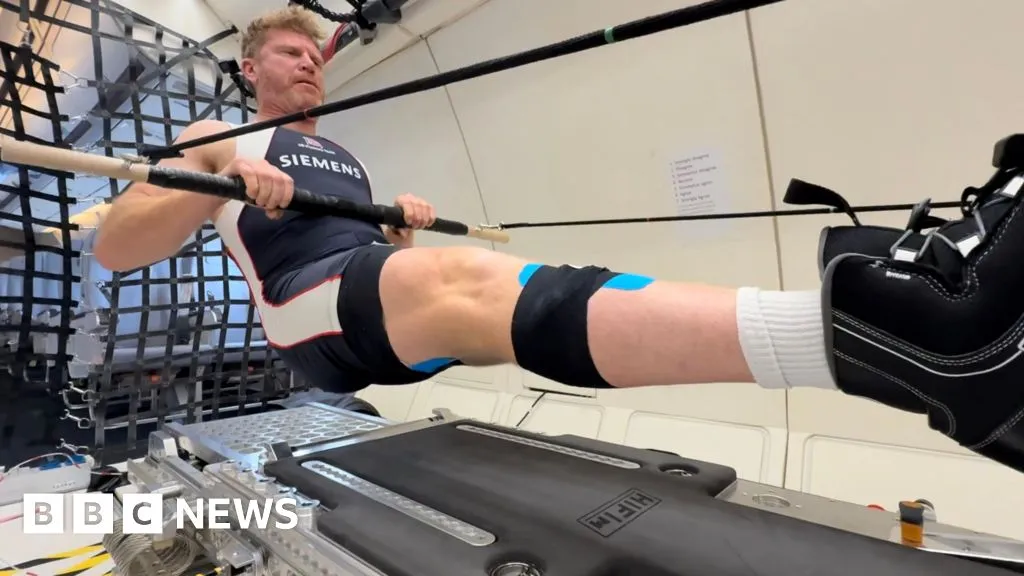
The European Space Agency (Esa), NASA, the Canadian Space Agency and the UK Space Agency have all played some part in the equipment's development and testing, including Esa providing the parabolic flight tests.This is where a plane climbs and nose dives to create weightless conditions like in space, giving the researchers 22 seconds to gather data before the maneuver is repeated to build up their analysis.ESA/NASAAstronauts have to work out for at least two hours a day on the International Space Station to maintain fitnessCalled HIFIm (High-Frequency Impulse for Microgravity), the kit has already been through a round of testing for other exercises, such as its "jumping" setup. The idea for the device came out of a competition between three different consortia around Europe to come up with an exercise device for the Gateway Space Station, an orbital space station for the Moon, explains Dr Meganne Christian – a reserve astronaut for the European Space Agency and Senior Exploration Manager at the UK Space Agency.Although Gateway has effectively been sidelined by NASA, Christian says we are at a "really exciting moment in space exploration" where these devices can be used for new space stations and "the lunar surface" with Artemis missions going back to the moon "this time to stay".ESA/NovespaceDr Meganne Christian is a reserve astronaut for ESA who also helped test the equipment on the parabolic flightThe British invention is not the only piece of equipment in development and testing. "In space we don't experience any forces, our muscles, our bones immediately start to diminish because we're not being loaded by those forces," says Dr Dan Cleather, professor of strength and conditioning at St Mary's University who is on the team developing the British equipment, HIFIm.He designed the technology that allows it to monitor how effectively the user is exercising.If astronauts do not do exercise, they also lose coordination and cardiovascular fitness, they become less able to carry out the functional tasks that they're required to do.But there are challenges with exercising in space too, from the weight of current exercise equipment to the limited range of exercises you can do and the time it currently takes astronauts to keep fit.BBC/Tony JolliffeSFX engineers who have worked on Star Wars, Mission Impossible and James Bond, winning an Oscar for 1917, have worked on making HIFIm. "On the International Space Station, for example, astronauts spend about two hours of every day doing exercise… that all adds up, it takes time," Christian explains.For her, if you can reduce the amount of time you're exercising, it frees up more time for astronauts to do science and experiments "which could cause a whole range of breakthroughs."The team behind HIFIm believe their device can reduce this exercise time down to 1/2 hour a day.
SRCBBC News - World
LANGEN
LEANCenter
WORDS459
ENT11
FRI · 2026-05-22 · 23:42 GMTBRIEF NSR-2026-0523-78569
NSR-2026-0523-78569News Report·EN·Technology
The space race to create gym equipment for future astronauts
Scientists from the European Space Agency (ESA), NASA, the Canadian Space Agency, and the UK Space Agency are developing new exercise equipment for future space missions. This equipment, including a British invention called HIFIm, aims to address the challenges of maintaining astronaut fitness in microgravity, such as muscle and bone loss, and coordination decline.
BBC News - WorldFiled 2026-05-22 · 23:42 GMTLean · CenterRead · 2 min
BBC News - WorldFIG 01
Reading time
2min
Word count
459words
Sources cited
3cited
Entities identified
11entities
Quality score
100%
§ 01
Briefing Summary
AI-generatedNEWSAR · AI
Scientists from the European Space Agency (ESA), NASA, the Canadian Space Agency, and the UK Space Agency are developing new exercise equipment for future space missions. This equipment, including a British invention called HIFIm, aims to address the challenges of maintaining astronaut fitness in microgravity, such as muscle and bone loss, and coordination decline. HIFIm utilizes high-frequency impulses and has undergone testing in parabolic flights to simulate weightless conditions. The goal is to significantly reduce the daily exercise time required for astronauts, from the current two hours on the International Space Station to potentially 30 minutes, freeing up more time for scientific research. This technology is intended for use on new space stations and lunar missions.
Confidence 0.90Sources 3Claims 5Entities 11
§ 02
Article analysis
Model · rule-basedFraming
Technology
Human Interest
Tone
Measured
AI-assessed
CalmNeutralAlarmist
Factuality
0.70 / 1.00
Factual
LowHigh
Sources cited
3
Well sourced
FewMany
§ 03
Key claims
5 extracted01
SFX engineers who worked on Star Wars, Mission Impossible, and James Bond have contributed to the development of HIFIm.
factualarticle
Confidence
1.00
02
In space, astronauts' muscles and bones diminish due to lack of physical loading.
factualDr Dan Cleather
Confidence
1.00
03
Astronauts must exercise for at least two hours daily on the International Space Station to maintain fitness.
statisticarticle
Confidence
1.00
04
The European Space Agency, Nasa, the Canadian Space Agency, and the UK Space Agency have contributed to the development and testing of new gym equipment for astronauts.
factualarticle
Confidence
1.00
05
The new device, HIFIm, aims to reduce daily exercise time for astronauts to 30 minutes.
predictionarticle
Confidence
0.80
§ 04
Full report
2 min read · 459 words§ 05
Entities
11 identifiedKey playerOppositionContextPositiveNeutralNegative
Organizations5
Locations2
Topics1
§ 06
Keywords & salience
10 termsastronaut fitness
1.00
space exploration
1.00
microgravity exercise
0.90
hifim
0.80
space station equipment
0.70
nasa
0.60
european space agency
0.60
artemis missions
0.50
lunar surface
0.40
bone density loss
0.40
§ 07
Topic connections
Interactive graph Network visualization showing 5 related topics
View Full Graph Person Organization Location Event|Click node to navigate|Edge numbers = shared articles