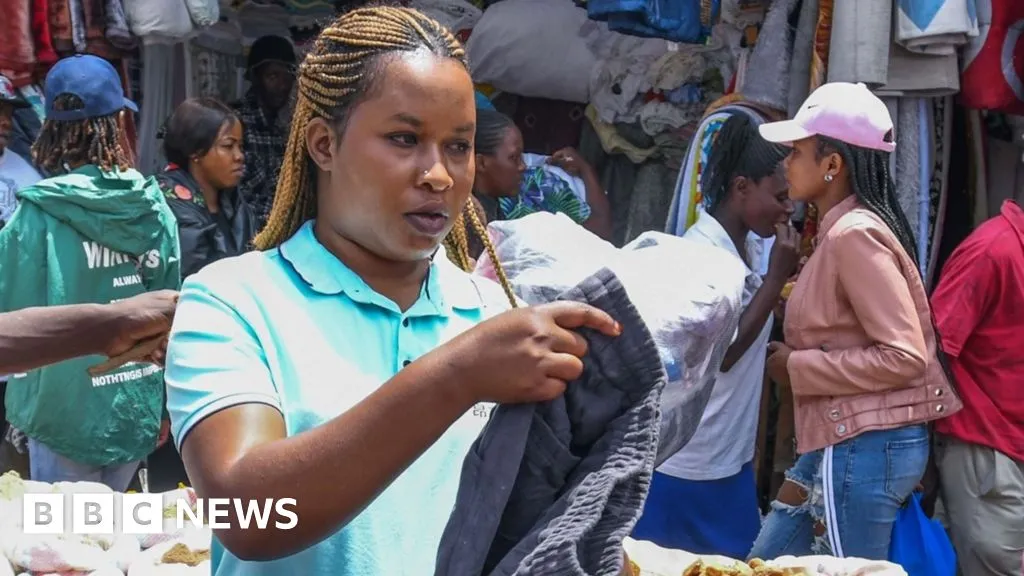
Not even heavy rain can keep shoppers away from Gikomba, a lively Kenyan market that stands as the largest open-air trading hub in East Africa.Sections of the site were waterlogged on the day the BBC visited, yet shoppers, some wearing rubber boots, still inched their way through the congested pathways, hunting for Gikomba's speciality - second-hand clothing.The trade in garments imported from the US, Europe and China poses a perennial problem for the East African Community (EAC), a regional bloc of which Kenya is a member. How can the region build a thriving fashion industry when it is saturated with cheap cast-offs?"We're competing with second-hand clothing, but we can't compete on price," Zia Bett, founder of Kenyan womenswear brand Zia Africa, tells the BBC.Elizabeth Paul, who owns Kuya Creations in Tanzania's main city of Dar es Salaam, agrees: "In my shop, the minimum price of a dress is 50,000 Tanzanian shillings (£14.50; $19.20). People tell me: 'For 50,000 I can get 10 second-hand dresses, so let me buy those.'"A decade ago, the EAC decried the influx of second-hand clothing and was primed to impose a ban across its member states. After some strong-arming from the US, the proposal fell apart but now the debate has resurfaced.Uganda, a country whose president once criticised second-hand clothing as coming from white "dead people", has introduced an additional 30% tax on imports in an effort to boost the local garment industry and protect the environment.Days later, the treasury in neighbouring Kenya attempted to change the way it taxed used clothing, saying its proposed system would simplify things for importers. But following a backlash from Kenyans worried that this would lead to price rises, the proposal was swiftly dropped from the Finance Bill.
SRCBBC News - World
LANGEN
LEANCenter
WORDS288
ENT12
SAT · 2026-05-23 · 23:55 GMTBRIEF NSR-2026-0524-78748
NSR-2026-0524-78748News Report·EN·Economic Impact
East Africa wants to curb imports of used clothes. But it's not easy
East African countries, including Kenya, Uganda, and Tanzania, are struggling to develop their local fashion industries due to the significant import of used clothing from Western countries and China. Markets like Gikomba in Kenya are major hubs for this trade, where cheap second-hand garments undercut local designers.
BBC News - WorldFiled 2026-05-23 · 23:55 GMTLean · CenterRead · 2 min
BBC News - WorldFIG 01
Reading time
2min
Word count
288words
Sources cited
2cited
Entities identified
12entities
Quality score
100%
§ 01
Briefing Summary
AI-generatedNEWSAR · AI
East African countries, including Kenya, Uganda, and Tanzania, are struggling to develop their local fashion industries due to the significant import of used clothing from Western countries and China. Markets like Gikomba in Kenya are major hubs for this trade, where cheap second-hand garments undercut local designers. A decade ago, the East African Community (EAC) attempted to ban these imports but faced opposition. Recently, Uganda introduced a 30% tax on used clothing imports to support its domestic industry and environmental goals. Kenya also proposed changes to its taxation of used clothing, but this was quickly withdrawn after public backlash over potential price increases. The core issue is the difficulty for local businesses to compete on price with the influx of affordable used garments.
Confidence 0.90Sources 2Claims 5Entities 12
§ 02
Article analysis
Model · rule-basedFraming
Economic Impact
Human Interest
Tone
Measured
AI-assessed
CalmNeutralAlarmist
Factuality
0.70 / 1.00
Factual
LowHigh
Sources cited
2
Limited
FewMany
§ 03
Key claims
5 extracted01
Local fashion designers in East Africa struggle to compete on price with cheap second-hand clothing imports.
quoteZia Bett, founder of Zia Africa; Elizabeth Paul, owner of Kuya Creations
Confidence
1.00
02
Kenya's treasury dropped a proposed tax change on used clothing after public backlash over potential price increases.
factual
Confidence
0.90
03
Uganda has introduced a 30% tax on used clothing imports to boost its local garment industry and protect the environment.
factual
Confidence
0.90
04
The trade in second-hand clothing from the US, Europe, and China poses a problem for the East African Community's fashion industry.
factual
Confidence
0.90
05
The East African Community previously attempted to ban second-hand clothing imports a decade ago but failed due to US pressure.
factual
Confidence
0.80
§ 04
Full report
2 min read · 288 words§ 05
Entities
12 identifiedKey playerOppositionContextPositiveNeutralNegative
Organizations3
§ 06
Keywords & salience
8 termsused clothes imports
1.00
east african community
0.90
local fashion industry
0.80
trade policy
0.70
economic impact
0.60
taxation
0.50
import ban
0.50
market competition
0.40
§ 07
Topic connections
Interactive graph Network visualization showing 51 related topics
View Full Graph Person Organization Location Event|Click node to navigate|Edge numbers = shared articles