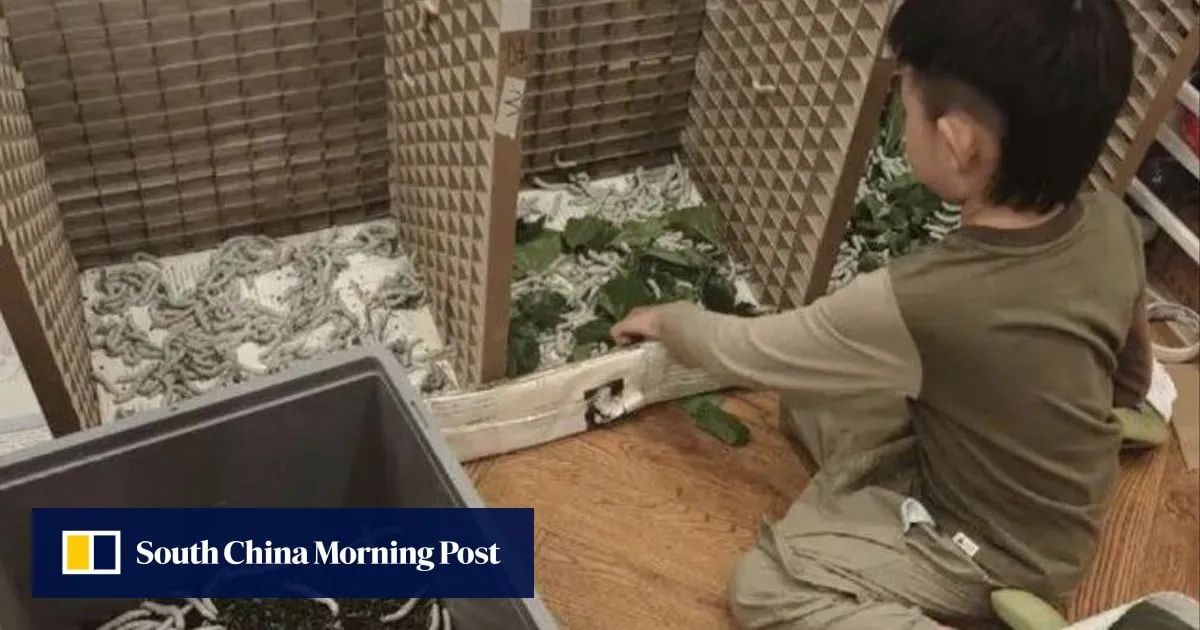
A boy in central China dreamed of making his own silk-quilt" class="entity-link entity-topic" data-entity-id="132963" data-entity-type="topic">silk quilt, prompting his parents to buy 10,000 silkworm eggs to nurture his curiosity.In May, a mother surnamed Ruan from Wuhan, Hubei province, revealed online that her family was raising silkworms to help realise her six-year-old son’s unusual dream.Ruan told the mainland outlet Chengshi Interactive that the idea came during the silkworm-rearing season. The optimal window generally runs from May to October.The family, who raise silkworms every year and even made a silk fan in 2024, decided to support the boy’s plan.The boy’s mother, above, collects mulberry leaves to feed the silkworms. Photo: BaiduHis father bought 10,000 silkworm eggs online. Combined with eggs saved from the previous year, the family eventually hatched about 12,000 larvae.On one major mainland e-commerce platform, 10,000 silkworm eggs sell for just 30 yuan (US$4), with an incubation box, mulberry leaves and a rearing guide included.With limited space at home, Ruan kept the silkworms in the living room, where she and her husband built a multi-tiered rack from cardboard boxes and steel pipes.The mulberry leaves, above, had to be cleaned and dried before they could be used for feeding the silkworms. Photo: BaiduThe makeshift “silkworm house” rose to about 1.2 metres.Ruan’s biggest daily challenge, she told mainland media, was finding enough mulberry leaves to feed them.After dropping her son at school each morning, she would search parks and lakesides for leaves. At peak demand, the silkworms consumed up to 20kg a day.The work was painstaking. The leaves had to be dry before feeding, meaning each one had to be wiped clean.Further ReadingRuan said much of her day was spent cleaning, feeding and caring for the insects.The boy and his father working together to build a makeshift silkworm “house”. Photo: BaiduSilkworms typically take 20 to 28 days to grow from hatchlings to cocoon-spinning larvae, depending on temperature and rearing conditions.By May 18, the silkworms had spun more than 5,000 cocoons.After school, the boy’s first task was to feed them, clear away their droppings and count the growing pile of cocoons.Ruan said a single cocoon can yield 800 to 1,500 metres of silk, enough to circle a school playground several times.About 2,200 cocoons can make a baby quilt, while 12,000 could potentially produce a full-sized one, she added.A lightweight summer silk-quilt" class="entity-link entity-topic" data-entity-id="132963" data-entity-type="topic">silk quilt typically requires about 0.5kg to 1kg of filling.The boy’s father reportedly self-studied the quilt-making process and is guiding his son through it.Fresh cocoons are usually boiled to remove the pupae and sericin before the silk is machine-processed, but the family hopes to stretch the fibres by hand at home to make the experience more memorable.The silk cocoons rest on the home-made frame, above, that the father and son made together. Photo: BaiduRuan said her son tends to the silkworms every day with shining eyes, and that the responsibility and joy of caring for living creatures is more valuable than any toy.“I hope he has the courage to explore, even if he fails,” she told the media.silk quilts have a long history in China, with records of their use in imperial courts dating back to the Tang dynasty (618–907).By 2025, China’s domestic silk-quilt" class="entity-link entity-topic" data-entity-id="132963" data-entity-type="topic">silk quilt market was worth more than 28 billion yuan (US$4 billion)..
SRCSouth China Morning Post
LANGEN
LEANCenter-Right
WORDS537
ENT10
SUN · 2026-05-24 · 01:00 GMTBRIEF NSR-2026-0524-78750
NSR-2026-0524-78750News Report·EN·Human Interest
China boy wants to raise silkworms to create silk quilt, prompting parents to buy 10,000 seeds
A six-year-old boy in Wuhan, China, inspired by the silkworm-rearing season, expressed a desire to create his own silk quilt. To support his curiosity, his parents purchased 10,000 silkworm eggs, adding to previously saved ones, resulting in approximately 12,000 larvae.
Zoey ZhangSouth China Morning PostFiled 2026-05-24 · 01:00 GMTLean · Center-RightRead · 3 min
South China Morning PostFIG 01
Reading time
3min
Word count
537words
Sources cited
1cited
Entities identified
10entities
Quality score
100%
§ 01
Briefing Summary
AI-generatedNEWSAR · AI
A six-year-old boy in Wuhan, China, inspired by the silkworm-rearing season, expressed a desire to create his own silk quilt. To support his curiosity, his parents purchased 10,000 silkworm eggs, adding to previously saved ones, resulting in approximately 12,000 larvae. The family constructed a multi-tiered rearing space in their living room and dedicated significant effort to collecting and cleaning mulberry leaves for feeding, with the silkworms consuming up to 20kg daily at peak times. The boy actively participates in caring for the silkworms, and his father is reportedly learning the quilt-making process to guide him. The family aims to hand-stretch the silk fibers from the over 5,000 cocoons spun to date for a more memorable experience.
Confidence 0.90Sources 1Claims 5Entities 10
§ 02
Article analysis
Model · rule-basedFraming
Human Interest
Tone
Measured
AI-assessed
CalmNeutralAlarmist
Factuality
0.70 / 1.00
Factual
LowHigh
Sources cited
1
Limited
FewMany
§ 03
Key claims
5 extracted01
The family built a multi-tiered rack from cardboard boxes and steel pipes to house the silkworms.
factual
Confidence
1.00
02
A boy in central China dreamed of making his own silk quilt.
quotemother surnamed Ruan
Confidence
1.00
03
By May 18, the silkworms had spun more than 5,000 cocoons.
statistic
Confidence
0.90
04
At peak demand, the silkworms consumed up to 20kg of mulberry leaves per day.
statisticmother surnamed Ruan
Confidence
0.90
05
The family purchased 10,000 silkworm eggs online, costing 30 yuan (US$4) on a major mainland e-commerce platform.
statistic
Confidence
0.90
§ 04
Full report
3 min read · 537 words§ 05
Entities
10 identifiedKey playerOppositionContextPositiveNeutralNegative
Locations4
§ 06
Keywords & salience
8 termssilkworm rearing
1.00
silk quilt
0.90
mulberry leaves
0.80
sericulture
0.70
children's dreams
0.60
home-based project
0.50
wuhan
0.40
insect farming
0.40
§ 07
Topic connections
Interactive graph Network visualization showing 51 related topics
View Full Graph Person Organization Location Event|Click node to navigate|Edge numbers = shared articles