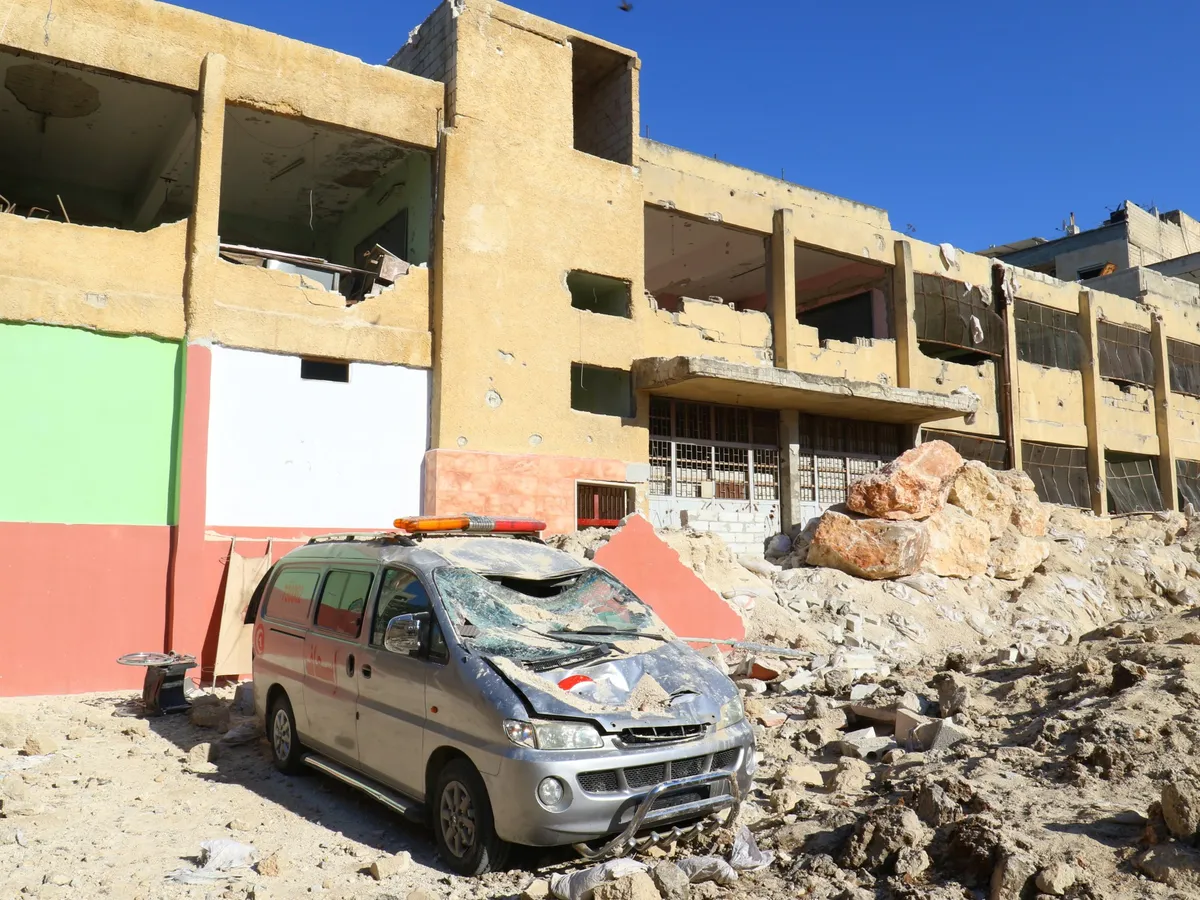
Many Syrian returnees cannot access proper healthcare. Urgent action is required for Syria’s health system to recover.Published On 24 May 2026A damaged ambulance and hospital at a site hit by an air raid, in Kafr Takharim, northwest of Idlib city, Syria, on April 25, 2017 [Ammar Abdullah/Reuters]Last week, European Union and Syrian officials met in Brussels for high-level talks on the country’s reconstruction. The EU’s support for Syria’s health system, including 14 million euros ($16.25m) to rehabilitate Ar-Rastan Hospital in Homs, is a significant contribution that merits recognition.While the EU is demonstrating what strategic investment can achieve, the gap between the conditions returnees face and what they need for a healthy life remains a major barrier for the country’s recovery. After 14 years of conflict, Syria is facing a public health crisis that no government can address on its own.The restoration of health services will instead require large-scale, coordinated action from across the international community.A recent report authored by my organisation, Relief International, details the crisis at hand: many of the 3.7 million Syrians who have returned home are encountering a health system left fractured and struggling after years of devastation. According to our findings, 78 percent of returnees in Deir Az Zor reported that healthcare was unavailable. In al-Tebni district, 41 percent of surveyed households said at least one family member had been unable to access emergency care in the previous six months. From shortages of staff and equipment to long wait times, communities are facing obstacles to care with life-or-death consequences.Across the 50 healthcare facilities Relief International supports, our teams are seeing the consequences every day. Children arriving with acute malnutrition that should have been identified months earlier and adults with chronic conditions such as diabetes and hypertension are going without medication. Pregnant women and their babies are being put at risk without critical antenatal support and skilled obstetric care during birth.We also hear from people who have stopped seeking care altogether; they no longer trust that quality services exist, are worth the journey, or can be relied on. For many, whatever care is available is simply unaffordable.Families like Aref’s in al-Tebni are still waiting for healthcare to be restored. When Aref went back to his hometown months ago, he found the local health centre closed: its gates locked, its staff long gone, and its pharmacy empty of the asthma medication he needed. For a family that had already endured years of insecurity, it was especially painful to find that while home remained, healthcare did not.Relief International teams also see the hidden wounds this war has left across Syrian society. Our report found that 86 percent of women surveyed were experiencing anxiety and psychological distress, driven by exposure to conflict and the uncertainty of displacement. Anxiety, grief, and trauma are widespread, yet mental health and psychosocial support remain severely underfunded and understaffed.These challenges affect every aspect of Syria’s recovery. How can Syria know peace when its people have no peace of mind?The scale of disability following the war is equally staggering and raises concerns about the quality of life that is possible upon return. An estimated 28 percent of Syrians – nearly double the global average – now live with some form of disability, a figure that continues to rise amid widespread landmine and unexploded ordnance contamination, yet rehabilitation services are among the most severely under-resourced in the country.Rebuilding Syria’s health system is, at its core, about restoring the conditions for life itself. This requires confronting both the visible and the less visible scars of the war.This means investing in primary healthcare as the backbone of any recovery: the clinics, doctors, midwives and community health workers, and the supply chains that allow people to be seen, diagnosed and treated close to home.It means reinforcing mental health and psychosocial support as a critical component of primary care across the country. Equally, it means targeted, specialised services for those who cannot afford to fall further behind, including women and girls, children suffering from malnutrition, people living with chronic disease, and those with disabilities.Meanwhile, we must continue to support refugees who remain displaced. With health services in host countries declining rapidly due to aid cuts, Syrians face barriers to critical care whichever way they turn. We must sustain required services and uphold the principles of safety, dignity, and choice upon their return.Restoring access to quality, equitable healthcare in Syria begins with centring health and wellbeing in the country’s recovery. It requires whole-of-government cooperation and sustained support from the international community, reinforced by multiyear investments and technical assistance.Last week’s meeting in Brussels signalled an important step change in international cooperation. Now other governments, donors and capable actors must consider whether their support matches the scale of what Syria needs for sustainable recovery and a healthy, prosperous future.The views expressed in this article are the author’s own and do not necessarily reflect Al Jazeera’s editorial stance.
SRCAl Jazeera
LANGEN
LEANCenter
WORDS813
ENT12
SUN · 2026-05-24 · 13:53 GMTBRIEF NSR-2026-0524-78831
NSR-2026-0524-78831News Report·EN·Public Health
Syria cannot heal without a rebuilt health system
Syria's health system is severely fractured, preventing many of the 3.7 million returnees from accessing essential healthcare. A report by Relief International highlights that in Deir Az Zor, 78% of returnees reported unavailable healthcare, and in al-Tebni, 41% of households couldn't access emergency care.
Valerie DocherAl JazeeraFiled 2026-05-24 · 13:53 GMTLean · CenterRead · 4 min
Al JazeeraFIG 01
Reading time
4min
Word count
813words
Sources cited
1cited
Entities identified
12entities
Quality score
100%
§ 01
Briefing Summary
AI-generatedNEWSAR · AI
Syria's health system is severely fractured, preventing many of the 3.7 million returnees from accessing essential healthcare. A report by Relief International highlights that in Deir Az Zor, 78% of returnees reported unavailable healthcare, and in al-Tebni, 41% of households couldn't access emergency care. This crisis, exacerbated by a lack of staff, equipment, and affordability, leads to untreated malnutrition, chronic conditions, and risks for pregnant women. Mental health and psychosocial support are also critically underfunded, despite widespread anxiety and trauma. Rebuilding Syria's health system requires large-scale, coordinated international action, focusing on primary healthcare, mental health services, and specialized care for vulnerable populations, to restore the conditions for life and well-being.
Confidence 0.90Sources 1Claims 5Entities 12
§ 02
Article analysis
Model · rule-basedFraming
Public Health
Human Interest
Tone
Measured
AI-assessed
CalmNeutralAlarmist
Factuality
0.70 / 1.00
Factual
LowHigh
Sources cited
1
Limited
FewMany
§ 03
Key claims
5 extracted01
86 percent of women surveyed were experiencing anxiety and psychological distress.
statisticRelief International
Confidence
0.95
02
In al-Tebni district, 41 percent of surveyed households said at least one family member had been unable to access emergency care in the previous six months.
statisticRelief International
Confidence
0.95
03
78 percent of returnees in Deir Az Zor reported that healthcare was unavailable.
statisticRelief International
Confidence
0.95
04
The EU has contributed 14 million euros to rehabilitate Ar-Rastan Hospital in Homs.
factualarticle
Confidence
0.90
05
Many Syrian returnees cannot access proper healthcare due to a fractured health system.
factualRelief International
Confidence
0.90
§ 04
Full report
4 min read · 813 words§ 05
Entities
12 identifiedKey playerOppositionContextPositiveNeutralNegative
Organizations3
Locations7
§ 06
Keywords & salience
9 termssyrian health system
1.00
healthcare access
0.90
public health crisis
0.80
reconstruction
0.70
returnees
0.70
international community
0.60
health services
0.50
european union
0.40
malnutrition
0.40
§ 07
Topic connections
Interactive graph Network visualization showing 51 related topics
View Full Graph Person Organization Location Event|Click node to navigate|Edge numbers = shared articles