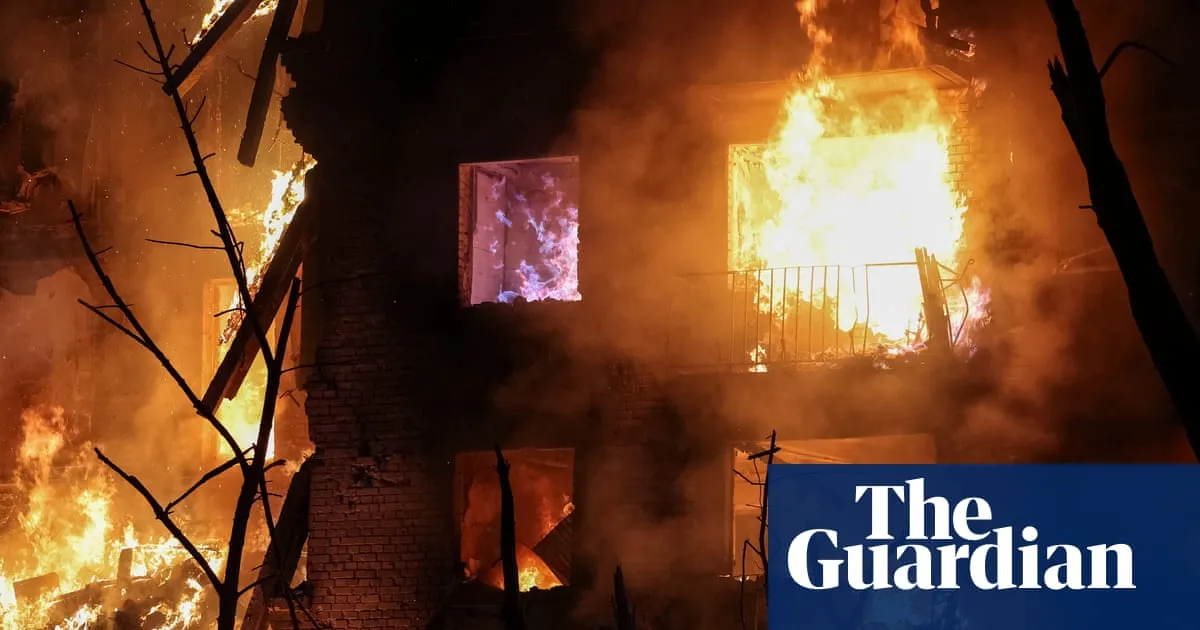
Russia used its powerful hypersonic Oreshnik ballistic missile for a third time in Ukraine as part of a massive attack on Kyiv and its surrounding region that killed at least four people and injured dozens.Russia hit the city of Bila Tserkva in the Kyiv-region" class="entity-link entity-location" data-entity-id="2540" data-entity-type="location">Kyiv region with the missile, Ukraine’s president, Volodymyr Zelenskyy, said. He described a Russian assault that hit a water supply facility, burned down a market, damaged dozens of residential buildings and several schools, as well as the Oreshnik missile strike.“They are genuinely deranged,” Zelenskyy said on Telegram.Adding further details on Sunday, Zelenskyy wrote on X that at least 83 people had been confirmed injured since midnight with some fatalities as a result of the Russian attack, which he said had hit Kyiv the hardest.A Ukrainian rescuer at the site of a Russian strike on a shopping centre in Kyiv. Photograph: Sergey Dolzhenko/EPARussia’s defence ministry confirmed the use of the Oreshnik, which is capable of carrying nuclear or conventional warheads, making it the third time the weapon has been used in the conflict.Quoted by local news agencies, the Russian defence ministry said it had carried out successful attacks on Ukrainian military command facilities, airbases and other military enterprises, using Oreshnik, Iskander, Kinzhal and Zircon missiles.It said the attack was retaliation for Ukrainian strikes on “civilian facilities on Russian territory”. Zelenskyy described a “heavy attack” targeting Kyiv that involved 600 drones and 90 missiles of various kinds, 36 of which were ballistic ones. “Unfortunately, not all of the ballistic missiles were intercepted – the largest number of hits was in Kyiv. Kyiv was the primary target of this Russian attack,” he wrote on X.“It is important that this does not pass without consequences for Russia.”Vitali Klitschko, Kyiv’s mayor, said two people had been killed in the capital and 56 wounded, while the head of the surrounding Kyiv-region" class="entity-link entity-location" data-entity-id="2540" data-entity-type="location">Kyiv region said two people had also been killed there, and nine wounded, based on preliminary estimates.Klitschko said damage had been recorded in every district of Kyiv, adding that an attack on a school had started a fire and another on a business centre led to people being trapped in a shelter.Svitlana Onofryichuk, a Kyiv resident who had worked for 22 years in the market that was hit, told the Associated Press: “It was a terrible night and there has never been anything like it in the entire war.“I am very sorry that I have to say goodbye to Kyiv now, I am not staying there any more, there is no possibility,” she added. “My job is gone, everything is gone, everything has burned down.”Yevhen Zosin, 74, who witnessed the attack in Kyiv, told AP when he heard the explosion he’d rushed to grab his dog. “Then there was another explosion and she and I were thrown back like a pin by the shock wave. We both survived, she and I. My apartment was blown to pieces,” he said.Ukraine’s National Art Museum, housing one of the country’s largest and most important collections, was also damaged in the blast, the culture ministry said, posting images of damaged ceilings, broken windows, shattered glass and debris scattered across floors and staircases.Firefighters extinguish a fire in an apartment building partially destroyed by a Russian strike in Kyiv. Photograph: Global Images Ukraine/GettyStaff and services were inspecting the building to assess the extent of the damage. The Kyiv Independent reported that the collection was not damaged.“Russia is systematically attacking civilian infrastructure and cultural institutions. Each such strike is an attempt to intimidate and destroy our identity,” Tetyana Berezhna, Ukraine’s minister of culture, wrote on Instagram.Ukraine’s foreign ministry was damaged for the first time since the second world war, Andrii Sybiha, the foreign minister, said. The historic building with “unique architectural heritage” had been lightly damaged as a result of nearby explosions, he said. Russian strikes had “targeted a historic area”, Sybiha added. “Yet another proof we are dealing with hordes of barbarians, not the heirs of civilisation.”Putin has long claimed that Ukraine is part of Russia’s historic lands, to buttress his justification for the illegal invasion.Ukraine’s government headquarters were also damaged, with windows blown out, but no one injured, said Yulia Svyrydenko, the prime minister.Remains of a Russian cruise missile at a football field near a school, which was hit during a Russian missile and drone strike in Kyiv. Photograph: Alina Smutko/ReutersThe intense barrage on Kyiv came after Putin vowed revenge on Ukraine, having accused its forces of a deadly drone attack on a student dormitory in Luhansk, a Russian-controlled region in eastern Ukraine.Ukraine denied the Russian accusations and said it had struck an elite drone command unit in the area. The Russian government said the attack in Starobilsk had killed 21 people and wounded 42 others, and Putin said he had ordered his military to prepare options to retaliate.At a UN security council emergency meeting called by Russia, Ukraine’s ambassador rejected Russia’s accusations of war crimes, calling them a “pure propaganda show”.Emmanuel Macron, the French president, condemned the attacks, including the use of the Oreshnik missile, which he said signalled “the dead end of Russia’s war of aggression”.Responding to the latest strikes on Ukraine, Kaja Kallas, the EU’s foreign policy chief, said: “Russia hit a dead end on the battlefield, so it terrorises Ukraine with deliberate strikes on city centres. These are abhorrent acts of terror meant to kill as many civilians as possible.”A resident in Kyiv tries to put out the fire in his apartment after a Russian air attack. Photograph: Efrem Lukatsky/APShe described the reported use of the Oreshnik as a “political scare tactic and reckless nuclear brinkmanship”, adding that next week EU foreign ministers would discuss “how to dial up the international pressure on Russia”.Beate Meinl-Reisinger, Austria’s foreign minister, among other European leaders, offered support to Ukraine, saying she was “deeply appalled” by Russia’s massive attack on Kyiv. “These attacks only reinforce what is at stake: Ukraine’s freedom, Europe’s security, our shared values,” she wrote on X.Hours before the latest attacks, Zelenskyy wrote on social media that American and European partners had warned Ukraine that Russia was preparing a strike with the Oreshnik missile. Russia first used the Oreshnik on the Ukrainian city of Dnipro in November 2024, then a second time in January in the western Lyiv region.Putin has previously claimed that the Oreshnik is impossible to intercept, as it travels at 10 times the speed of sound – and that its destructive power rivals that of a nuclear weapon even when armed with a conventional warhead.Although some western analysts have expressed scepticism about those claims, Ukraine has no air defence systems capable of intercepting the missile.
SRCThe Guardian - World News
LANGEN
LEANCenter-Left
WORDS1 103
ENT12
SUN · 2026-05-24 · 12:59 GMTBRIEF NSR-2026-0524-78837
NSR-2026-0524-78837News Report·EN·Conflict
Russia hits Kyiv with hypersonic ballistic missile in ‘deranged attack’
Russia launched a massive attack on Kyiv and its surrounding region, utilizing its hypersonic Oreshnik ballistic missile for the third time in Ukraine. The assault, described by Ukraine's president as "deranged," resulted in at least four deaths and dozens of injuries.
Jennifer RankinThe Guardian - World NewsFiled 2026-05-24 · 12:59 GMTLean · Center-LeftRead · 5 min
The Guardian - World NewsFIG 01
Reading time
5min
Word count
1 103words
Sources cited
5cited
Entities identified
12entities
Quality score
100%
§ 01
Briefing Summary
AI-generatedNEWSAR · AI
Russia launched a massive attack on Kyiv and its surrounding region, utilizing its hypersonic Oreshnik ballistic missile for the third time in Ukraine. The assault, described by Ukraine's president as "deranged," resulted in at least four deaths and dozens of injuries. The Oreshnik missile struck the city of Bila Tserkva in the Kyiv region, while other strikes hit a water supply facility, a market, residential buildings, and schools across the area, including the capital. Russia's defense ministry confirmed the use of the Oreshnik and other missiles, stating the attacks were retaliation for Ukrainian strikes on Russian territory. Kyiv was reportedly the primary target of the barrage, which also damaged cultural institutions and government headquarters.
Confidence 0.90Sources 5Claims 5Entities 12
§ 02
Article analysis
Model · rule-basedFraming
Conflict
Human Interest
Tone
Mixed Tone
AI-assessed
CalmNeutralAlarmist
Factuality
0.70 / 1.00
Factual
LowHigh
Sources cited
5
Well sourced
FewMany
§ 03
Key claims
5 extracted01
Zelenskyy described the Russian assault as a 'deranged attack' that hit a water supply facility, burned down a market, and damaged residential buildings and schools.
quoteVolodymyr Zelenskyy
Confidence
0.90
02
Russia used its hypersonic Oreshnik ballistic missile for a third time in Ukraine in a massive attack on Kyiv and its surrounding region.
factualRussia's defence ministry
Confidence
0.90
03
Russia's defence ministry stated the attack was retaliation for Ukrainian strikes on 'civilian facilities on Russian territory'.
quoteRussian defence ministry
Confidence
0.85
04
Kyiv's mayor reported two people killed and 56 wounded in the capital.
statisticVitali Klitschko
Confidence
0.80
05
The attack killed at least four people and injured dozens.
statisticUkraine's president, Volodymyr Zelenskyy
Confidence
0.80
§ 04
Full report
5 min read · 1 103 words§ 05
Entities
12 identifiedKey playerOppositionContextPositiveNeutralNegative
People3
Organizations2
Locations5
Topics1
§ 06
Keywords & salience
10 termskyiv attack
1.00
hypersonic missile
1.00
russia ukraine conflict
0.90
oreshnik missile
0.80
ballistic missile
0.70
civilian infrastructure
0.60
military facilities
0.50
volodymyr zelenskyy
0.50
retaliation
0.40
residential buildings
0.40
§ 07
Topic connections
Interactive graph Network visualization showing 51 related topics
View Full Graph Person Organization Location Event|Click node to navigate|Edge numbers = shared articles